Prediction markets = the future of journalism -said, from day one, Emile Servan-Schreiber of NewsFutures. Emile, if you have balls, lets do it -all together.

My yesterday&#8217-s post about the Obama&#8211-Clinton prediction markets was the most popular Midas Oracle story of that Monday. Hummmm&#8230- No idea why&#8230- I was not helped by Google Search or by an external blogger. Sounds like our Midas Oracle web readers and feed subscribers liked it &#8230- for some reasons I have yet to discover fully.

Anyway.

  1. I&#8217-m minding a grand &#8220-Midas Oracle Project&#8220-, and you can join it.
  2. Emile believes that prediction markets represent &#8220-the future of journalism&#8220-. I am trying to mind, specifically, what form could take the &#8220-prediction market journalism&#8220-.
  3. The idea is this: We need to put the charts of prediction markets inside news stories, and those stories should incorporate the meaning of the probability fluctuations (a la Justin Wolfers).
  4. If we stay in our armchairs, nothing will happen, because most of the old-school journalists and bloggers don&#8217-t think much of the prediction markets. The prediction market infiltration in the Mediasphere and the Blogosphere is like a weak stream, right now. I don&#8217-t have the patience to wait until &#8220-2020&#8243-.
  5. I don&#8217-t think that much will come out of the prediction exchanges. The BetFair blog and the InTrade newsletter are 2 pieces of crap &#8212-they compete in content quality with the Mongolian edition of the News Of The World.
  6. If you look at the evolution of the media, you see that the old-school, dead-tree publications are slowly dying, and are replaced by professional blog networks &#8212-look especially in the IT industry, with TechCrunch, etc. What you have is writers who publish only for the Web, and who fill a vertical niche. (And, the Washington Post is now publishing content from&#8230- guess who.)
  7. Needless to say, prediction market journalism is costly. Now, go directly to point #8, because that&#8217-s where the beef is.
  8. Yes, I have &#8220-heard of Christmas&#8221- :-D , and I understand Robin Hanson&#8217-s reasoning. [*] That&#8217-s where my funding idea lays. The idea is to think hard about who &#8220-might actually be willing to pay&#8221-. I am thinking of a class or organizations that &#8220-might actually be willing to pay&#8221-, provided 2 things. Number one, that I operate a certain twist on my form of prediction market journalism. Number two, that this project becomes the project of many prediction market people, or, better, of the whole prediction market industry &#8212-not just Chris Masse&#8217-s one. Those 2 things are essential.
  9. So, Emile, wanna join the &#8220-Midas Oracle Project&#8220-?

[*] APPENDIX:

The &#8220-high IQ&#8221- Robin Hanson:

Chris, you’ve heard of Christmas I presume. Many people circulate lists of items they might like for Christmas. If you did, would you circulate a list of million franc/dollar gift ideas for people to give you? Would you consider that list more honest/logical than a list of gifts of roughly the price you think others might actually be willing to pay?

Yet another guy, writing about prediction markets in the mainstream media, who does not master what he is talking about.

No Gravatar

Via Adam Siegel of Inkling Markets,

John McQuaid of Wired.

  1. It&#8217-s incoherent to start a rant against prediction markets by this upbeat line, &#8220-Prediction markets can be spookily accurate.&#8221-
  2. He blames the New Hampshire upset on poor liquidity. Where is the scientific evidence of that? Total invention by our good friend Barry Ritholtz. The New Hampshire prediction markets were wrong because the advanced, primary indicators (the polls) were wrong. As simple as that. [For why the polls were wrong, see: The New York Times, Zogby, Rasmussen, Gallup…]
  3. Prediction markets &#8220-have a lot of political junkies but few real insiders or outsiders, so they&#8217-re not very good at catching something the polls might miss.&#8221- Hummm&#8230- Most of the &#8220-real insiders&#8221- don&#8217-t keep scoops for themselves (if and when they have some), they are too happy to act as a source for some thirsty journalists or bloggers, so as to have their name printed somewhere. Hence, the political junkies would be able to aggregate any kind of extraordinary information &#8212-if that were to happen.
  4. How could the prediction markets &#8220-get out ahead of conventional wisdom&#8221-? It&#8217-s impossible, other than by reversing our psychological arrow of time (remembering the future, instead of the past). At the contrary, the job of the prediction markets is to quantify exactly that so-called &#8220-conventional wisdom&#8221-. They won&#8217-t go further, and we&#8217-re happy to run with that, because, that way, we are not prisoner of the bias of a handful of experts. Plus, prediction markets give us an objective probability of event outcome &#8212-a thing that individual experts can&#8217-t give us.

The excerpt below is good enough, though:

[…] But forecasting also needs more so-called noise traders, who do business with almost no information. Noise traders boost accuracy by increasing volume and the potential profits of informed traders. Diversity helps, too. If you can get different types of people to play, experts say, not only do you get a bigger pool and more information, but differing random guesses will cancel each other out, leaving real signals to rise above the noise. Plus, if you have a critical mass of investors with a variety of backgrounds, locations, and interests, they are less likely to move as a herd. […]

Previous blog posts by Chris F. Masse:

  • A second look at HedgeStreet’s comment to the CFTC about “event markets”
  • Since YooPick opened their door, Midas Oracle has been getting, daily, 2 or 3 dozens referrals from FaceBook.
  • US presidential hopeful John McCain hates the Midas Oracle bloggers.
  • If you have tried to contact Chris Masse thru the Midas Oracle Contact Form, I’m terribly sorry to inform you that your message was not delivered to the recipient.
  • THE CFTC’s SECRET AGENDA —UNVEILED.
  • “Over a ten-year period commencing on January 1, 2008, and ending on December 31, 2017, the S & P 500 will outperform a portfolio of funds of hedge funds, when performance is measured on a basis net of fees, costs and expenses.”
  • Meet professor Thomas W. Malone (on the right), from the MIT’s Center for Collective Intelligence.

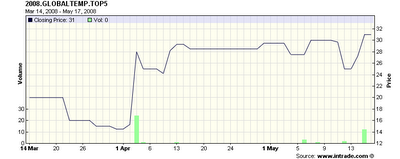
Land-Ocean year-to-date temperatures 0.35 Celsius over baseline

No Gravatar

according to GISS. Assuming the Intrade &#8220-Top 5&#8243- global warming contract expires according to the Land Ocean Index, May – Dec 2008 temperatures will need to average 0.65 Celsius over baseline. The record was set back in 2005, 0.62 Celsius over baseline.

Intrade needs to specify the expiry conditions more precisely.

Still, I&#8217-m remain short the contract:

Cross-posted from Caveat Bettor.

Previous blog posts by Caveat Bettor:

  • Final InTrade v. Zogby Showdown Results
  • Intrade lists Global Warming Contracts!
  • Intrade beats Zogby on Super Tuesday
  • Super Tuesday Showdown: Intrade v. Zogby
  • The Democrat SC Showdown: Intrade v. Zogby
  • Zogby beats Intrade in predicting Nevada caucus winner Clinton.
  • The GOP SC and Dem NV Showdown: Intrade v. Zogby

ROBIN HANSONS PUBLIC ADMISSION: He signed Bobs petitions, not because he heartfully endorsed them fully, but because he wanted to please Bob, didnt want to be left out of the party, and was persuaded that his own blue-sky proposals wouldnt make it -and other irrational excuses for not saying the tru

No Gravatar

Robin Hanson:

Hal and Silas, endorsing this proposal does not mean that I would not prefer other proposals- it just means I prefer this to the status quo. Chris Masse is an example of someone who has difficulty accepting this endorsement concept.

Doc,

Why wouldn&#8217-t you:

  1. Gather with yourself and determine under what precise circumstances you want the real-money prediction markets (which you co-invented with the IEM people) to flourish in your country-
  2. Then, consult with your peers (Wolfers et al.) on whether they&#8217-d agree with you-
  3. Publish a petition that lays out how the real-money prediction markets would blossom in America-
  4. Add, at the bottom of that petition, an appendix laying out what would be, for you, an acceptable Plan B-
  5. Hummmm&#8230-.??&#8230- Sounds more logical to me.

Previous blog posts by Chris F. Masse:

  • Prediction Markets
  • Meet professor Justin Wolfers.
  • Become “friend” with me on Google E-Mail so as to share feed items with me within Google Reader.
  • Nigel Eccles’ flawed “vision” about HubDub shows that he hasn’t any.
  • How does InTrade deal with insider trading?
  • Modern Life
  • “The Beacon” is an excellent blog published by The Independent Institute.

Robin Hanson would be better off lobbying for prediction markets with the people who will be in power next November -that is, the Democrats, not the right-wing people of the American Enterprise Institute.

No Gravatar

Does Robin Hanson read the political prediction markets which he co-invented? If he read them, he would see that we&#8217-re going to get a big Democratic swipe, in November 2008. The American people will get rid of the neo-cons, the warmongers, and other right-wing nuts.

Then, if you wanted to &#8220-lobby&#8221- for the prediction markets, you would get your message thru using either a Democratic or bi-partisan vehicle &#8212-not the right-wing American Enterprise Institute. What weight will those right-wing people carry next November? They&#8217-ll be finished &#8212-until a brand-new Newt Gingrich alike pops up in the years 2020.

Get a ride in K Street with the right people, doc &#8212-that is, in our case, like it or not, the leftists.

Robust, the prediction markets are the best mechanism for aggregating information. Thus, companies should use them for assessing strategy and hedging risks.

No Gravatar

Via Emile Servan-Schreiber of NewsFutures, John Auters in the Financial Times.

[…] This leads to [Justin Wolfers]&#8216- claim that [prediction markets] are the best way to aggregate information. This is true of any given amount of information. Take three economists and make them trade out a market over their predictions for next month&#8217-s inflation number, he suggests, and they will arrive at a more accurate prediction than a poll of the same three economists. In a market, those with stronger conviction (or inside information) can express that conviction- those less confident will not be willing to stake money. […]

Prediction markets remain subject to the same weaknesses as other markets. The principle of &#8220-garbage in, garbage out&#8221- [*] applies. If there is only poor information to aggregate, they will be as wrong as everyone else. […]

It would make sense to incorporate these odds when making investments. […]

Excellent.

(I don&#8217-t get his micro slam against the wisdom of crowds. Anyway.)

[*] As explained in the prediction market explainer published on the frontpage of Midas Oracle.

The managing editor of CNBC.com asks readers whether they should report what the (play-money and real-money) prediction markets say. He is not that hot on the idea -to say the least. Which is why we should develop a blog network on prediction markets -to get rid of the journalists filter and report

No Gravatar

But the &#8220-gambling&#8221- nature puts some journalists off.

Is it just providing information &#8230- or promoting betting action?

See, that&#8217-s exactly why I want to develop my &#8220-Midas Oracle Project&#8221-.

Classic journalists and classic bloggers will never treat prediction markets with the maximum sophistication they deserve.

Only brand-new blog networks that will specialize in prediction markets will do a good job.

I&#8217-ll provide more details soon.

I hope that some of you will join this project. It should be a collective endeavor.

E-mail me to join.

A historical Robin Hanson fanboy cant believe his hero signed Bobs ill-informed and unwise petition.

No Gravatar

Hal Finney:

My concern is that the small stakes limit of $2,000, the limits on who can operate markets, and the limitations on the scope of markets, will lead to spotty coverage which will preclude a robust evaluation of the merits of prediction markets in general. After all, we have intrade.com already which provides spotty coverage of a number of issues – how much more will this add?

Maybe &#8220-gambling can save science&#8220-, but I don&#8217-t see how these steps would show it.

Proof that you can be &#8220-high IQ&#8221- and still lack judgment (in small ways).

P.S.: Over that the micro slam above, I have the highest esteem and respect for Robin Hanson &#8212-a prediction market pioneer.

STEVE LEVITTS FREAKONOMICS HIJACKED BY HACKER – FAMOUS ECONOMICS BLOG TEMPORARILY DEFACED – ANTI-SPORTS BETTING BILE VOICED

No Gravatar

Freakonomics, the famous blog on economics, is powered by WordPress, which is known [*] to have grave security vulnerabilities. Yesterday, a dangerous hacker managed to get access to their blogging software, and published an opinion on the regulation of prediction markets, which represents the total opposite of what Steve Levitt believes in. No doubt the hacker (who signed as &#8220-The Australopithecus&#8220-) will get caught by the Police. No doubt Steve Levitt will get out of his torpor soon and re-establish the truth. We will then give airtime to Steve Levitt&#8217-s arguments, on Midas Oracle. We&#8217-re with you, doctor Levitt.

[*] I know that for a fact. Midas Oracle was hijacked yesterday by a dangerous hacker who signed as &#8220-The Barbecue&#8221-. I&#8217-m not responsible for what he said.

ABC 20/20 – A good (but servile) explainer on the wisdom of crowds and the prediction markets

No Gravatar

ABC 20/20 featuring InTrade – (May 9, 2008)

Foretelling The Future: Online Prediction Markets &#8212- (4 pages in all)

ABC video

YouTube video

  1. Not a single word about InTrade-TradeSports fucking up its traders during the North Korea Missile episode.
  2. Although James Surowiecki is a great thinker overall, I&#8217-m not happy he served InTrade&#8217-s past forecasting successes in absolute terms &#8212-and not in terms of probabilities. That shows James Surowiecki can&#8217-t be the ultimate leader of the field of prediction markets. Robin Hanson, Justin Wolfers, Koleman Strumpf, Eric Zitzewitz, or even Emile Servan-Schreiber, would have not made that mistake.
  3. All prediction markets are not created equal. Spot that they go too far, saying terrorism prediction markets or earthquake prediction markets could serve a societal purpose. That is complete bullshit. That is pure hype. As I said yesterday, an analyst should check whether a given prediction market is really able of aggregating important information. Just because John Delaney wants to create a betting market to get money doesn&#8217-t mean that that given prediction market will be able to give sound forecasts. Otherwise, we would have prediction markets about future lottery outcomes and we would make a fortune out of that. :-D
  4. Spot that they put the emphasis on the easy translation between the 0&#8211-100 prices and the 0&#8211-100 probabilities. That puts BetFair&#8217-s model (based on those damn digital/decimal odds) out of the picture.