THE FATE OF HARRY POTTER IN J.K. ROWLINGS 7TH BOOK, THE DEATHLY HALLOWS: prediction market vs. bookmaker

No GravatarSPOILER ALERT: MIDAS ORACLE IS REVEALING WHO DIES IN HARRY POTTER AND THE DEATHLY HALLOWS. IF YOU DON&#8217-T WANT TO KNOW, STOP READING. (Hit your back button.)

&#8212-

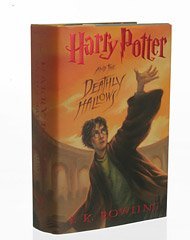
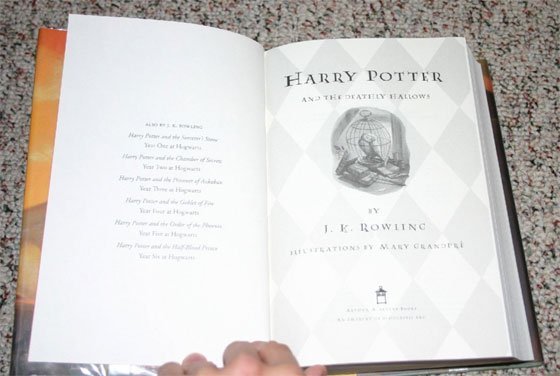
Harry Potter and the Deathly Hallows

Harry Potter and The Deathly Hallows

&#8212-

Pioneer Press:

Here&#8217-s the good news: Harry [Potter], Ron, Hermione, Ginny and Hagrid do not die. But others do. The good guys who meet their demise include Fred Weasley- Tonks (the witch who loves to change her hair color) and her husband, werewolf Remus Lupin- and Tonks&#8217- father, Ted. Bad guys who die are Professor Snape- Bellatrix, Voldemort&#8217-s favorite servant- Crabbe, one of Draco Malfoy&#8217-s mean friends- and Pettigrew, Voldemort&#8217-s servant known as Wormtail. One of the saddest scenes follows the death of Dobby, the house elf Harry [Potter] freed in a previous book. Harry [Potter]&#8217-s beloved owl, Hedwig, also dies.

There is also an epilogue, which takes place 19 years later, revealing that Harry [Potter] married Ginny Weasley and Ron married Hermione. They meet at platform 9? to send their children to Hogwarts.

OK, but I would like more info about the epilogue. Does J.K. Rowling mentions that Harry Potter dies as a happy man at an old age? I think it&#8217-s important because, since the statement of the Harry Potter event derivative is vague (&#8221-alive&#8221-), that could be a factor in the expiry of the NewsFutures contract. (As for me, no matter what is said in the epilogue about Harry Potter dying as an happy man at an old age, I believe that Harry Potter is still &#8220-alive&#8221- if J.K. Rowling will be able to write a sequel to her 7th book.)

&#8212-

TEMPORARY CONCLUSION (until we get strong confirmation of the outcome of The Deathly Hallows from two other sources):

1. The NewsFutures event derivative was predictive (as was an Internet poll), thanks to comparative literature analysis (analysis of the past writings of J.K. Rowling).

2. The William Hill people were bull-shitting when they said that Harry Potter died and when they opened betting on who was the killer. They took 50,000 British pounds from suckers. 100% pure profit for William Hill. Niall O&#8217-Connor, who swallowed the William Hill P.R. bullshit, should come on Midas Oracle, concede defeat, and analyze the root of his debacle.

&#8212-

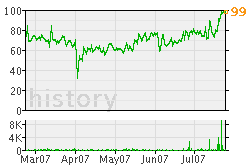
PREDICTION MARKET VS. BOOKMAKER: THE PREDICTION MARKET WON.

&#8212-


© NewsFutures

&#8212-

Static chart:

Harry Potter NewsFutures

&#8212-

THE NIALL O&#8217-CONNOR FESTIVAL (1 + 2):

[1] What is the conclusion to be drawn here? In a market such as this, the outcome will already be known, by certain people. Are we too assume that these individuals choose to bet with traditional risk-averse bookmakers such as William Hill, forcing said bookmakers to close their books on the event? And that the uniformed, who know nothing, but cannot believe that Harry Potter will be killed off, choose to bet on NewsFutures?

[2] My own opinion is that the insiders have no reason to trade on NewsFutures (they are not interested in the notion of bragging rights). Moreover, it is extremely unlikely that they are even aware of the prediction exchange. They are interested however, in being able to take 500 sterling of William Hill, on a [fairly] anonymous basis. And this it would seem is what they have indeed done. The fact that the NewsFutures market has not fallen into line, gives rise to the notion that it represents nothing more than an amalgam of uninformed guessers, who are ignorant in the psychology of traditional betting markets. If Harry Potter is killed off- there will certainly be a lot of explaining to do……

Well, sounds like it&#8217-s Niall O&#8217-Connor who will have &#8220-a lot of explaining to do&#8221-. :) &#8230- And sounds like Niall O&#8217-Connor is &#8220-ignorant in the psychology&#8221- of high-volume play-money prediction markets. :)

&#8212-

And Michael Giberson, too, should have some explaining to do. :)

&#8212-

DISCLOSURE: At times, I was a participant in this Harry Potter prediction market, but decided to get out some time ago because of the incertitude regarding how the epilogue would be taken into account in the expiry process.

&#8212-

NEXT: NEWSFUTURES JUDGES THAT HARRY POTTER IS STILL ALIVE AT THE END OF J.K. ROWLING&#8217-S 7TH NOVEL, THE DEATHLY HALLOWS.

Previous blog posts by Chris F. Masse:

  • Red Herring’s list of the top 100 North-American high-tech startups includes Inkling Markets —but not NewsFutures, Consensus Point, or Xpree.
  • Professor Koleman Strumpf explains the prediction markets to the countryland people.
  • Professor Koleman Strumpf tells CNN that a prediction market, by essence, can’t predict an upset.
  • Time magazine interview the 2 BetFair-Tradefair co-founders, and not a single time do they pronounce the magic words, “prediction markets”.
  • One Deep Throat told me that this VC firm might have been connected with the Irish prediction exchange, at inception.
  • BetFair Rapid = BetFair’s standalone, local, PC-based, order-entry software for prediction markets
  • Michael Moore tells the Democratic people to go Barack Obama in Pennsylvania (a two-tier state), but the polls and the prediction markets tell us that that won’t do the trick.

NOBEL LAUREATE VERNON SMITH LEAVES ROBIN HANSONS GEORGE MASON UNIVERSITY TO GO WORKING FOR TOM W. BELLS CHAPMAN UNIVERSITY.

No Gravatar

Felix Salmon:

GMU&#8217-s economics department is, famously, full of bloggers. Its chairman Donald Boudreaux blogs at Cafe Hayek with colleague Russ RobertsRobin Hanson founded Overcoming Bias- Bryan Caplan and Arnold Kling blog at EconLog- Peter Boettke blogs at The Austrian Economists- and, of course, Tyler Cowen and Alex Tabarrok are bona fide stars of the blogosphere with their hugely popular Marginal Revolution. I&#8217-m sure there are more I don&#8217-t know about, too. All of these bloggers are famously unrestrained. GMU&#8217-s economics department is, famously, also home to 2002 Nobel laureate Vernon Smith. (He&#8217-s 80 years old, and a Nobelist, so you&#8217-ll forgive him for not having a blog of his own.) Smith more or less invented the hugely fecund field of experimental economics, and is by far the most important economist at GMU. So when GMU grad student Brian Hollar broke the news that Smith was leaving GMU and taking most of its experimental economics faculty with him to Chapman University in California, it&#8217-s not surprising that the blogosphere immediately started buzzing. Or rather, it is surprising that the blogosphere didn&#8217-t start buzzing: so far, none of the GMU economists has seen fit to mention this news at all. One might almost think that a don&#8217-t-blog-this edict had gone out, either explicitly or implicitly. But certainly the silence is puzzling.

Note: The experimental economics is the ancestor of the prediction markets, one could say.

NEXT: All GMU’s ICES faculty except Houser and McCabe are leaving to join Chapman University.

NEXT: Deep Throat on the George Mason University exodus to Chapman University.

NEXT: OFFICIAL: NOBEL LAUREATE VERNON SMITH DECAMPS FOR WEST COAST&#8217-S CHAPMAN UNIVERSITY.

NEXT: The latest about the departing of Nobel Laureate Vernon Smith from George Mason University to Chapman University

Innovation happens when these new things are delivered to the marketplace for the benefit of consumers/society.

No Gravatar

Via the Mises Economics blog, Carleen Hawn.

Commenter Francis Wu:

I’d rather be known as an innovator. Anybody can come up with an idea, but an idea is worthless unless it’s acted upon and properly executed (innovation). Sometimes the idea and the innovation can come from the same person. Other times, the idea people get drunk on their own big ideas and fail to execute.

For more on the &#8220-Invention vs. Innovation&#8221- debate, see this April 2007 blog post from Mike Linksvayer, with plenty of good comments.

One way of putting it is that six billion people generate a huge number of ideas, some number of which could be called inventions. Most are hopeless (the inventions- the people at least manage to survive for a time). Most of the rest are not actively pursued. The only way to test whether an invention is hopeless or useful is to attempt to deliver it at scale. So innovators (think of them as idea entrepreneurs, or whatever) both figure out which inventions are not hopeless and deliver the useful ones at scale. Innovators create all of the surplus, inventors do little more than breathe.

Chris Masse is bull-shitting. On the paper, NewsFutures is OBVIOUSLY the market leader.

No Gravatar

That&#8217-s what all the people thought, after I published my ranking.

The NewsFutures clients:

Arcelor Mittal
The world&#8217-s largest steel maker.

CORNING
Display Technologies.

Dentsu
Japan&#8217-s largest advertising firm.

HVG
Hungary&#8217-s leading news weekly.

Eli Lilly
Voted &#8220-most innovative&#8221- pharmaceutical company in Fortune&#8217-s 2003 and 2004 rankings.

Masterfoods
The US packaged foods giant.

Pfizer
Giant U.S. Pharmaceutical.

Rand Corporation
Leading provider of objective analysis and effective solutions.

SAIC
One of the world&#8217-s leading providers of outsourcing and IT services.

SCA
Europe&#8217-s leader in corrugated packaging.

Siemens
Germany&#8217-s global powerhouse in electrical engineering and electronics.

Texas Department of Transportation
Texas Department of Transportation.

Thomson Financial
The most complete source for integrated information and technology applications in the global financial services industry.

de Volkskrant
The Netherlands&#8217- daily newspaper of reference.

World Economic Forum
Host of the annual Davos meeting of world leaders.

Yahoo!
The No. 1 Internet brand globally.

INTEL BUSINESS CASE: Does Intel really use internal prediction markets?

No Gravatar

Emile Servan-Schreiber and Chris Hibbert (two veterans of the field of prediction markets) have strong doubts that Intel is using a trading mechanism. (Nothing wrong with using a non-trading mechanism, we just want to know for sure. :) )

I will re-read the Intel paper later on, but here is a quick stats: the phrase &#8220-prediction markets&#8221- is used 15 times in the paper, including 7 times in the section titled, you guessed it, &#8220-MARKET MECHANISMS AS FORECASTING TOOLS&#8220-.

And here&#8217-s a crucial sentence I found out in the abstract:

The process enables product and market experts to dynamically negotiate product forecasts in an environment offering anonymity and performance-based incentives.

Does negotiation mean trading here? My first reading was &#8220-yes&#8221-, but I wonder what it means in light of the comment made by market design expert Chris Hibbert.

Previous: INTEL BUSINESS CASE: INTERNAL PREDICTION MARKETS DO WORK.

New Kid on the Blog: Nosco.

No Gravatar

Nosco is a Danish company specialized in Prediction Markets. We are very happy to have been given the opportunity to blog here at Midas Oracle.

We will try to keep you all updated on the business of prediction markets in Scandinavia.

A few words about Nosco
Nosco was founded in 2006 by Jesper Krogstrup and Oliver Bernhard Pedersen. We are currently five employees. We use our own custom-designed software, Information Exchange. Among our clients are TV 2 (the largest Danish television channel) and Danske Bank (Scandinavia’s largest bank).

TV 2
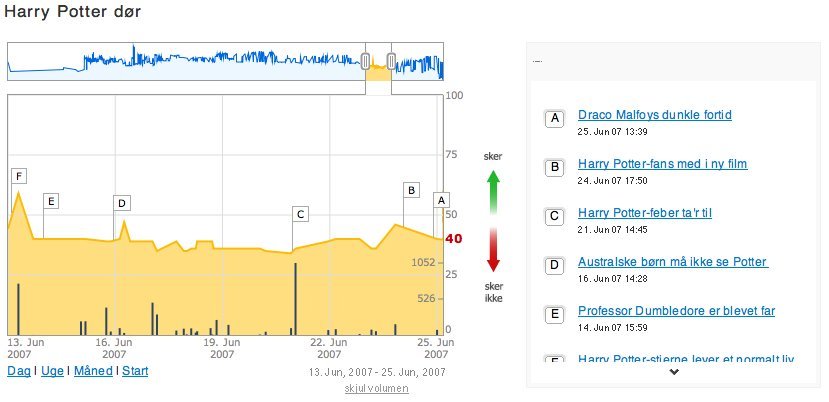
In February 2007, the Danish Television channel TV 2|Denmark launched &#8216-Nyhedsspillet&#8216- (The News game). ‘Nyhedsspillet’ is a Prediction Market in news. Our main approach has been to make the user an active part of the news and thereby giving the user a feeling of influence and interaction. In less than 3 months, 21.000 people participated in ‘Nyhedsspillet’.

harry-potter.jpg

By means of RSS, we show all relevant news/articles on a dynamic graph. This provides the participant with a visual timeline of all relevant news. Also, we can automatically push a small graph of the share to all relevant articles.

Danske Bank
Nosco have also designed internal Prediction Markets for the largest banks in Scandinavia. In this case, Prediction Markets are being used to evaluate ideas and to estimate key variables in regards to change management.

Hal Varian becomes Googles chief economist.

No Gravatar&#8212-

Via Greg Mankiw (whom you will have to read between the lines), this New York Times piece:

The View column will now be written by a rotating panel of outside economists. Besides Mr. Mankiw, it will include Alan Blinder, Judith Chevalier, Robert Shiller and Lester Thurow, as well as three of the economists who have been writing the Economic Scene column on Thursdays: Austan Goolsbee, Tyler Cowen and Robert Frank. (The fourth member of the Scene rotation, Hal R. Varian, is leaving to concentrate on his new role as Google’s chief economist.)

The Midas Oracle readers will remember that professor Hal Varian is the economics authority (revered by the Google executives) who consulted with Bo Cowgill&#8217-s 20% team on designing and pitching an internal prediction markets pilot. Professor Hal Varian commands respect and has made important contributions to Google&#8217-s core business.

&#8212-

Hal R. Varian interviewed by the Wall Street Journal on his new position at Google.

WSJ: What does the job entail?

Varian: During my time at Google we have built up a world-class group of quantitative analysts, and the economics team will complement these existing resources. Google has a great infrastructure for data analysis, and a management team that is very receptive to quantitative methods and willing to invest in this area. So what more could you ask for? In addition to working on analytics, I’ve also worked on various business strategy and public policy issues, and will continue to do so as the occasion arises. This set of issues will only get more important to Google as time goes on, so I expect that this will also involve a fair amount of my time.

Note: Bo Cowgill&#8217-s official business title at Google is &#8220-Technical Data Analyst&#8220-.

&#8212-

Previous: Meet Hal Varian, Google&#8217-s Chief Economist.

Previous blog posts by Chris F. Masse:

  • If I had to guess, I would say about 50 percent of the “name pros” you see on television on a regular basis have a negative net worth. Frightening, I know.
  • You can’t measure the usefulness of a system by how many resources it consumes.
  • STRAIGHT FROM THE DOUBLESPEAK DEPARTMENT: NewsFutures CEO Emile Servan-Schreiber, well known to chase tirelessly the Infidels who dare calling “prediction markets” their damn polling system, is eager to sell the confusion to his clients and whomever would listen.
  • John Delaney is such a poor marketer that he is willing to outsource the making of InTrade’s next logo (a company’s most important visual message) to the first moron met over the Internet who is stupid enough to work for a bunch of figs.
  • ProKons strongly believe that (play-money) prediction markets are bozo immune.
  • REBUTTAL: SalesForce, StarBucks and Dell demonstrate that enterprise prediction markets as intra-corporation communication tools (as opposed to forecasting tools) are overhyped by the prediction market software vendors and a little clique of uncritical courtisans.
  • Comments are often more interesting than the post that ignited them.

HISTORY: Prediction Markets Timeline

For an updated version of this document, see the &#8220-paged&#8221- Prediction Markets Timeline.

CHRONOLOGY &amp- HISTORY: Prediction Markets Timeline

Feel free to post a comment or contact me, and I&#8217-ll correct or add a factoid. Thanks.

#1. Historical Prediction Markets

According to Paul Rhode and Koleman Strumpf, prediction markets almost never got it wrong forecasting the 19 presidential elections that took place from 1868 to 1940. (PDF)

#2. The three Iowa Electronic Markets founders (Robert Forsythe, Forrest Nelson and George Neumann)

&#8220-We ran our first market in 1988. We didn’t have regulatory approval at that point so we were restricted solely to the University of Iowa community. We had under 200 traders and under $5,000.&#8221- &#8211- [Robert Forsythe – PDF file]

– [CFTC’s no-action letter to the IEM – 1992 – PDF file]

– [CFTC’s no-action letter to the IEM – 1993 – PDF file]

#3. Robin Hanson

a) Robin Hanson set up and ran a rudimentary prediction exchange (a market board, PPT file) in January 24, 1989. The outcome to predict was the name of the winner of a Poker party.

b) Until evidence of the contrary, it seems that Robin Hanson was the first to set up and run a corporate prediction exchange &#8212-at Xanadu, Inc., in April 1989. See: A 1990 Corporate Prediction Market + Anonymity is important for employees trading on internal prediction markets.

Robin Hanson: &#8220-I started a market at Xanadu on cold fusion in April 1989. In May 1990, I started a market there on whether their product would be delivered before Deng died.&#8221-

c) Until evidence of the contrary, it seems that Robin Hanson was the first to set up and run a bunch of imagination-based prediction markets. See the Murder Mystery Evening described by Barney Pell &#8212-circa June 8, 1989.

d) Until evidence of the contrary, it seems that Robin Hanson was the first to write a paper on prediction markets created and existing primarily because of the information in their prices (as opposed to markets created primarily for speculation and hedging).

Could Gambling Save Science? &#8211- (Reply to Comments) &#8211- by Robin Hanson &#8211- 1990-07-00
Market-Based Foresight: a Proposal &#8211- by Robin Hanson &#8211- 1990-10-30
Idea Futures: Encouraging an Honest Consensus &#8211- (PDF) &#8211- by Robin Hanson &#8211- 1992-11-00

e) Robin Hanson godfathered the Foresight Exchange (created in 1994) and NewsFutures (created in 2000).

f) Robin Hanson invented the concepts of decision markets (PDF) and decision-aid markets.

g) Robin Hanson invented a new market design (for the 2000-2003&#8242-s Policy Analysis Market), the Market Scoring Rules, a mix between CDA and Scoring Rules &#8212-now in use for most enterprise prediction markets and public, play-money prediction exchanges. Note that MSR is mainly used in a one-dimension version, but many researchers are interested in its combinatorial version.

#4. Other Pioneering Public Prediction Exchanges (Betting Exchanges, Event Derivative Exchanges) and Inventors/Innovators/Entrepreneurs

a) The Foresight Exchange was founded on September 22, 1994 by Ken Kittlitz, Sean Morgan, Mark James, Greg James, David McFadzean and Duane Hewitt. The Foresight Exchange is a play-money prediction exchange (betting exchange) managed by an open group of volunteers. It pioneered user-created and user-managed, play-money prediction markets. Any person can join the Foresight Exchange and interact with the rest of the Web-based organization. An independent judge (independent from the owner of the claim) should be appointed among the volunteers. [Thus, it’s not “DYI prediction markets”.]

b) The Hollywood Stock Exchange was founded on April 12, 1996, by Max Keiser and Michael Burns. See the patent for the Virtual Specialist. For more info, see: Is HSX the “longest continuously operating prediction market”??? &#8211- REDUX

c) BetFair was founded in 1999 by Andrew Black and Edward Wray, and was launched in England in June 2000. As of today, BetFair is the world&#8217-s biggest prediction exchange (betting exchange, event derivative exchange).

d) NewsFutures was founded in March 2000 and launched in September 2000 in France and in April 2001 in the US by Emile Servan-Shreiber and Maurice Balick. See: NewsFutures Timeline. NewsFutures was the first exchange to let people buy or sell contracts for each side of a binary-outcome event. The advantage of this design is that it avoids the need for &#8220-shorting&#8221-, a notion that tends to confuse novice traders. NewsFutures later extend that approach to deal with n-ary outcome events while implementing automatic arbitrage.

e) TradeSports was launched in Ireland in 2002 by John Delaney. InTrade was later purchased and became a non-sports prediction exchange (betting exchange). As of today, InTrade is the biggest betting exchange on the North-American market &#8212-where betting exchanges are still illegal. As for TradeSports, it closed at the end of 2008, alas.

#5. The Policy Analysis Market Brouhaha

a) Robin Hanson was the main economist behind the 2000–2003 US DoD&#8217-s DARPA&#8217-s IAO&#8217-s FutureMAP–Policy Analysis Market project. (For this project, Robin Hanson invented a new market design, the Market Scoring Rules.) On July 28, 2003, two Democratic US Senators called for the termination of PAM, the the big media gave airtime to their arguments, and the US DOD quickly ended the IAO&#8217-s FutureMAP program.

b) The second branch of the 2000–2003 US DoD&#8217-s DARPA&#8217-s IAO&#8217-s FutureMAP program was handled by the Iowa Electronic Markets and was intended to predict the SARS pandemic. (This project later gave birth to IEM&#8217-s Influenza Prediction Market.)

#6. James Surowiecki&#8217-s The Wisdom Of Crowds

a) James Surowiecki&#8217-s book, The Wisdom Of Crowds, was published in 2004.

b) Impact of The Wisdom Of Crowds.

#7. Recent Public Prediction Exchanges (Betting Exchanges, Event Derivative Exchanges) and Inventors/Innovators/Entrepreneurs

a) US-based and US-regulated HedgeStreet was launched in 2004 by John Nafeh, Russell Andersson, and Ursula Burger. A designated contract market (DCM) and a registered derivatives clearing organization (DCO), HedgeStreet is subject to regulatory oversight by the Commodity Futures Trading Commission (CFTC). In November 2006, IG Group bought HedgeStreet for $6 million.

b) Inkling Markets was launched in March 2006 and co-pioneered (with CrowdIQ, which later bellied up) the concept of DIY, play-money prediction markets.

c) In September 2006, TradeSports-InTrade was the first prediction exchange (betting exchange, event futures exchange) to apply Chris Masse&#8217-s concept of X Groups. See: TradeSports-InTrade prediction markets on Bush approval ratings.

d) HubDub was launched in early 2008 and is the second most popular play-money prediction exchange, behind HSX.

#8. Enterprise Prediction Markets

a) Until evidence of the contrary, it seems that Robin Hanson was the first to set up and run a corporate prediction exchange &#8212-at Xanadu, Inc., in April 1989. See: A 1990 Corporate Prediction Market + Anonymity is important for employees trading on internal prediction markets.

b) In the 1996&#8211-1999 period, HP ran a series of internal prediction markets to forecast the sales of its printers.

c) Eli Lilly sponsored 10 public, industry-level prediction markets in April 2003 (on the NewsFutures prediction exchange).

d) Eli Lilly began using internal prediction markets in February 2004 (powered by NewsFutures).

e) Google&#8216-s Bo Cowgill published about their use of internal prediction markets in October 2005.

f) Since then, many companies selling software services for enterprise prediction markets have been created.

#9. Disputes Between Traders And Exchanges

a) The scandal of the North Korean Missile prediction market that erupted in July 2006 is, as of today, the biggest scandal that rocked the field of prediction markets.

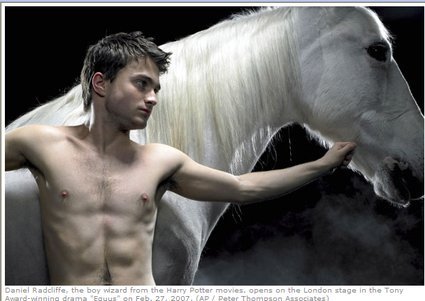
Harry Potter actor Dan Radcliffe nude on Midas Oracle… AGAIN

No Gravatar

EQquus

Equus

Previous: Harry Potter actor Dan Radcliffe nude on Midas Oracle + Deep Throat sells Harry Potter short. + The contract of the Harry Potter event derivative at NewsFutures may be flawed. + The Harry Potter litmus test

Previous blog posts by Chris F. Masse:

  • Meet professor Thomas W. Malone (on the right), from the MIT’s Center for Collective Intelligence.
  • Tom W. Bell rebuts the puritan and sterile petition organized by the American Enterprise Institute (which has on its payroll Paul Wolfowitz, the bright masterminder of the Iraq war).
  • The upcoming CFTC ruling may come as thunder and lightning —or may not. That is the question. Will they exempt or will they regulate?
  • PROF TOM W. BELL, PLEASE, DO SKIP THE PAGAN CELEBRATIONS, AND, PLEASE, DO RETURN TO YOUR DESK TO FINISH THE DRAFT OF YOUR COMMENT TO THE CFTC. THANKS FOR YOUR PRAGMATIC (NOT ‘ETHEREAL’) CONTRIBUTION TO “THE FUTURE OF HUMANITY”. (There is a hidden slam to Robin Hanson in this title. I wonder whether people will get the joke.)
  • The CFTC is going to close the comments in 3 days. We have 3 days left to convince the CFTC to accept FOR-PROFIT prediction exchanges (e.g., InTrade USA or BetFair USA), and counter the puritan and sterile petition organized by the American Enterprise Institute (which has on its payroll Paul Wolfowitz, the bright masterminder of the Iraq war).
  • TOM W. BELL: “Thanks, Chris. Thanks, too, for being such an effective gadfly. I might well have blown off the whole exercise if you had not kept blogging about how you were awaiting my comment!”
  • What to think of HedgeStreet’s comment to the CFTC

Copernican Principle: How To Predict the End of the World

No Gravatar

John Tierney&#8217-s column the Science section of today&#8217-s New York Times discusses a method for forecasting difficult to predict events. The Copernican Method, advocated by Princeton physicist Richard Gott, allows one to generate confidence intervals that an event will occur using only the duration time until now (that is, how long the event has been at risk but has not occurred). Using the often not realistic assumption that there is nothing special about today, one can derive the ninety-five percent confidence interval for the time until the event occurs,

(1/39)*t_past &lt- t_future &lt- 39*t_past

where t_past is the duration time so far and t_future is the stochastic time until the event occurs.(*) Intuitively, events for which we have not observed a failure for a long-time are more likely to persist than ones which have only been in existence for a short time period. The article (along with the original Gott (1993) piece) give many examples of his formula at work such as how long Stonehenge will remain standing to how long political leaders will stay in power.

I remember reading the New York Times column in 1993 which first discussed this approach (sorry may be gated) and finding this to be not very convincing. Think about the Doomsday case. Of course today is quite different from the past: the events which could have led to man&#8217-s extinction in the past (largely exogenous natural events) are quite different from the dangers of today and the future (man-made events). But I always find data convincing. The NYT article claims that Gott made accurate forecasts of political tenure and the closing date of Broadway plays though I have been unable to track down the original predictions myself.

Well I doubt this will be of any use to folks investing in prediction markets. It has been about seven years since the last Democratic president. Applying Gott&#8217-s formula, this means with ninety-five percent accuracy we can say that the next Democratic administration will begin at least two months from now and no more than 273 years from now. I think we do not need a formula to figure that out.

(*) See Monton and Kierland (2006) for a derivation

Previous blog posts by Koleman Strumpf:

  • Prediction Markets in the Classroom: Inkling Markets
  • Slides of presentations from Conference on Corporate Applications of Prediction/Information Markets (1 November), Kansas City
  • Summary of Conference on Corporate Applications of Prediction/Information Markets (1 November), Kansas City
  • Reminder: Corporate Applications of Prediction Markets Conference (1 November)
  • Conference: Corporate Applications of Prediction/Information Markets (Thursday, 1 November 2007)
  • Win Justin’s Money? (re: Is there manipulation in the Hillary Clinton Intrade market? Redux.)
  • Is there manipulation in the Hillary Clinton Intrade market?