UKs super casino: Manchester rejoices; Blackpool is disapointed.

No Gravatar

Blackpool Today:

&#8220-Blackpool had the best case, proved it and still lost&#8221- is a sentiment shared by a town in shock at the decision to award the lucrative prize to Manchester. Our North West neighbours were, said the CAP, the best bet on all counts &#8211- for helping assist regeneration of a poor district and as the social impact test bed for Las Vegas-style glitz and gambling. Not so, say MPs, council leaders and Gazette readers who today made an 11th hour appeal to Culture Secretary Tessa Jowell to think again ahead of the crucial Parliamentary vote on the matter.

The City of Paris, too, had the best case in bidding for hosting the 2012 Olympics &#8212-it lost to London. The error (or &#8220-bias&#8221-?) is to think that small, secretive committees only judge on merits.

Previous: 17 New British Casinos &#8211- BetFair predicted Blackpool (62,5%).

&#8211-&gt- Beware event derivatives whose expiry is based on the decision of a group of people&#8230- you know close to nothing about. (((Psstt&#8230- I will talk to you, later on, about&#8230- event derivatives whose expiry is based on the decision of a group of people&#8230- you know everything about. Ha! ha! ha! I&#8217-m serious. It&#8217-s the high end of my concept of X Groups.)))

Share:

An invitation to join the simExchange beta

No Gravatar

The simExchange, a virtual video game stock exchange, is a new project to help gamers learn about upcoming video games and predict how well they will sell. Countless new games are on the horizon all the time and it is too time consuming to read up on all of them. The simExchange applies the Wisdom of the Crowds concept to upcoming video games. You can quickly identify the most anticipated upcoming games by simply checking out the most valued game stocks or the most traded game stocks.

Users submit the games they want to trade. Users also submit articles, images, and videos about the games. The community votes through a unique “content bidding system” to measure the value of submitted content to the community. This makes it easier for users to learn about games by quickly seeing the most valuable content about the game available and allows traders to more easily value the game stocks up for trading.

The simExchange is also a great opportunity to learn about the stock market by trading stocks that gamers care about. Unlike many prediction markets, the simExchange follows real market mechanics, such as a double call auction order system. The simExchange allows players to actually short stocks.

Games Stocks:
– The stock price forecasts the game’s lifetime worldwide unit sales. 1 DKP corresponds to 10,000 copies sold.
– Game stocks are perpetual and are structured similar to real stocks.
– Users can submit the games they want listed on the simExchange for trading. Users bid on games to indicate demand for that game’s listing.
– Read more about the stock structure here.

Trading Features:
– A virtual stock market that follows real stock market mechanics such as a double call auction order book (CDA form prediction market).
– Users can place limit orders and short stocks
– Players learn to manage margin. Will receive margin calls and forced liquidation if leveraged position moves against them.
– Liquidity provided by automated and human market makers.

User Interface:
– AJAX interface enables user to dynamically pull up a stock’s order book by clicking on a stock. No need to enter stock prices.
– Option for basic trading (market orders with easy to understand bid and ask) or advanced trading featuring limit orders with Level II Order Book.
– Level II Order Book auto-updates best bids and asks orders.
– Portfolio, Quick Portfolio, and Order Status pages auto-update balance, margin, and positions.
– Find stocks by browsing genre or platform or searching title or summary content
– AJAX forms dynamically appear and change content

Content System:
– All game stocks are accompanied by a succinct but comprehensive summary so that traders do not need to leave the site to learn about the underlying game.
– Extensive resources provided by articles, images, and videos submitted by the community give traders quick access to the news that can move the stock.
– The community bids on content using the simExchange Content Bidding System to determine the value of the content to the community.
– The news aggregator is part of the overall simExchange game- players earn DKP from submitting valuable content and posting intelligent comments.

The simExchange is currently in public beta and I welcome anyone to join and share feedback.

If you would like to learn about the development of the simExchange, you can follow everything from the beginning by reading the simExchange Official Blog. The first post discussing how I came up with the idea starts here. We are also currently exploring ways to provide the simExchange technology to third-parties. You can always contact us through the form in the simExchange&#8217-s Help section.

17 New British Casinos

No Gravatar

Via Betting Market, the U.K. government:

After careful consideration of the proposals and all the relevant evidence against the remitted criteria, the Panel recommend that the area in which a regional casino should be licensed is the City of Manchester.

After careful consideration of the proposals and all the relevant evidence against the remitted criteria, the Panel recommend that the areas in which large casinos should be licensed are: Great YarmouthKingston-upon-HullLeedsMiddlesbroughMilton KeynesNewhamSolihull and Southampton.

After careful consideration of the proposals and all the relevant evidence against the remitted criteria, the Panel recommend that the areas in which small casinos should be licensed are: Bath [*] and North East SomersetDumfries and GallowayEast LindseyLutonScarboroughSwanseaTorbay and Wolverhampton.

[*] I love the City of Bath. It&#8217-s beautiful. There&#8217-s a good university, and there are Roman remains &#8212-the Roman &#8220-baths&#8221– naturally warm waters (hot springs). Plus, it&#8217-s not far away from Stonehenge. I recommend it.

&#8212-

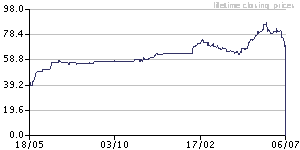
OK, so the prediction market news of the day is that the super casino license (or &#8220-licence&#8221-, as they say) is granted to Manchester &#8212-while BetFair predicted Blackpool (62,5%). Let&#8217-s remember that Paris was the favorite to be the host city of the 2012 Olympics (it will be London):

Paris 2012 Olympics

&#8212-

TAKEAWAY: It&#8217-s very difficult to figure out what will be the decision of a small, secretive committee &#8212-whether it&#8217-s a group of aristocrats (International Olympic Committee) or a group of civil servants (U.K.&#8217-s Casino Advisory Panel).

What are futures?

No Gravatar

A futures contract is an agreement between a buyer and a seller. It obligates the buyer to take possession of a specified amount of a given commodity or financial instrument and to do so by a given date. Likewise, it obligates the seller to deliver (sell) a specified amount of a given commodity or financial instrument by a given date. The specified date is the expiration date of the futures contract. Futures contracts lock in current prices, that is, the prevailing prices at the time the contracts were bought or sold. This protects both the buyer and seller against the risk of price change between the moment of the contract transaction and the time of delivery (the expiration date). Futures contracts can be bought or sold at any time by anyone and they can change hands any number of times before expiration.

Related to the expiration date is the first notice date. This is the date after which the contract holder may be required to take possession (if long) or to deliver (if short) the specified quantity of the underlying commodity. After first notice date, those who are long futures contracts can demand delivery and those who are short may be required to deliver. Futures speculators who want to maintain a position past first notice date &#8220-roll over&#8221- their contracts to others that have later expiration dates.

Futures contracts may be used in several ways. For example, producers of commodities use them to hedge risks. A grain producer may have 10,000 bushels of corn that will be ready on a given date, and he or she wants to lock in specific sales price on that date. Locking in the price with a futures contract avoids the risk of vagaries in the corn market. Consequently, the use of futures allows the producer to budget and plan, knowing what price to expect on delivery. The way the producer ensures the price is by selling futures contracts. The buyer of futures contract is then obligated to take delivery of the corn on a given date, at the specified price.

For the speculator [or] day trader, futures contracts are used purely as trading instruments. They enable profits to be made from correctly anticipated price changes. For example, a trader expecting stocks to rise can profit from the anticipated move by going long an S&amp-P 500 or E-Mini contract. To avoid acquiring the commodity and then having to turn around and sell it, speculators generally do not hold futures contracts past expiration or first notice date.

Today, futures trading on modern exchanges is highly standardized. Future contracts have fixed expiration dates and contract sizes, and each contract is identified by a unique symbol. Specifying a futures contract, such as when requesting a quote or placing an order, requires knowledge of the month in which the contract terminates or expires, and the root symbol used to identify the contract series.

Tony Reed

Cross-posted from &#8220-What are futures?&#8220-. Please, visit Tony Reed&#8217-s home page, Futures Trading &amp- Futures Market, for more information.

CALL TO ALL PREDICTION MARKET SCHOLARS

THE MIDAS ORACLE READERS WOULD BE HIGHLY INTERESTED IN ANY BLOG POST POINTING TO ANY BRAND-NEW PREDICTION MARKET PAPER.

Feel free to write any blog post linking to a brand-new paper. No need to write a novel-long text &#8212-5 sentences and a link is more than enough. Takes less than 5 minutes to write a short blog post, and you will be seen by millions (if not billions) of prediction market-thirsty readers.

Thanks. Appreciated. Will make up to you.

Psstt&#8230- If you are an old schmuck, have lost your Midas Oracle .ORG login or password, or don&#8217-t have the first clue about how to blog, contact me privately and I&#8217-ll help you.

Psstt&#8230- There are some decerebrated idiots (like John &#8220-phoney&#8221- Baloney and some of the rascals who give him 2,500 bucks per speaker seat) who criticize me behind my back as being too focused on some areas and not others. MIDAS ORACLE .ORG is actually a user-created publication, so if somebody thinks that one sub-field is not covered, it&#8217-s up to him/her to write something on it. I have only ten fingers- I&#8217-m doing all I can. I have empowered 90 blog authors, in all &#8212-the workload should be shared among many shoulders, not just mine. The champ des possibles has been defined quite broadly &#8212-we are about prediction markets, but we are interested in all peripheral matters, and God knows it&#8217-s quite a huge understatement. As I said, every aspect of life could be turned into an event derivative, and the prediction markets can excite our curiosity on science, technology, technology business, geo-political matters, economic and finance stuff, legal news, major sports events, etc.

The e-mail interview with Ken Kittlitz is being downloaded like crazy &#8212-we will repeat the operation with other consenting victims. With always the same purpose in mind: getting to the truth, real quick. Which means pissing off two or three decerebrated idiots in the process &#8212-I take it as a badge of honor.

&#8212-

one-trick pony

Read the last blog posts by Chris Masse:

MIDAS ORACLE .ORG has a Google PageRank of 5/10.

Via this SEO page.

Google PageRank Checker

CFM – (vertical portal to prediction markets &#8212- since December 2004) – GPR 6/10

Midas Oracle .ORG – (group blog on prediction markets &#8212- since September 2006) – GPR 5/10

Midas Oracle .NET – (group blog nobody reads and nobody wants to write on &#8211-not even Jason Ruspini, whom I asked two times.) – GPR 6/10

Midas Oracle .COM – (totally empty website &#8211-as empty as Paris Hilton&#8217-s skull) – GPR 6/10

Well, let me renew my long-term goal for Midas Oracle .ORG: GPR 7/10. It will take some years, but we will get to it, in the end.

Psstt&#8230- Odd Head and Overcoming Whatever are at 6/10.

Read the last blog posts by Chris Masse:

Email Interview: Ken Kittlitz

My responses to a set of questions Chris Masse recently emailed to me:

Chris. F. Masse: Ken Kittlitz, you co-founded the Foresight Exchange (it went by the name &#8220-Idea Futures&#8221- at the time) in 1994. Would you mind telling me two words on your co-founders? Which ones brought the most into the project? Are you still in touch with them? Do you know what they have become?

Ken Kittlitz: David McFadzean got the ball rolling by bringing one of Robin Hanson&#8217-s early prediction market papers to our weekly discussion group. Sean Morgan realized that the WWW, then still in its infancy, would be a great way to create such a market. Mark James, along with Sean, did most of the coding of the initial prototype. Duane Hewitt and myself did most of the work on a paper and presentation that our group presented at a conference the following year.

I&#8217-m still in touch only with David- he&#8217-s currently a software architect at QuIC, a company that creates financial risk analysis/mitigation products.

CFM: What was the spirit of your group at that time (in 1994). Did &#8220-entrepreneurship&#8221- mean something for you, guys? Did you envision a commercial venture, or was it just collegians&#8217- play?

KK: Our weekly discussion group was known as the &#8220-BS Group&#8221- (Biological Simulation, in case you&#8217-re wondering), so I&#8217-d have to admit that &#8220-collegians&#8217- play&#8221- is a fair summary. In 1995, we did try to turn it into a commercial venture, which quickly revealed our lack of business experience. We were all techies of one sort or another, and techies often struggle in the business realm.

CFM: Would you mind telling me two words on GMU professor Robin Hanson? How would you introduce him to some of our readers (I pity them) who have never heard of him?

KK: Robin&#8217-s one of the smartest people I&#8217-ve ever met and, unlike many smart people, not over-specialized. He has deep understanding of a number of fields: artificial intelligence, physics, economics and likely a few others I&#8217-m not aware of. He has a habit of coming up with fascinating, controversial ideas, prediction markets being just one example.

CFM: You co-founded this play-money prediction exchange (Foresight Exchange) in 1994. In 1999/2000, Andrew Black and Edward Wray created and launched BetFair in England. BetFair became one of the most successful British start-ups and its two co-founders are now sitting pretty on a small fortune. In hindsight, don&#8217-t you think that you should have moved to the U.K. and incorporated the Foresight Exchange there, using real money?

KK: In hindsight, I think that I should have done a massively-leveraged short sale of NASDAQ stocks in March, 2000. :-)

The best way forward is always hard to identify, even with tools like prediction markets&#8230-

When we tried to commercialize the original &#8220-Idea Futures&#8221-, starting a real-money market offshore was certainly something we considered &#8212- though at that point, somewhere in the Caribbean seemed the likely venue. Even back then, it seemed likely that prediction markets would be considered a form of gambling, and hence subject to draconian restrictions. The Caribbean can be a nice place to live, but the prospect of never being able to return to North America to visit family and friends was quite a disincentive.

CFM: One thing that strikes me when visiting the Foresight Exchange is that you forbid sports prediction markets, which are very popular on the betting exchanges. Even Bo Cowgill&#8217-s group of Googlers trade on sports, sometimes &#8212-I believe. Sports trading can be fun. Are you a jock hater?

KK: Not really, but the Foresight Exchange was created primarily to focus on science and technology claims. Having it cluttered with a couple of dozen &#8220-tonight&#8217-s game&#8221- claims per day wasn&#8217-t too appealing.

CFM: If I can count, you have more than 12 years of experience in the field of prediction markets. You&#8217-ve seen them all, in all colors and shapes. Do you agree with what Robin Hanson said at the Yahoo! Confab, namely that the DARPA&#8217-s PAM scandal ignited interest in corporate prediction markets? Was the PAM scandal a &#8220-tipping point&#8221-?

KK: No. I think the real tipping point was the publication of James Surowiecki&#8217-s &#8220-The Wisdom of Crowds&#8221-. Those of us interested in prediction markets tend to overestimate the PAM controversy&#8217-s importance- it was a big deal for us, but only an incremental step in the general public&#8217-s awareness of the topic. The interest generated by Surowiecki&#8217-s book showed that prediction markets had &#8220-arrived&#8221- &#8212- they weren&#8217-t just of academic interest, but instead had real-world applicability.

CFM: Note that the DARPA&#8217-s PAM prediction markets was to be public. Which leads to my next question. You and partner David Perry at Consensus Point help Fortune-500 companies setting up and running their own internal prediction markets. Have you ever had the case where one firm opened its corporate prediction markets to contractors and clients?

KK: Some of the firms we deal with are certainly interested in having a fairly wide audience, including customers and contractors, for their markets. I can&#8217-t go into specifics at the moment, however.

CFM: How is Consensus Point doing, so far? Can you draw for us the portrait of the firm that wants to use internal prediction markets? Is it always to forecast sales? Do you sense that the requests come from senior executives or from mid-level prediction markets-enthusiast managers?

KK: Consensus Point is doing very well so far. A lot of inquiries do indeed originate from mid-level managers and researchers, but a fair number also come from the executive level. Sales forecasting is a popular application of the market, but project completion times and commodity price forecasting have also proved to be frequent questions.

CFM: Sorry to ask you this question bluntly. Would TradeSports and Betfair make great competitors of Consensus Point if ever they decided one day to sell prediction market services to organizations?

KK: Quite possibly, but it&#8217-s certainly not a given. Both companies have great trading platforms, but their expertise is in running real-money, public markets. Corporations aren&#8217-t really looking for that sort of domain knowledge when considering how to implement and use a prediction market.

CFM: Would you mind describing in a few words the prediction market services you sell? I guess it&#8217-s web-hosted CDA, but are some firms interested in web-hosted MSR?

KK: We offer both hosted and on-site installations of our software, as well as training, analysis and consulting services. As for MSR versus CDA, see below.

CFM: Speaking of Market Scoring Rules, why did you decide to use this design as the engine for the Washington Stock Exchange? What is its main competitive advantage to CDA? How can MSR best be described: &#8220-betting&#8221- or &#8220-simplified trading&#8221-?

KK: The line between an MSR and a CDA is thinner than you might think! We have a market maker for each stock that provides liquidity by placing bid and ask orders- this is a convenient way of implementing an MSR within a CDA framework. An MSR really helps to start (and keep) the market going, because people always have a price they can buy or sell at. With an unadorned CDA, the bid/ask spread can be enormous, and trading volumes very thin. This alas, is often the case on the Foresight Exchange.

I&#8217-d describe an MSR as allowing for &#8220-simplified trading&#8221- rather than &#8220-betting&#8221-, though I suppose it depends on how much thought the person interacting with it puts in!

CFM: Just curious. When a prediction exchange decides to use MSR, does it have to pay fees or royalties to its inventor, Robin Hanson?

KK: I don&#8217-t believe so, but Robin is in a far better position to answer that question than I am&#8230-

CFM: What is the biggest mistake (if any) you have made since the grand opening of Consensus Point? What did you learn from this big mistake?

KK: No really big mistakes come to mind. Of course, such things are often only obvious in retrospect, so ask me again in a few years.

CFM: What are corporate prediction markets competing against (if any)? Internal polls? Groups of in-house experts? The firm&#8217-s executives? Something else?

KK: Generally, the firm&#8217-s executives. We haven&#8217-t encountered too many cases where firms have been trying to use internal polls as part of their forecasting efforts.

CFM: Are you positive that corporate prediction markets will show something for it? Will the economics literature soon be filled with business cases on how firms can clearly benefit from using internal prediction markets?

KK: Based on my experiences in the field thus far, I&#8217-m confident that prediction markets will prove to compare favorably with the other forecasting methods companies use. This isn&#8217-t to say that they&#8217-ll always yield good information, or be the best thing to use in all situations, but I think they will turn out to be valuable.

Am I positive of this? Not absolutely. But then, I try not to be absolutely positive of anything!

CFM: Now, the question that kills. Tell me frankly. Are corporate prediction markets a &#8220-fad&#8221- or are they just started?

KK: Great question! I think it largely depends on how the prediction market community presents the ideas. There&#8217-s a very real danger that the topic will be over-hyped and, consequently, ultimately dismissed, just as so many other trendy business ideas have been in the past. Today&#8217-s darling is often tomorrow&#8217-s pariah. That would be a shame, since (obviously) I think the markets have a lot of merit.

Note by &#8220-prediction market community&#8221-, I&#8217-m referring not only to those who create and sell prediction markets and associated services, but also people who blog about the topic, create vortals, etc. Not mentioning any names here --) .

CFM: Are prediction markets just one forecasting tool, or do they have a bigger function, in your view?

KK: The pragmatist in me says they&#8217-re just one tool, albeit a great one. The idealist finds something profoundly appealing in their ability to democratize how information is gathered and, ultimately, how decisions are made. The idealist thinks they&#8217-re something more.

Aloha, Poker Players Alliance

No Gravatar

As more prediction market enthusiasts in the U.S. reconcile themselves with eventual CFTC regulation, the Poker Players Alliance is making a bid to join the ranks of the privileged exemptions to UIGEA. Prediction markets have simply not been profitable enough to support a national lobby for a similar exemption. The CFTC route is cheaper and less controversial, though more restrictive.

Is there is room in the PPA&#8217-s tent for prediction market interests? Probably not, but it is worth looking into, especially since they are characterizing their request as a &#8220-skill game exemption&#8221-.

If not, while I don&#8217-t begrudge the PPA their relative progress, I would not be inclined to support their efforts to attain an exemption for the game. According to PPA President Michael Bocherek, &#8220-While we are working toward the short-term goal of a poker exemption, the PPA will also be laying the foundation for the eventual U.S. regulation of online poker. This is the only proven public policy for online gaming.&#8221-

Perhaps they ought to keep to their long-term goals, as in the short-term, poker is a game of chance.

You could say that these opinions are divisive, but I would counter that it&#8217-s up to the PPA to determine how specific their interests are. The more they act like a privilege-seeking special interest, the more my general libertarian support for all forms of legal gaming is trumped.

[Cross-posted from Risk Markets and Politics]

Previous blog posts by Jason Ruspini:

  • The CFTC safe-harbor option for event markets
  • CFTC regulation and election contracts
  • Asymmetry in Obama nomination market
  • Prediction Markets: Powerful enough to be dangerous?
  • 2009 tax futures yielding 1.5%
  • Intrade, with carry
  • Talking tax futures on BNN, Canada’s business channel