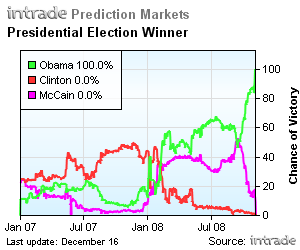
InTrade-TradeSports and BetFair-TradeFair are barred from advertising on Google, Yahoo! and MicroSofts networks of websites.

Via Jason Ruspini and Daniel Horowitz, The Associated Press &amp- Reuters.

But I will remark that Google Ads serve both InTrade and TradeSports. [I don&#8217-t mind. Just a remark.]


Author Profile&nbsp-Editor and Publisher of Midas Oracle .ORG .NET .COM &#8212- Chris Masse&#8217-s mugshot &#8212- Contact Chris Masse &#8212- Chris Masse&#8217-s LinkedIn profile &#8212- Chris Masse&#8217-s FaceBook profile &#8212- Chris Masse&#8217-s Google profile &#8212- Sophia-Antipolis, France, E.U. Read more from this author&#8230-


Read the previous blog posts by Chris. F. Masse:

  • Comments are now completely open on Midas Oracle.
  • Albert Einstein, Chairman of the Midas Oracle Advisory Board
  • Erratic –but not Stochastic– Charts
  • Barack Obama is the 44th US president.
  • We already have prediction markets in future tax rates. It’s called the municipal bond yield curve.
  • DELEGATES AND SUPERDELEGATES ACCOUNTANCY
  • O’Reilly – Money-Tech Conference

Can you think of another name to add in this list?

No Gravatar

Acknowledments

– Friedrich August von Hayek (an economist who introduced, among other things, the concept of the market as an information aggregation tool in The Use of Knowledge in Society, and the 1974 co-winner of the Nobel Prize in economics)-

– Professor Vernon Smith (an experimental economics pioneer, and, as such, the 2002 co-winner of the Nobel Prize in economics)-

– Professor Robin Hanson (one of the contemporary co-inventors of the prediction markets)-

– Doctor James Surowiecki (author of The Wisdom Of Crowds)-

– Professor Steve Levitt (co-author of Freakonomics)-

– Professor Tyler Cowen (co-author of Marginal Revolution and author of Discover Your Inner Economist)-

– Donald Luskin (author of The Conspiracy To Keep You Poor And Stupid)- [*]

– The W3C, Mozilla, Yahoo!, Google, Wikipedia, WordPress and Linux people (among others) for freeing our information-based society.

&#8212-

[*] Don Luskin helped me with finding a good blog name, &#8220-Midas Oracle&#8221-. :-D

Yahoo! Election 2008 Political Dashboard

No Gravatar

(Cross posted from Oddhead Blog.)

I&#8217-m happy to report the launch of the Yahoo! Election &#8216-08 Political Dashboard. Using the dashboard, you can navigate through a wealth of election-related data, including prediction market data from intrade.com, polling data from Real Clear Politics, search buzz data from Yahoo!, and financial contributions data, regional demographic data, and historical voting records from AP. You can view the election landscape from the national level or dive in deeper to investigate trends state by state.

Yiling, Tej, Lance, and I played supporting roles among a cast that includes fantastic teams at Yahoo! News, UI/Design, Ops, Q&amp-A, and more.

We&#8217-ve come a long way since 2006.

See also coverage from TechCrunch and the Yahoo! corporate blog.

Previous: From Chris &#8220-Outrageous Spin&#8221- Masse.

Midas Oracle readers = information workers

Bill Gates (the head of the Evil Empire):

The skills you need to succeed

One of the most important changes of the last 30 years is that digital technology has transformed almost everyone into an information worker. [&#8230-]

I also place a high value on having a passion for ongoing learning. When I was pretty young, I picked up the habit of reading lots of books. It&#8217-s great to read widely about a broad range of subjects. Of course today, it&#8217-s far easier to go online and find information about any topic that interests you. Having that kind of curiosity about the world helps anyone succeed, no matter what kind of work they decide to pursue.

Thanks to Lord JC Kommer for the link.


Author Profile&nbsp-Editor and Publisher of Midas Oracle .ORG .NET .COM &#8212- Chris Masse&#8217-s mugshot &#8212- Contact Chris Masse &#8212- Chris Masse&#8217-s LinkedIn profile &#8212- Chris Masse&#8217-s FaceBook profile &#8212- Chris Masse&#8217-s Google profile &#8212- Sophia-Antipolis, France, E.U. Read more from this author&#8230-


Read the previous blog posts by Chris. F. Masse:

  • Comments are now completely open on Midas Oracle.
  • Albert Einstein, Chairman of the Midas Oracle Advisory Board
  • Erratic –but not Stochastic– Charts
  • Barack Obama is the 44th US president.
  • We already have prediction markets in future tax rates. It’s called the municipal bond yield curve.
  • DELEGATES AND SUPERDELEGATES ACCOUNTANCY
  • O’Reilly – Money-Tech Conference

Polls-Based Forecasting Vs. Prediction Markets

Via AskMarkets&#8216- George Tziralis, The Daily Kos:

Poblano Model


Author Profile&nbsp-Editor and Publisher of Midas Oracle .ORG .NET .COM &#8212- Chris Masse&#8217-s mugshot &#8212- Contact Chris Masse &#8212- Chris Masse&#8217-s LinkedIn profile &#8212- Chris Masse&#8217-s FaceBook profile &#8212- Chris Masse&#8217-s Google profile &#8212- Sophia-Antipolis, France, E.U. Read more from this author&#8230-


Read the previous blog posts by Chris. F. Masse:

  • Comments are now completely open on Midas Oracle.
  • Albert Einstein, Chairman of the Midas Oracle Advisory Board
  • Erratic –but not Stochastic– Charts
  • Barack Obama is the 44th US president.
  • We already have prediction markets in future tax rates. It’s called the municipal bond yield curve.
  • DELEGATES AND SUPERDELEGATES ACCOUNTANCY
  • O’Reilly – Money-Tech Conference

Markets for Telling CEOs to Step Down

No Gravatar

Robin Hanson (back in April 1996):

One of the biggest problems with existing corporate capitalism is keeping CEOs (chief executive officers) accountable to their shareholders. Unaccountable CEOs can give themselves huge salaries and perks, discriminate freely in hiring and promotion, and build empires rather than shareholder value.

In theory, boards of directors oversee CEOs, and can be sued by shareholders should they fail in that task. But in practice such failure is hard to prove, board members are often nominated by the CEO, and CEOs often put each other on their boards. In theory shareholders can dump the current board or CEO at annual meetings, but a commons greatly reduces the incentives for any one shareholder to mount an expensive campaign to find and convince other shareholders. In principle someone could buy out the whole company, dictate changes, and then sell the better-run company at a profit, but existing law and CEOs now lay many obstacles in this path.

The biggest problem with unaccountable CEOs is that they don&#8217-t know when to step down and let someone else run the company. The value of companies often jump when such a CEO dies. So a recent &#8220-Just Vote No&#8221- campaign focuses on this problem, and proposes that dissatisfied shareholders withhold their vote in a certain way, in order to signal they think the current management should step down. The companies with the highest no votes are then publicized, to try and shame management into action.

The main proponent of this Vote No campaign thinks the following proposal of mine has promise. I propose to create, for each stock, a separate market in that stock for trades which are &#8220-called-off&#8221- if the CEO does not step down in the next year. The price of the stock in this market should indicate the market&#8217-s expectation of the value of that company with a different CEO. If that stock price is consistently and significantly higher than the ordinary stock price, that should be a clear market signal, from informed traders, for the CEO to step down. (If there is no price, because there is no trading, then there is no signal.)

Ordinarily CEOs respond to statistics showing how poorly their company is fairing relative to similar companies by explaining how they are really different. And they respond to statistics of unhappy shareholders by pointing out how little incentives any one of them has to become well informed. These excuses should be blunted by my proposal, and board members may more plausibly fear legal action for ignoring these market signals.

This proposal is an example of a more general concept of policy markets.

Robin Hanson&#8217-s comment on my previous blog post:

You make a valid point about there being a difference between CEO futures and decision markets. It is the board, not the CEO, who we might hope would be willing to overrule the CEO ego. And I&#8217-ve had a web page arguing for CEO decision markets since 1996. [See above.]

Robin Hanson (in Forbes in 2006):

[…] My idea: Set up two new stock markets where investors would be making not outright bets on the future of a company but conditional bets. In one market the trades are consummated only if the current chief executive remains in place at the end of the current quarter. In the other market the trades are consummated only if the incumbent is bounced out by the end of the quarter. The price spread between these two markets would send a signal about whether the boss should stay or go.

Say Eisner is the current boss and you own one share of Disney you want to sell. Instead of selling on the New York Stock Exchange for, say, $30, you could do simultaneous sell orders, each for one share, on the two alternative markets. Perhaps Disney is trading in the Stays Put market at $29 and in the Early Retirement market at $31. If Eisner does keep his job, only the first trade becomes valid: You give up your share and get $29. If he gets the ax, only the second trade is valid and the buyer (probably a different buyer) gives you $31.

Just as the $30 price on the Big Board reflects the collective wisdom about the value of Disney, the $29 Stays Put and the $31 Early Retirement prices would reflect the collective wisdom about relative values under different management scenarios. Spreads would open up because sellers (or buyers) in the alternative markets would often do only one of the two trades. If you happen to think Disney is worth $30 a share overall but would be disappointed to see Eisner leave, you would sell only in the Early Retirement market. If he does get bounced, you&#8217-re happy to have the $31 cash- if he stays put, you are happy to continue owning the stock. On the other side of your trade: a hedge fund that thinks Disney would be worth $32 if a new manager came in.

The directors&#8217- job would be to listen to the markets. If a wide enough spread opens up in favor of a departure&#8211-maybe 1%&#8211-get out the pink slip. […]

Previously: PaddyPower&#8217-s betting lines on CEO exits + Marginal Revolution on CEO exit betting lines

CEO Termination prediction markets, anyone??

No Gravatar

New York Times&#8217- Andrew Ross Sorkin:

Betting on the Next Wall Street C.E.O. Exit

[…] Paddy Power, the Irish gambling site, has decided to tap the wisdom of crowds and set odds on who the next C.E.O. casualty will be. […]

Andrew Ross Sorkin does not know what he is talking about. PaddyPower is a bookmaker (which does not prove to us that it balances its book on those CEO Termination betting lines), and not a prediction exchange like InTrade (which, indeed, taps &#8220-the wisdom of crowds&#8221- and is wide open about it).

CEO Resignations

UPDATE: Niall O&#8217-Connor&#8230-

The over-round on Power&#8217-s market is 154.8. This means that they expect to pay out 100 for every 154.8 that they take in- yielding an expected profit of 54.8/154.8 = 35.4%. This is of course a disgrace. It reflects the fact that the market is nothing more than a gimmick – as soon as they catch sight of anybody looking to get a decent bet on, it is likely that they will simply close the book. A clear case of tapping into the wisdom of fools!

INTRADE, PLEASE, PUT THAT DAMN LEGEND ON THE LEFT SIDE, OUTSIDE OF THE CHART, FOR CHRISTS SAKE.

YOU&#8217-RE MESSING WITH HISTORICAL DATA I NEED FOR MY ANALYSIS:


Author Profile&nbsp-Editor and Publisher of Midas Oracle .ORG .NET .COM &#8212- Chris Masse&#8217-s mugshot &#8212- Contact Chris Masse &#8212- Chris Masse&#8217-s LinkedIn profile &#8212- Chris Masse&#8217-s FaceBook profile &#8212- Chris Masse&#8217-s Google profile &#8212- Sophia-Antipolis, France, E.U. Read more from this author&#8230-


Read the previous blog posts by Chris. F. Masse:

  • Comments are now completely open on Midas Oracle.
  • Albert Einstein, Chairman of the Midas Oracle Advisory Board
  • Erratic –but not Stochastic– Charts
  • Barack Obama is the 44th US president.
  • We already have prediction markets in future tax rates. It’s called the municipal bond yield curve.
  • DELEGATES AND SUPERDELEGATES ACCOUNTANCY
  • O’Reilly – Money-Tech Conference

Marginal Revolutions Tyler Cowen re-writes history to favor his GMU colleague.

No Gravatar

I respectfully disagree with that.

#1. BetFair floated CEO Resignation event derivatives back in 2004 &#8212-2 years before Robin Hanson&#8217-s CEO Firing idea [CORRECTION: see below], and 3 years before PaddyPower&#8217-s press release.

#2. Robin Hanson was about decision markets, in his Forbes Op-Ed &#8212-neither about prediction markets nor book betting.

#3. The main obstacle of implementing Robin Hanson&#8217-s concept of decision markets is the business executives&#8217- egos. Why would they outsource the decision making to a crowd machine if the added value is marginal? Publishing complacent blog posts on the premier economics blog won&#8217-t solve this problem.

Trying to sell decision markets to business executives is like trying to sell robotized dildos to young, horny men. Whatever the merit of the product, they don&#8217-t need it &#8212-they prefer using their own thing (if you see what I mean). :-D

&#8212-

UPDATE: Comment from Robin Hanson&#8230-

You make a valid point about there being a difference between CEO futures and decision markets. It is the board, not the CEO, who we might hope would be willing to overrule the CEO ego. And I&#8217-ve had a web page arguing for CEO decision markets since 1996.

&#8212-

Robin Hanson (back in April 1996):

[…] The main proponent of this Vote No campaign thinks the following proposal of mine has promise. I propose to create, for each stock, a separate market in that stock for trades which are &#8220-called-off&#8221- if the CEO does not step down in the next year. The price of the stock in this market should indicate the market&#8217-s expectation of the value of that company with a different CEO. If that stock price is consistently and significantly higher than the ordinary stock price, that should be a clear market signal, from informed traders, for the CEO to step down. (If there is no price, because there is no trading, then there is no signal.)Ordinarily CEOs respond to statistics showing how poorly their company is fairing relative to similar companies by explaining how they are really different. And they respond to statistics of unhappy shareholders by pointing out how little incentives any one of them has to become well informed. These excuses should be blunted by my proposal, and board members may more plausibly fear legal action for ignoring these market signals.

This proposal is an example of a more general concept of policy markets.

Do sports prediction markets corrupt sport? No.

No Gravatar

Mark Davies (&#8221-managing director of corporate affairs at BetFair&#8221- = their spin doctor) in The Guardian:

Does the existence of betting exchanges corrupt sport?

NO

In the world of finance, it has always been far easier for employees to have a negative impact on a company&#8217-s share price than a positive one. Even a chief executive would be hard pushed to cause a price rise on any given day, but anyone with physical access to the company can very easily cause a fall. No one would suggest people should only be able to buy shares, and not sell them. Instead, regulators ensure that sanctions against corruption tip the balance heavily against trying it. Make the penalty draconian, and you deal with corruption at its heart.

Betting on sport is no different. The only people who can corrupt sport are those taking part – a fact unchanged by the existence of betting exchanges. If you prevent people from succumbing to the temptation, would-be corrupters have no one to help them . You and I cannot rig a race just because we can bet against its outcome: we need someone who can affect the result. If that person might lose a livelihood, would they risk it for a fast buck?

Attack corruption at source, and it does not matter where the bet was placed. Nevertheless, some still long for the days when more traditional bookmakers held every card (an interesting notion considering what has historically been their dubious reputation)- others prefer a Tote monopoly- and some believe that banning bets against outcomes would constrain corrupters.

This series of arguments is based on the naive belief that a black market does not exist. This is absurd. Asian syndicates behind apparently rigged football matches (like those who turned floodlights out at grounds in the late 1990s) are no more dependent on Britain&#8217-s legitimate market than Colombian drugs barons are on sales of aspirin at Boots. The difference between legal, regulated, transparent betting – nowhere more so than on the leading betting exchange [= BetFair], where every transaction is open to scrutiny from 29 different sporting regulators – and the murky, illegal market, is the difference between chalk and cheese.

Black markets thrive where legal ones offer poor value. Now that the exchanges offer the best value, those previously tempted by odds on the black market are returning to the legal fold. Corruption-free sport comes from total transparency. The exchanges are the only part of the market that offer it. People get hung up on &#8220-betting to lose&#8221-.

Leave aside the obvious: bets to win (most clearly demonstrated in two outcome sports like tennis or snooker) are direct bets on the opposite outcome to lose. &#8220-Betting to lose&#8221- is just betting at value: if the price unfairly reflects the realistic chance of something happening, why should you not bet against it?

Value bets, placed for or against, are perfectly legitimate- acting to impact a given outcome adversely is corrupt. But banning the former through fear of the latter is like banning cutlery because some people use knives to harm. It is not the knives doing the damage, but the criminals using them. Legal betting does not corrupt sport- people do – and they are more likely to do it when they think they w ill not get caught. Measures to protect sport are not best aimed at open, transparent, and audited betting markets but through its participants, where the corruption can occur.

Excellent.