OPEN LETTER TO THE COMMENTERS OF THE MARGINAL REVOLUTION BLOG

No Gravatar

Hello Professor Tyler Cowen and all the commenters,

#1. Professor Lance Fortnow made a specific point: taken one day before Election Day, the TradeSports&#8217-s prediction markets of the individual races for the US Senate were accurate (provided that Virginia and Montana go democratic).

#2. Professor Lance Fortnow DID NOT SAY that the TradeSports&#8217-s prediction market for the control of the US Senate was accurate. Please, don&#8217-t put words in his mouth.

#3. Analysis reports from economists and statisticians are coming, but, please give them time to digest the data&#8230- once the dust has settled.

Thanks for your attention,

Chris Masse

BetFair: Which of these parties will have more seats in the US Senate following the 2006 US Senate Elections?

No Gravatar

Republicans: 49%

Democrats: 53.8%

Ex-BBC News Mike Smithson (of the Political Betting blog) wonders whether BetFair will count the two Independent U.S. Senators (Liberman and Sanders) in the Democratic camp.

Lieberman won re-election as the “Connecticut For Lieberman” party candidate – an independent political party he created after losing the 2006 Democratic primary election to Ned Lamont. He has said he will sit as part of the Democratic Senate caucus in the upcoming 110th Congress.

Sanders won yesterday in Vermont as an independent but will caucus with the Democrats and it is said will be counted as a Democrat for the purposes of committee assignments.

The problem that Betfair will have to resolve is that neither ran as a Democrat although they will be attached to the Democrats in the Upper House.

To add to the complication Nick Palmer, MP, posted this on the previous thread at 1.34pm – “I have it in writing from Betfair that they will count the two independents as Democrats. (I asked them a month or two ago before I put a tenner on.) If you have opposite advice in writing, they should be embarrassed!”.

Addendum: From one commenter&#8230-

The question was “Which of these parties will have more seats in the US Senate following the 2006 US Senate Elections?”

The options were Republicans and Democrats. The result is 49-49 with two independents.

It’s a draw- I can’t see how anyone can see otherwise.

Addendum 2: From Yahoo! News (whose data are provided by the Associated Press)&#8230-

Liberman (CT) and Sanders (VT) are counted as Democrats.

Addendum 3: From the Washington Post frontpage&#8230-

Editor&#8217-s Note: Independent members of Congress typically caucus with the Democrats.

Addendum 4: From the New York Times&#8230-

Full Senate Results &#8212- Republican: 49 &#8212- Democratic: 50 – Includes independents who align with the Democratic caucus. &#8212- [CFM’s NOTE: Virginia is still in play at the time of writing.]

Addendum 5: Mike Smithson&#8230-

So punters who are tempted into this market are risking money on how they think Betfair will settle the market.

Prediction markets, idea futures, event-driven futures, European call options, event derivatives…

No Gravatar

&#8230- and now &#8220-information derivatives&#8220-. (Via George Tziralis) What is remarkable is that you can shorten it as &#8220-ID&#8221- (or &#8220-IDs&#8220-, plural). (Prediction markets are often referred as &#8220-PMs&#8221-.)

My Question To My Readers: Which term(s) do you like most? In my short list, in the blog title, I forgot to mention terms including the word &#8220-stock&#8221-, which Alex Kirtland told us is the most commonly understood by &#8220-people&#8221- (as opposed to prediction market professionals).

My Questions To Bernd Ankenbrand: Would you mind telling us more about GEXID, here, on this blog? And do you know some English-speaking colleagues of yours who would like to be registered at Midas Oracle? And Gutten Tag!&#8230- (That means Bonjour, right?)

Addendum: This is hilarious. They needed to consult an army of German lawyers to make sure that play-money prediction exchanges won&#8217-t be assimilated with gambling operators.

Are you trading with real money?

No. In all gexid markets we trade with gexid euro (play money). Your portfolio at the end can be converted in prices the issuer prices.

Is trading at gexid like gambling?

No. gexid is not a place for gambling. Independent expert opinions by several lawyers in Germany confirm this fact. Therefore there is not need for regulating gexid. Upon request gexid will provide you those expert opinions.

TEN CEO John Delaney finally admits that the new law will cut off TradeSports-InTrades revenues.

No Gravatar

He writes:

Our entire team are very busy with a bunch of things right now
&#8212-
** Offering new and easier ways for members to deposit funds to the exchange.

As for trader &#8220-Todd73NJ&#8221-, he found out that Web-based bookmaker/sportsbook BetCris is testing a workaround for the Internet Gambling Prohibition and Enforcement Act:

1) They mail you the card
2) You fund it via Western Union – either online from a credit card or at a location via credit card or cash
3) You will be charged by Western Union approx $40 per $1,000 transfered
4) They refund the charges you are charged once you deposit to their site and roll over the money.
5) Withdrawing is free to send the money back to your debit card.
6) Normal ATM transaction fees when you take out cash from any ATM. Or you can use it at places that [accept] the certain purchase options they mentioned.

Remember: Neteller (the main financial source of TradeSports-InTrade) is out of the US market.

Partisan impacts on the economy: Evidence from prediction markets and close elections – by Erik Snowberg, Justin Wolfers and Eric Zitzewitz – REDUX

No Gravatar

The breaking news is that Professor Justin Wolfers (of the Wharton business school in Philadelphia) has responded to my unforeseeable attack and to the subsequent Mike Linksvayer&#8217-s comment.

A quick response to Chris:
Let me clarify what I think the key puzzle is: the odds of either Democrats or Republicans are – literally – unchanged since the week before the 2004 election. It seems amazing to me that there has been *no news* that is relevant to the 2008 election.

And I don’t really know which way it should have gone (I’m not yet calling ‘08 for the Dems). For instance, Bush winning in ‘04 provides the Republicans with an incumbency advantage. Countering that, the last two years have provided the Dems with an advantage in the midterms, which you might think could persist to ‘08. And the cast of possible candidates is also starting to take shape, and the absence of Warner, the rise of Barak, and the continuing dominance of both Hillary and McCain are all important factors that we didn’t know about two years ago. All of this is hard to reconcile with the odds remaining unchanged.

I[n] response to Mike’s point: he is exactly correct to emphasize the difficulty in discerning the direction of causation between election outcomes and economic outcomes. But that is precisely the point of my forthcoming QJE paper with Snowberg and Zitzewitz (available at: PDF).

In that paper (which is what I describe in the WSJ), we look at stock market reactions to what are clearly random (or exogenous) shocks to the expectations of Bush’s re-election – the leaked exit polls, and the subsequent vote count. These experiments allow us to draw inferences about how changes in electoral prospects drive economic outcomes.

The Abstract Of That Paper:

Partisan impacts on the economy: Evidence from prediction markets and close elections – by Erik Snowberg, Justin Wolfers and Eric Zitzewitz – (PDF) – 2006-03-XX

Analyses of the effects of election outcomes on the economy have been hampered by the problem that economic outcomes also influence elections. We sidestep these problems by analyzing movements in economic indicators caused by clearly exogenous changes in expectations about the likely winner during Election Day. Analyzing high frequency financial fluctuations following the release of flawed exit poll data on Election Day 2004, and then during the vote count, we find that markets anticipated higher equity prices, interest rates and oil prices and a stronger dollar under a Bush presidency than under Kerry. A similar Republican-Democrat differential was also observed for the 2000 Bush-Gore contest. Prediction market based analyses of all Presidential elections since 1880 also reveal a similar pattern of partisan impacts, suggesting that electing a Republican President raises equity valuations by 2 3 percent, and that since Reagan, Republican Presidents have tended to raise bond yields.

Justin Wolfers cant believe that prediction markets dont show already a clear win for the Dems in the 2008 presidential election.

No Gravatar

How Much Do Election Shakeups Affect the Nation&#8217-s Economy? – [US politics &amp- financial markets] – by Justin Wolfers and Mark Thoma – 2006-11-03

[Justin Wolfers] And the major puzzle that I currently see? The past two years have clearly been terrible for Republicans, with Iraq deteriorating, Katrina undermining the public trust, and corruption scandals aplenty. And consequently their chances of keeping control of the House have fallen precipitously (Intrade.com charts here). But the real surprise? Prediction markets tell us that the odds of Republicans winning the White House in 2008 remain virtually unchanged. Neither the incumbency advantage coming from victory in the 2004 elections, nor the subsequent declines in Republican fortunes have shifted the odds (chart: here), and the 2008 Presidential election remains a coin flip. Stay tuned: It looks like Tuesday will be a long night. And when the counting ends, the two-year campaign for the White House begins.

My Take: Our good doctor Justin Wolfers takes his Democratic dreams for the reality (all that said in all due respect for this bright researcher). We&#8217-re two years away from the November 2008 presidential election. The margin of error is still enormous, so today&#8217-s market-generated probabilities (Dems: 48.6% – GOP: 48%) for the 2008 presidential race mean strictly nothing. Plus, at times, a US presidential candidate can get substantial votes from the other camp (e.g., Ronald Reagan seducing many Democratic voters, etc.).

Addendum: Mike Linksvayer has an interesting comment, attached below this blog post.

Addendum 2 (November 04): Professor Justin Wolfers has responded, in the comment area, below this blog post. (And his paper is excerpted here, on Midas Oracle.)

Accuracy of futures prices as predictors of the fed funds rate

No Gravatar

I&#8217-m just finishing writing a new research paper whose goal is to come up with a better measure and understanding of the lagged effect of monetary policy on the economy. One of my claims is that the public&#8217-s expectations of what the Fed is going to do next play a key role in that process. In this, the first of several posts based on that paper, I describe some of the properties I&#8217-ve found for fed funds futures prices as predictors of subsequent Fed policy changes.

The primary policy tool of the U.S. Federal Reserve is manipulation of the federal funds rate, an overnight interest rate on interbank loans that is quite sensitive to the total quantity of reserve deposits that are created by the Fed. The Chicago Board of Trade offers a futures contract whose payoff is based on the average value for the effective fed funds rate over all of the calendar days of a specified month.If this were a pure forward contract, no money would change hands until the first-of-month settlement day. The actual futures contracts are a little more complicated, since the exchange will require you to commit collateral to prove you can honor the contract, and these margin requirements will increase if the market moves against you. However, a recent paper by Monika Piazzesi and Eric Swanson demonstrates that the impact of these margin calculations on the value of the contracts should be quite small, and I will discuss here the simpler case of how to evaluate a pure forward contract.

Consider first how a contract that specified a 5.25% value for the current month&#8217-s fed funds rate would be valued at the start of the last day of the month (the day before settlement). If the actual rate turns out to be lower than 5.25%, the next day the seller of the contract will have to compensate the buyer for the difference (paying $41.67 per basis point in the standard contract). If you were the buyer of the contract, this would for you be a pure profit. The primary consideration that might prevent you from taking this bet is a concern that perhaps the rate would end up above 5.25%, in which case you&#8217-ll owe money. If speculators are risk neutral, the contract price will be bid up or down to the point at which its implied interest rate just equals traders&#8217- expectations of what the settlement rate will turn out to be.

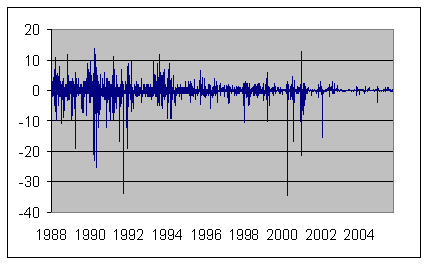
On the next-to-last day of the month, similar logic would again imply that the price reflects the market expectation at that time. New information could well come in after this, causing the price to move up or down before settlement. But if it were possible to anticipate, say, a price increase between the penultimate and last day of the month, there is a pure profit opportunity from buying on October 30 and selling on October 31. A statistical principle known as the Law of Iterated Expectations implies that the October 30 price should not only equal the expected settlement value, it should also equal the expected October 31 price. As time goes on and new information comes in, of course we know that the price is likely to change. But none of us can predict the direction. In other words, this simple theory suggests that the futures price should follow a martingale, in which the best forecast of where the price is going to be tomorrow is always just today&#8217-s price.In my statistical analysis I looked at daily changes in the interest rate implied by the current month&#8217-s fed funds contract (denoted f1d), the following month&#8217-s contract (f2d), and the month after that (f3d)- for example, for d = October 31 we could consider the change in the October contract (f1d), the November contract (f2d), or the December contract (f3d). The graph below plots daily changes in the interest rate implied by the current month contract from October 1988 through June 2006.
f1d.gif

On average, the values of f1d, f2d, and f3d all turn out to be negative over this sample period, with t-statistics around -4. This represents strong evidence against the martingale hypothesis, and some researchers have interpreted this bias as evidence of some kind of average risk or hedging premium reflected in the futures prices.

However, if you look at the graph above, you will see that it is a pretty wild series. Forty-six percent of the observations are identically zero, while 25 observations exceed 5 standard deviations. The variance is considerably larger at the beginning of the sample or the start of a month, with the volatility appearing in clusters and particularly on days of major monetary policy announcements. If one models all these volatility dynamics and departures from a Gaussian distribution, the maximum likelihood estimate of the population mean of f1d, f2d, or f3d all turn out to be positive rather than negative, and far from statistically significant. The sample median of all three series is also exactly zero. I therefore see the nonzero sample mean not as an indication of bias on the part of futures markets, but rather as reflecting the fact that there were a few big moves down in interest rates over this period

that caught traders by surprise.

I also looked for whether changes could be predicted on the basis of lagged changes, by regressing fid on a constant and five of its own lagged changes. OLS coefficient estimates along with their 95% confidence intervals are shown below.

fid_autoregressions.gif

The first lag is always highly statistically significant. Its value, however, is only around 0.15, which gives the regression an R2 of less than 0.03 and essentially zero predictability looking more than one day ahead. It is quite likely that this very modest degree of predictability could be attributed to measurement error in resolving daily bid-ask factors rather than systematic errors or risk factors in futures markets.

The paper by Piazzesi and Swanson mentioned above documents some predictability using monthly data of longer-horizon fed funds futures prices based on a number of interest rate spreads. However, consistent with their findings, I find these spreads do not predict the daily movements in the prices associated with the near-term fed funds futures contracts that I am studying, as summarized in the table below:

Explanatory variableDependent variable
xd-1-1f1df2df3d
10-year minus 5-year
Treasury spread
0.058
(0.086)
-0.036
(0.117)
-0.070
(0.138)
5-year minus 2-year
Treasury spread
-0.009
(0.058)
-0.085
(0.079)
-0.126
(0.093)
2-year minus 1-year
Treasury spread
-0.072
(0.112)
-0.136
(0.153)
-0.172
(0.181)
1-year minus 6-month
Treasury spread
0.006
(0.173)
0.302
(0.236)
0.439
(0.279)
Baa minus 10-year
Treasury spread
-0.035
(0.058)
-0.126
(0.079)
-0.184*
(0.094)
12-month job growth
(revised data)
0.017
(0.023)
0.089**
(0.031)
0.125**
(0.036)
12-month job growth
(real-time data)
0.016
(0.024)
0.093**
(0.033)
0.121**
(0.039)

I also replicate with these data Piazzesi and Swanson&#8217-s observation that employment growth helps predict futures prices, though again for my data the R2 is only 2%, and the results I will describe in my next post turn out to be insensitive to whether one includes this conditioning variable. Overall, I conclude that although these data do not appear to follow an exact martingale, that is really an excellent approximation to their behavior.

A separate question from whether changes in futures prices are possible to predict is the question of how far in advance they give a useful estimate. One standard of comparison is the mean squared error, or the average squared difference between the implied futures forecast at a given date and what the actual fed funds rate turns out to be. A benchmark for comparison is the assumption that the fed funds rate itself follows a martingale, so that one&#8217-s forecast for the future value of the fed funds rate is always its current value. Such &#8220-no-change&#8221- forecasts have often proven to be very difficult to beat out-of-sample with financial data. The table below shows that, if you simply predicted that the fed funds rate isn&#8217-t going to change, you&#8217-d have a mean squared error of 389 basis points (that is, a standard deviation of about 20 basis points or 0.2%) predicting one month ahead and 2,522 basis points (50 basis-point standard deviation) predicting 3-months ahead. For comparison, the MSEs of the futures-derived forecasts are only a third as large.

Forecast horizonNo-change
MSE
Futures
MSE
Percent MSE
improvement
Futures
MAE
1 month ahead38912867%6.90
2 months ahead124839269%12.76
3 months ahead252291464%20.03

Futures prices have become even better predictors over the last three years, with an incredible 97% improvement over the &#8220-no-change&#8221- forecast:

Forecast horizonNo-change
MSE
Futures
MSE
Percent MSE
improvement
Futures
MAE
1 month ahead183597%1.50
2 months ahead6651997%3.18
3 months ahead14844897%5.40

The moral is, if you think the fed funds rate is going to do something over the next few months that differs from what is predicted by the futures prices, then think again.

And what the futures prices say right now is, no change in December.

How to obtain an edge in short-term trading?

No Gravatar

An intriguing brand-new blog (written by &#8220-mrgroovski&#8221-):

Purpose of CASTrader

Welcome to CASTrader. The purpose of this blog is to document the development of a Complex Adaptive System (CAS) Trading System (CASTrader) for the stock, futures and potentially other markets in a quest for 50%-plus returns. The exact details will remain proprietary, but the basic development and thought processes will be documented.

Complex adaptive systems are typically composed of diverse sets of many agents that are programmed to accomplish some goal. The interaction of these agents can make the population smarter than any individual agent. By emulating biological systems (e.g. – reproduction and gene mutation), such a system can &#8220-evolve&#8221- to produce emergent, very interesting behavior. In CASTrader, each agent will act as a trader following some trading rule that can evolve with time. Agents that are good make money and survive. Agents that don&#8217-t die out. It&#8217-s survival of the fittest.

The reason for using CAS is that it is my opinion that CAS can provide a significant edge to trading, and before long, CAS or other computerized trading systems will eventually be one of the few ways traders will obtain an edge in short term trading.

Chinese Markets

No Gravatar

In its October 25, 2006 press release, Cambridge-based consultancy Market Platform Dynamics says it has the &#8220-only China-based prediction market capability.&#8221- They actually seem to be referring to a survey. Their website gives no evidence of a price mechanism.

MPD’s partnerships in China give us exclusive access to a network of more than 11,000 Chinese managers who will serve as the firm’s Chinese “prediction market” and who will routinely surveyed on behalf of clients to determine their interests in new products and services.

Anyone know what&#8217-s up?

Faulty polls screw up the political prediction markets. – REDUX – The no polls case, now.

No Gravatar

Two days ago, I stated brashly that political prediction markets aggregate the polls, mainly. (Mike Linksvayer nuanced my propos, in the comment area.)

GOP Keeps Senate, Loses House, Betting Site Says. – [US political prediction markets] – by Ronald Kessler – 2006-10-24

One theory is that prediction markets are influenced by the results of opinion polls. But if that were true, individual polls would also influence each other. Moreover, long before the Internet and opinion polls came into existence, election betting was accurately predicting election outcomes. From 1884 to 1940, betting was conducted on Wall Street by specialized brokers called betting commissioners. The betting odds for each candidate were published daily in the New York Times and other papers. The so-called New York betting markets correctly predicted 12 of the 13 presidential elections between 1884 and 1940, according to Koleman S. Strumpf, Koch professor of economics, University of Kansas School of Business, who co-authored a paper examining the markets. In the one exception, the betting swung to even odds by the time the polls closed. The Gallup Poll, the first scientific opinion poll, began in 1935. The arrival of opinion polls and stricter anti-gambling laws drove out the New York betting markets. The Internet has led to their revival.

Paper: Historical Prediction Markets: Wagering on Presidential Elections – (PDF) – by Paul W. Rhode and Koleman S. Strumpf – 2003-11-10

My Question: Before 1935 (that&#8217-s when George Gallup crafted the first scientific polls), what the hell those political prediction markets were aggregating, for Christ&#8217-s sake??? And where is our good doctor Koleman Strumpf when we need him?

Previous blog posts by Chris F. Masse:

  • Become “friend” with me on Google E-Mail so as to share feed items with me within Google Reader.
  • Nigel Eccles’ flawed “vision” about HubDub shows that he hasn’t any.
  • How does InTrade deal with insider trading?
  • Modern Life
  • “The Beacon” is an excellent blog published by The Independent Institute.
  • The John Edwards Non-Affair… is making Memeorandum (twice), again.
  • Prediction Markets = marketplaces for information trading… and for separating the wheat from the chaff.