
Inferring market expectations from changes in fed funds futures prices

No Gravatar

I recently completed a new research paper studying how interest rates of different maturities change with market expectations of what the Fed is going to do next.

Settlement on a fed funds futures contract is based on the average effective fed funds rate over each of the calendar days of a specified month. If a month contains N calendar days and rt denotes the effective fed funds rate on date t, settlement of the contract is based on the value of

(r1 + r2 + &#8230- + rN)/N.

My latest research paper uses just the spot-month contract, whose payoff is based on what the current month&#8217-s average fed funds rate turns out to be. Suppose that the Fed raises the target by 50 basis points on the 16th day of a month containing N = 30 calendar days. If the target change doesn&#8217-t alter the fed funds rate for days 1 through 15, it would only raise the average effective rate over the month by 25 basis points, since half the observations that go into the average would be at the lower rate. If market participants had previously been assuming there would be no change at all, and then learned on some day t early in the month that the change was coming on the 16th, we would see the fed funds futures rate move on day t by 25 basis points, even though the market knows a 50-point hike is coming, as a consequence of the averaging. If we wanted to infer the change in the market&#8217-s expectation of the fed funds target from the change in the spot-month contract, we would need to multiply the observed spot-month contract change by 2. In general, for a month in which the target change, if it occurs, will come on day n of the month, a paper by Oberlin Professor Ken Kuttner published in the Journal of Monetary Economics in 2001 used such reasoning to propose that the change in the market&#8217-s expectation of the target might be measured by

(DF)(N)/(Nn + 1).

where DF is the observed change in the spot-month contract.

There are a couple of concerns that Kuttner and others have raised about this expression, however. For one thing, it does not take into account the fact that the effective fed funds rate (on which the futures contract payoff is based) is not exactly the same as the target rate itself. There are often quite significant deviations towards the end of the month, and the formula above would severely amplify this end-of-month measurement error. Furthermore, although there are some months when everybody knows exactly when the change, if there is to be one, is going to occur, there are also other months where we really don&#8217-t know, and some times when a target change did occur but was not announced, and the market did not immediately realize it. We speculated here at Econbrowser as to whether this could have happened this August, and a paper by Poole, Rasche, and Thornton discusses a number of other historical episodes.

My latest paper generalizes Kuttner&#8217-s formula in three directions. First, I explicitly model deviations between the effective rate and the target, and show how to modify the formula to take into account this measurement error. Second, I take the view that markets may be gradually learning about the target change well before it actually occurs. And third, I ask what the data would look like if the econometrician does not assume to know the exact date on which the target was changed.

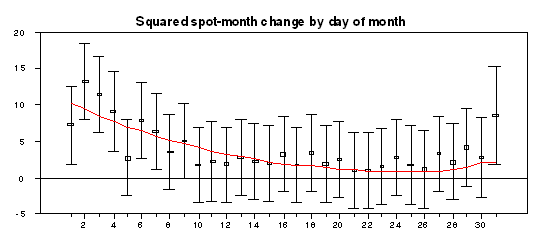
These modifications imply a certain pattern for the volatility of daily changes in the spot-month futures contract over the days of the month. The volatility generally should decline during the month, as uncertainty becomes resolved as to what this month&#8217-s target is going to be, but then increases again a bit at the end of the month due to the greater volatility of deviations of the target from the actual on those days:
kuttner1.gif

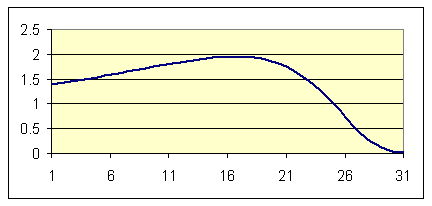
On the basis of the observed volatility of fed funds futures and the effective fed funds rate, the framework then implies a generalization of the Kuttner weights one should use to multiply an observed change in the spot-month futures contract to infer the change in the market&#8217-s expectation of the target. The relation is not monotonic. The ideal weight initially increases as one gets farther into the month, for the same reason as the original Kuttner formula. But it then starts the decrease in the last third of the month, because it is more likely that spot-month changes on those days are driven by noise in the effective fed funds rate rather than news about the target itself.
kuttner2.gif

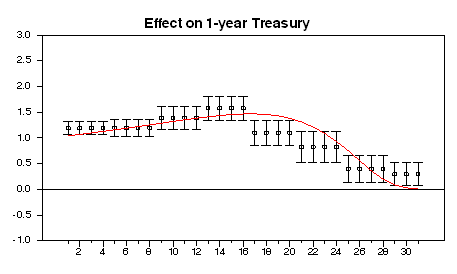
The model then implies a prediction as to what sort of response one should see of an interest rate such as the 1-year Treasury yield to a given change in the spot-month contract. Since it is the target itself, and not deviations between the effective rate and the target, that will matter for longer term yields, the coefficient from a regression of the change in yield on the spot-month change should show exactly the same calendar pattern as the figure above. The following figure reproduces the predicted pattern (the smooth red line), as well as the actual estimated coefficients when days of the month are grouped into octiles based on calendar date. The prediction seems to fit the facts reasonably well.
kuttner3.gif

One thing we obtain from such calculations is an estimated average extent to which interest rates of various maturities respond to news about what the Fed is gong to select for the target for the current month. I found that a 10-basis-point increase in the expected target was on average associated with a 6- or 7-basis-point increase in Treasury yields at horizons up to 3 years, and a 4-basis-point increase even for a 10-year horizon. Although the methods and data sets are rather different from those of earlier researchers, these estimates are very similar to those obtained by earlier researchers. The consistent finding in this literature has been that changes in Fed policy have surprisingly long-lived consequences.

MaturityResponse
3 months0.66
6 months0.71
1 year0.75
2 years0.68
3 years0.64
10 years0.43

Cross-posted from EconBrowser.

Could prediction markets help our society to become more truthful?

No Gravatar

[…] [About the Iraq war] – “There is no question that America is living a nightmare with no end in sight,” retired Lt. Gen. Ricardo Sanchez told a convention of military journalists on Friday. […]

But why didn&#8217-t he come forward before, then?

[…] Asked why he did not speak out about his concerns, Sanchez said general officers take an oath to carry out the orders of the president while in uniform. “The last thing that America wants, the last thing that you want, is for currently serving general officers to stand up against our political leadership,” he said. However, general officers do have the option of stepping down if they disagree with the country&#8217-s leaders. Sanchez said he felt he could not resign and go public with his reservations while he was in Iraq, because he feared that move could further jeopardize troops serving there. “I think once you are retired, you have a responsibility to the nation, to your oath, to the country, to state your opinion,” he said.

Associated Press:

Retired Lt. Gen. Ricardo Sanchez

We can&#8217-t rely on retirees to tell us the truth. We need an anonymous information aggregation mechanism that gives an incentive to people who come forward with advanced information: the prediction markets.

Have Betfair ever extended a ?1m credit line to Harry Findlay?

No Gravatar

Asked the lawyer representing one of the defendants in the Fallon case. For your information, &#8220-Harry Findlay&#8221- is the name of a &#8220-high-profile, high-staking punter who has never been connected with the case.&#8221- Why is it that his name is brought into the courtroom, then?? Bizarre. There is something they know and we don&#8217-t, obviously.

The link is from Niall O’Connor.

UPDATE: More from the Beeb.

UsableMarkets Reports from the NYC Prediction Market Conference (Yes, a little, er, a lot, late)

No Gravatar

I recently published some thoughts resulting from the NYC Prediction Market Conference.

There were three items:

1. Contract Content which discusses &#8220-whether having related content and links appear alongside a contract make any difference as to how well informed the traders are when trading that contract … and therefore, does it have any impact on the price of that contract?&#8221-

2. Losing the Market in Prediction Markets talks about the recognition that the desire for simpler trading interfaces in the prediction market community is finally leading to real results, as an abundance of sites, if not every PM site, looks to make predicting easier to do, and understand.

3. Shapers and Voters reflects on a slide about trader distribution in Jed Christiansen&#8217-s presentation.

I hope you enjoy.
~alex

What in the hells global warming have to do with world peace?

No Gravatar

Asks Rush Limbaugh. Maybe our good friend Caveat Bettor could answer this question. Rush Limbaugh thinks they should give the Nobel Peace price&#8230- to him (no kidding):

I don&#8217-t even know why Gore&#8217-s qualified for this. &#8230- I have done more for world peace to promote liberty and freedom than Al Gore has.

My lawyers at the Landmark Legal Foundation are looking into the possibility of filing an objection with the Nobel committee over the unethical tampering for this award that Al Gore is engaging in.

What in the hell&#8217-s global warming have to do with world peace?

I file this blog post in the &#8220-humor&#8221- category, of course. :-D Not sure whether Rush Limbaugh&#8217-s humor is intentional, though.

Previous: Will Al Gore win the 2007 Nobel Peace Prize?

The InTrade-TradeSports explainer

No Gravatar

InTrade-TradeSports:

I just want to make a bet – what do I do?
– In this case you may want to go to our Betting Screen. This displays the bets in a format familiar to Sports Book users. On the Betting Screen you can view moneyline or digital odds and choose the amount of money you want to bet. The Betting Screen has a seperate Help section to get you started.

I think an outcome isn&#8217-t going to happen, but you don&#8217-t have the opposite result, what do I do?
– That&#8217-s the beauty of InTrade, to bet against an outcome you simply sell the contract.

But I don&#8217-t own any contracts, how can I sell something I don&#8217-t own?
InTrade is modeled on a futures exchange. On InTrade when you sell a contract you&#8217-re actually entering into an agreement to sell the contract when it expires. So if you sell at 35 and the contract expires at zero you make 35 points because the contract is worth nothing. However if the contract was worth 100 then you have to pay the difference, in this case 65 points. The value of a point can vary depending on the contract, but for most contracts on InTrade one point is worth $0.10.

Justin Wolfers guest-blogging week at Marginal Revolution is over.

No GravatarJusitn Wolfers:

I&#8217-ve been amazed by how much work blogging can be. More than anything else, this past week has simply increased my admiration for the work that Alex [Tabarrok] and Tyler [Cowen] put into this site and our community.

Yes, blogging is hard and difficult. But Justin Wolfers has experienced only one third of the whole experience &#8212-writing. The two other parts are: finessing the parameters of your blogging software, and marketing your blog, posts and pages. In my experience, the last thing is the most difficult &#8212-you have to get inbound links from big bloggers, otherwise nobody reads you and the search engines don&#8217-t compute you. Your blog will only matter in your industry if you excel at each of these three tasks. (And if what you run is a group blog, then there is a fourth task, which is inciting other people to write for your group blog for free. :-D )

So, how did you like Justin Wolfers&#8217- guest-blogging week at Marginal Revolution?

Great. Smart guy. Very open to others. Very willing to let the readers discover plenty of external resources (including, two times, a weird stuff called Midas Oracle :-D ). His blogging style resembles much David Pennock&#8217-s one. That is, a smooth mix of home-made essays and news aggregation items. Very different than Robin Hanson&#8217-s blogging. (Robin Hanson is on a quest to show off that he is the world&#8217-s most intelligent human being, which is boring most of the times, but can output highly valuable fruits, occasionally.)

Read the previous blog posts by Chris F. Masse:

  • Bzzzzzzzzz…
  • Bzzzzzzzzz…
  • “No offense, but I think Radley Balko is the most valuable blogger in America right now.”
  • Are you a better predictor than John McCain?
  • What does climate scientist James Annan think of InTrade’s global warming prediction markets?
  • Inkling Markets, one year later
  • One trader’s view on BetFair’s new bet-matching logic

Prediction market infiltrations in the media – US vs. UK

No Gravatar

Folks, I want to tackle this important issue in this blog post. But first, I will excerpt two news articles from The Economist. The first one was written by their American correspondence, and the second one was written by their UK-based journalists. [Technical Note: Since each of the stories from The Economist is written collectively by a bunch of journalists (whose names are not disclosed, by the way), this is the reason I use the plural for the word “journalists”.]

&#8212-

The Economist #1:

Hillary Clinton
Ready to run the movie again?

Oct 4th 2007 | WASHINGTON, DC
From The Economist print edition
The betting is that the Clintons will follow the Bushes back into the White House

[SECOND PARAGRAPH] […] Mrs Clinton is way out in front of the Democratic field. The latest Washington Post/ABC News poll puts her 33 points ahead of Barack Obama and 40 points ahead of John Edwards. She raised $22m in the last quarter—more than Mr Obama at $19m and much more than Mr Edwards at $7m. The once-mighty Republican Party is a shadow of its former self, divided not only about who should lead it but also about where it should go. Intrade, a pay-to-play prediction market, shows a 36% chance of the Republicans holding the White House alongside a 12% chance of them taking the House and a 7% chance they might take the Senate. […]

The Economist #2:

Polls and elections
One man, one decision

Oct 4th 2007 – [BY A UK-BASED TEAM OF JOURNALISTS, I SUPPOSE]
From The Economist print edition
Public-opinion surveys cannot tell the prime minister when to go to the country

[LAST PARAGRAPH] In 2005 the most accurate predictions came not from the opinion polls but from online betting markets. This time, says Leighton Vaughan Williams of Nottingham Trent University&#8217-s Betting Research Unit, an election before Christmas is odds on and Labour is hot favourite to win the most seats. But the odds that Labour will get an overall majority are just slightly better than even. “So,” asks Mr Vaughan Williams, “is the prime minister willing to risk his majority on the toss of a coin?”

&#8212-

– INTERESTING OBSERVATION: Right away, in the first paragraph, the US-based journalists inform their audience with a combo of polls and probabilistic probabilities from the most liquid betting exchange in America (InTrade). Whereas the UK-based journalists will give, in the last paragraph, a bit like an anecdote you tell to your friends at the end of a good lunch, some vague indications given by the &#8220-betting markets&#8221- (not well defined). [*]

– ANALYSIS &amp- REMEDY: My hunch is that the UK-based journalists have not been spinned well enough by the prediction market economists. The remedy is that the British journalists (news writers, reporters, columnists, bloggers, etc.) should be exposed to the wisdom-of-crowds science in events or press conferences.

&#8212-

[*] ADDENDUM: Professor Leighton Vaughan-Williams&#8216- e-mail to me&#8230-

In the &#8216-Economica&#8217- article reference is made to the 2005 British election. For that election I used exchanges (notably, but not exclusively, Betfair and Intrade), the Cantor Spreadfair &#8217-spread betting&#8217- exchange, spread bookmakers, notably IG Index and Sporting Index, and to a lesser extent fixed-odds bookmakers like Ladbrokes and William Hill.

In reference to the next election, the odds quoted were those quoted on Betfair at 9.30 am (UK time) yesterday.

New Prediction Markets Software Site – Qmarkets

No Gravatar

hi all,

First of all, I&#8217-m delighted to join this site – now as a blogger, and not just as a reader.

You&#8217-ll have to forgive me, but my first blog will go to &#8220-self promotion&#8221- of my new site – www.qmarkets.net.

Qmarkets allows anyone to create their own prediction markets (we simply refer to them as &#8220-Questions&#8221-), and invite people to trade (we call it simply &#8220-Answering&#8221-&#8230-). Our target audience is anyone – from corporate, bloggers, site owners etc.

You can either add your questions in our public marketplace, or you can create your own Qmarkets group (where you can limit it to your company employees, or make it a public group).

So – I&#8217-d be happy to hear your feedback on our new site, which was just launched 2 weeks ago (after a short Beta period). We have many new features waiting in our to-do list, so we&#8217-ll keep updaing our site in upcoming months.

I promise – starting on my next post, no more &#8220-Qmarkets promotion&#8221-&#8230-

Noam Danon,

Qmarkets CEO

Betfair must display its revolutionary credentials.

No Gravatar

When publishing its results for the year ended 30 April 2007, Betfair said that it was in a &#8220-Very strong cash position with 180m stg of corporate funds at the year end in addition to 174m of client funds held on trust in seperate ring fenced accounts.&#8221- 174m sitting in a bank for a year, would, with an interest rate of 5.5% yield 9.6m. A radical thought, I know, but isn&#8217-t it time that the company began to pay interest to those that have money on deposit with it?

A second interesting aspect of Betfair&#8217-s recent results, concerned its disclosure that Timeform, which it acquired at the end of November 2006, for around ?15m, had &#8220-made a small loss in its first five months of trading after acquisition.&#8221- There are grounds for questioning the strategic viability of this acquisition, but perhaps what is most interesting, is the fact that Betfair is not exploiting a rich vein of content that is parked on its own servers.

Betfair is sitting on the most comprehensive database of information pertaining to the workings of the horse racing and sports betting markets ever compiled. Rather than give snippets of this information to some fat cat academic, who will then publish it in a weighty tome, priced well beyond the reach of the average punter, Betfair should release as much of it as is feasibly possible to the betting public.

Such an act would serve to give credence to the company&#8217-s claim that is has revolutionised the betting industry. Failure to do so, may leave it open to the charge that such information is being exploited by its employees, at the expense of the average punter in the street.

As a company that has consistently positioned itself as a radical alternative to traditional bookmakers, Betfair seems somewhat shy when it comes to disclosing which of said bookmakers, use it&#8217-s exchange as a hedging mechanism. It was recently alleged, for example, that Interactive Gaming Holdings, the owner of PremierBet and Heathorns, went to the wall owing Betfair the sum of 250K. And IG Index recently said that its sport business achieved revenue growth of 37%, to ?6m, with a component of this growth being their new business of market making into the betting exchanges- with revenue for the six months to 30 November 2006 coming in at ?650,000. Those that trade on Betfair are entitled to know who it is they are competing with – Time for full disclosure.

A final point concerns situations where betting markets are suspended due to fradulent activity. Is it right that Betfair should benefit from such markets, through the holding on to commission that it has earned on the market?

Four simple points- interest payments on all deposits- the opening up of its databases- the disclosure of all betting and spread betting companies that use its exchange- the return of commission that has been earned on fradulent markets. If Betfair does not implement them, then its competitors should.

[Cross-posted from Betting Market]