My open challenge to InTrade CEO John Delaney

No Gravatar

InTrade CEO John Delaney:

Our #1 untapped resource is the vast collective intellect that we have only started to use. Harnessing the &#8220-wisdom of the crowd&#8221- has a very big potential role in improving all of our lives. If we do it, we all have a voice and will feel part of the solution as well as the problem. We can solve some wicked problems, like climate, resource, growth, social, and economic challenges. In simple terms, there exists between us the best information on how we solve our key challenges. If our leader’s embrace and permission new systems like prediction markets to operate in a transparent prudent way I am convinced that we can contribute in no small part to the solution.

Recall, that US Department of Defence believed a prediction market could provide valuable information on growth, risks and social issues. Hundreds of academics, dozens of Fortune 500 companies, and millions of people believe that prediction markets can help provide valuable information on economic, financial, social and environmental issues.

I have already expressed my deep skepticism for this kind of grandiose discourse.

Today, if I may, I would like to ask these questions to John Delaney:

  1. We have just experienced one &#8220-wicked&#8221- problem, recently &#8212-the credit crunch crisis. Can you demonstrate that InTrade was &#8220-part of the solution&#8221-?
  2. Speaking of the credit crisis, for instance, what makes you think that InTrade can be &#8220-part of the solution&#8221-, whereas it is now documented that the World Economic Forum (a.k.a. Davos), where 2,500 &#8220-global leaders&#8221- gather each year, have failed miserably in raising interest for the speakers who were talking about this (then, looming) financial crisis? Is InTrade really stronger than Davos?
  3. Would you mind giving us specific instances, taken from the past 12 months, where the InTrade prediction markets were of high social utility to society?
  4. Can you cite the names of some research scientists who are endorsing the idea that the real-money prediction markets (from either InTrade or BetFair) &#8220-can contribute in no small part to&#8221- the solutions to the world&#8217-s &#8220-wicked problems&#8221-?
  5. What would you respond to those who say that, during the 2008 US presidential election campaign, the InTrade prediction markets sucked up to Nate Silver?

Here are my thoughts:

  1. I agree with InTrade CEO John Delaney that prediction markets are interesting, but I disagree when he suggests that they are radical tools &#8212-they are subtitle tools, actually.
  2. I agree with InTrade CEO John Delaney that prediction markets are (somewhat, I would say) useful to society &#8212-but the demonstration should be done using Robin Hanson&#8217-s guidance.

APPENDIX:

What Nate Silver predicted:

What InTrade predicted:

The Objectivity -according to BetFair

No Gravatar

BetFair Predicts (a blog run by BetFair) titled &#8220-The Power Of Objectivity&#8221- a post giving the latest odds produced by BetFair on the race for the White House.

The real &#8220-objectivity&#8221- would have been to quote the odds produced by the other prediction exchanges, too &#8212-InTrade, Iowa Electronic Markets, Betdaq, NewsFutures, HubDub, etc.

Midas Oracle is the only blog that lists prices and probabilities from all the prediction exchanges. No wonder, our daily readership is much, much bigger than the audience of all the other prediction market blogs combined. A blog that gives the odds of one exchange only is like a dead end &#8212-no one trusts a dead end.

Please, do support Midas Oracle.

Futarchy Lite 2008

No Gravatar

Below is a copy of a post yesterday on my personal blog. First, a couple asides for Midas Oracle readers.

After 2008

Two of Peter McCluskey&#8217-s four sets of contracts produced interesting results while all of Polimetrics&#8217- were duds. (Not complaining- I&#8217-ll take the successes.) What should we take from this, other than a subsidy being helpful? (How helpful?)

It would be nice to see improved versions of the two successful sets offered for 2012 and perhaps for control of the US Congress in 2010. The Iraq contracts could be generalized to expected number of troops killed, number of troops abroad, or even size of the military budget.

It would be great to see conditional contracts for non-US jurisdictions as well.

On Intrade&#8217-s part, I&#8217-d really, really like to see implied outcomes and graphs of same built into the Intrade interface. Their lack is a huge barrier to understanding conditional contracts, both for journalists and bloggers who might come to appreciate their importance, and even for traders who need to understand them, even really smart traders.

Futarchy Lite?

Futarchy imagines that constituents or their representatives specify (presumably democratically) desired outcomes and prediction markets evaluate whether specific policies further desired outcomes, neatly captured in the phrase vote on values, bet on beliefs. One could imagine a variety of implementations, in particular concerning how policies are proposed, but that&#8217-s the basic framework.

So what does the guide have to do with futarchy?

It encourages voters to govern their own vote as a policy making body would govern policies. Presumably individuals have values or can decide on them, so there&#8217-s no voting, but one can use prediction markets to determine how they should vote in order to further their values. So the catchphrase for the futarchist voter guide below or what I&#8217-ll call &#8220-Futarchy Lite&#8221- is vote with your values, consensus beliefs. Ok, that&#8217-s not at all catchy. And I&#8217-m afraid to too many people interpret values and beliefs to be roughly the same, but that&#8217-s a bigger problem.

Mike&#8217-s Futarchist Voter Guide (also posted on Mike&#8217-s blog)

Four years ago I used play money contracts traded at the Foresight Exchange to provide a Futarchist Voter Guide (though I didn&#8217-t call it that). This U.S. election cycle relevant real money contracts are traded on Intrade.

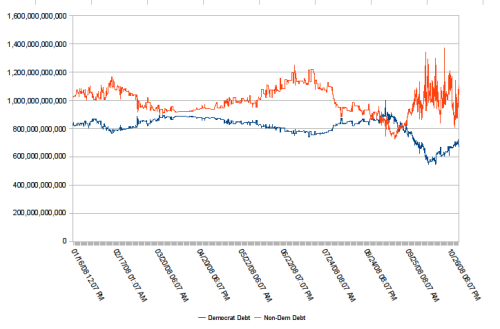
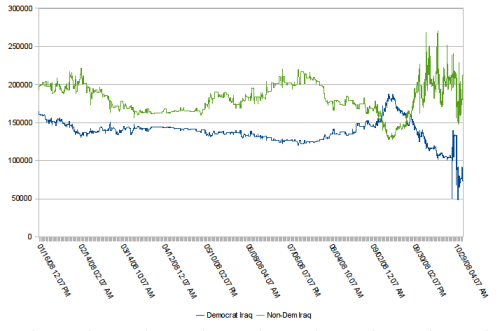
The first set was instigated and subsidized by Peter McCluskey. Two have attracted a fair amount of interest and seem to be informative. They have consistently indicated that a Democrat will result in a smaller (but still approaching US$1 trillion!) increase in the US federal government debt over one year and a smaller number of US troops in Iraq. (The others, regarding the movement of oil and interest rate futures on election day, have shown no difference between expected election outcomes.)


Above: Expected increase in US Government debt between 30 Sep 2010 and 30 Sep 2011 if party wins US presidency.


Above: Number of US troops in Iraq on 30 June 2010 if party wins US presidency.

Note that briefly in early September the contracts indicate lower debt and fewer troops in Iraq with a Republican candidate. I suspect this is due to McCain&#8217-s brief surge following the GOP convention &#8212- the implied outcomes above depend on election winner contracts, and with a much lower volume, presumably take awhile to fully respond to rapid shifts in election outcome expectations.

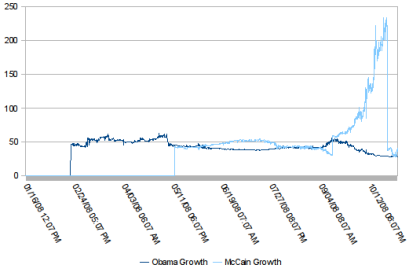
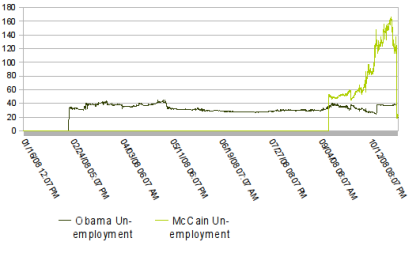
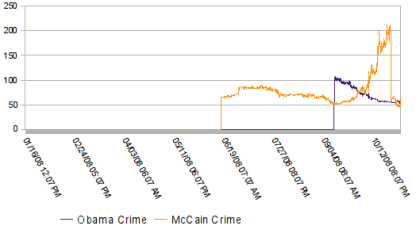
A second set of relevant contracts instigated by Polimetrics have unfortunately attracted almost no trading and probably tell us nothing. Note however they also reflect the brief McCain surge, at which point they implied a greater than 100% chance of growth, low unemployment, and lower crime with a McCain win. They have since reverted to showing essentially no difference between Obama and McCain. Note that each series only starts when there have been trades.


Above: Percent chance that economic growth averages 2.5% or more for 2009-2011 if individual wins US presidency.


Above: Percent chance the US unemployment rate is less than 5.0% at the end of 2011 if individual wins US presidency.


Above: Percent chance the number of violent crimes committed in 2010 is lower than the number of violent crimes committed in 2007 if individual wins US presidency.

Peter McCluskey has automatically updated pages showing implied outcomes for each set of contracts given their latest trades.

(I intended to make a page with frequently updating graphs, but got lazy when Peter published the aforementioned pages, and only collected the data until now, which is available in a spreadsheet.)

The proper way to predict Obamas electoral vote count

No Gravatar

I&#8217-m puzzled by the way Intrade projects the electoral vote count on its home page. Two methods are proposed: (a) add up the votes of all the states that are &#8220-leaning&#8221- (&gt-50%) for a candidate, or (b) compute a price-weighted average. The latter is obviously meaningless because electoral votes are winner-take-all in pretty much every state.

But what about the &#8220-leaning&#8221- method? Well, it only makes sense if you believe that market prices do not represent probabilities. In fact, the &#8220-leaning&#8221- method treats the 15 electoral votes from a swing state like North Carolina (65% chance to go blue) the same way it treats the 15 votes from a true-blue state like New Jersey (95% chance to go blue), tossing them both equally in the Obama column.

Now, Intrade has been known to want it both ways: interpreting its prices as probabilities most of the time, but then also claiming that it correctly predicted all 50 states in 2004 because all the contracts priced over 50% eventually expired at 100%. This claim conveniently ignores the fact that if prices are probabilities, then at least some of the states priced &#8220-red&#8221- or &#8220-blue&#8221- over 50% should in fact have gone the other way on election day.

It may very well be that, given the 2004 data, the prices of election markets (on Intrade and elsewhere) should not be interpreted as probabilities. Perhaps our academic friends can come up with another meaningful way of looking at those prices. But in the meantime, assuming the price/probability correlation holds, the proper way to project the electoral vote count from the market prices is to run monte-carlo simulations based on individual state prices.

Here&#8217-s an example using this morning&#8217-s prices on NewsFutures. The histogram shows the results of 1 million simulated elections where each state goes red or blue according to its market-derived probability of doing so. Note how the &#8220-most likely&#8221- outcome, 364 votes for Obama – which is the number the &#8220-leaning&#8221- method would report – is at the same time very unlikely with just 5% chance of happening.

Enterprise prediction markets help organizations mitigate risks.

No Gravatar

IT Business Edge – (I love the name of this magazine):

Seeking opinions from a diverse group of employees rather than just the usual decision-makers helps organizations mitigate risk, says Adam Siegel, co-founder and CEO of Inkling, Inc., a provider of prediction market software. “You want as much information as possible upfront so you can react to possible problems,” he says.

Siegel reads the 10K statements of potential clients to help identify their hot-button issues. When they express interest in the markets but wonder what kinds of questions to pose, he suggests establishing markets examining risk factors such as how pricing fluctuations affect the market for a company’s products or how acquisitions may impact the competitive landscape.

A drawback of prediction markets is that they won’t reveal the factors behind the bets. But, says Young, “If a red flag is raised about a particular issue, it’s not hard to go back and investigate” to determine the root causes of problems. “The bigger problem for most companies is they just don’t know what’s going to happen, and the red flag never goes up.”

– Excellent article.

– If you have missed our previous post, see here our little excerpt of the Forrester report.

– Adam Siegel is CEO of Inkling Markets, as you all know. His company website is very interesting to read. If you have never done it, do it right now. The general concept of prediction markets is explained, and they go down and dirty on how to set up your own enterprise prediction markets.

Would InTrade or BetFair have done a better job predicting how many people would see the Barack Obama infomercial?

No Gravatar

As I disclose on the other blog (Midas Oracle .COM), the HubDub traders wrongly thought that the (Socialist) Barack Obama informercial would have be seen by &#8220-more than 50 million&#8221-. No, no, no, no. It was 33.5 million, according to Nielsen. The HubDub traders were too optimistic.

Would the InTrade or BetFair traders have done a better job? Jesus, that&#8217-s a difficult question. Which boils down (mainly, but not uniquely) to whether some experts on TV business were quoted in the media with some predictions. To investigate that, I have run a Google News search for news articles published before October 30. I haven&#8217-t seen any expert predicting how many viewers would get that infomercial. However, here&#8217-s what I spotted in the New York Times article published in the morning preceding the airing of that infomercial:

Ross Perot, the last presidential candidate to run similar programming, broadcast eight long infomercials to an average of 13 million viewers, with one of them getting 16.5 million viewers.

Hummm&#8230- Obviously, the HubDub traders were too cocky with their &#8220-50 million&#8221- figure&#8230- but should we blame them when, obviously (too), the Barack Obama situation circa 2008 is very different than the Ross Perot situation circa 1992?

The HubDub traders were not informed by the Ross Perot history. They simply made the bet that the Barack Obama infomercial would get as many TV viewers as the Third Presidential debate got (56.5 million). They predicted in a gregarious fashion. They lost.

I don&#8217-t think that the BetFair or InTrade traders would have done better. Do you?

How many people will watch Barack Obama&#8217-s primetime address on 10/29?


2008 US electoral college: What I am betting on.

No Gravatar

PollTrack:

I like the way they color this electoral college map &#8212-with 5 colors only (simplicity is good). It is very clear and usable, I believe. You can see 6 states in gray (&#8221-too close to call&#8221-). I am heavily betting on Barack Obama for Florida and North Carolina. There will be a good payoff, next Tuesday &#8212-maybe. :-D

Price for Alabama - Florida at intrade.com

Price for New Jersey - Rhode Island at intrade.com

Who will win Florida in the 2008 Presidential Election?

Who will win North Carolina in the 2008 Presidential Election?

Explainer On Prediction Markets

A prediction market is a market for a contract that yields payments based on the outcome of a partially uncertain future event, such as an election. A contract pays $100 only if candidate X wins the election, and $0 otherwise. When the market price of an X contract is $60, the prediction market believes that candidate X has a 60% chance of winning the election. The price of this event derivative can be interpreted as the objective probability of the future outcome (i.e., its most statistically accurate forecast). A 60% probability means that, in a series of events each with a 60% probability, then 60 times out of 100, the favored outcome will occur- and 40 times out of 100, the unfavored outcome will occur.

Each prediction exchange organizes its own set of real-money and/or play-money markets, using either a CDA or a MSR mechanism &#8212-with or without an automated market maker.

Prediction markets produce dynamic, objective probabilistic predictions on the outcomes of future events by aggregating disparate pieces of information that the traders bring when they agree on prices. These event derivative traders feed on the primary indicators (i.e., the primary sources of information), like the polls, for instance. (Garbage in, garbage out&#8230- Intelligence in, intelligence out&#8230-) Armed with these bits of information, the speculators then trade based on their anticipations, which will be either confirmed or infirmed. Hence, the prediction markets (which are more than just an information aggregation mechanism) are a meta forecasting tool.

The value of a set of prediction markets consists in the added accuracy that these prediction markets provide relative to the other forecasting mechanisms, times the value of accuracy in improved decisions, minus the cost of maintaining these prediction markets, relative to the cost of the other forecasting mechanisms. According to Robin Hanson, a highly accurate prediction market has little value if some other forecasting mechanism(s) can provide similar accuracy at a lower cost, or if very few substantial decisions are influenced by accurate forecasts on its topic.

More Info:

The Best Resources On Prediction Markets = The Best External Web Links + The Best Midas Oracle Posts

More Charts Of Prediction Markets

Enterprise Prediction Markets = The wisdom of crowds comes to the enterprise.

No Gravatar

Here are short excerpts of the Forrester report on enterprise prediction markets and companies that provide software for enterprise prediction markets (e.g., Consensus Point &#8211-see the full list of providers at the bottom of this post).

The Forrester executive summary:

The &#8220-wisdom of crowds&#8221- is capturing the attention of corporate strategists across the globe, and, as a result, many are now looking to prediction markets — speculative markets in which traders collectively predict future events — to generate collective intelligence. For enterprises, prediction markets bring unique value: They focus on the future, aggregate diverse information pools that can be applied to multiple decision-making domains, create streams of actionable data suitable for executive decision-making, and can often cut through corporate politics and pressures at lower cost than traditional forecasting methods. Market researchers will, however, need to have an active hand in the management of these mechanisms, ensuring strong management support, the right incentives for traders, and a focus on appropriate questions. When executed properly, the value to the enterprise is enormous- as a result, Forrester believes that prediction markets will ultimately find a permanent home in the market research toolbox.

For information on hard-copy or electronic reprints, please contact the Client Resource Center at +1 866.367.7378, +1 617.617.5730, or resourcecenter &#8211-at&#8211- forrester &#8211-dot&#8211- com. We offer quantity discounts and special pricing for academic and nonprofit institutions.

My remark about the Forester report:

– It&#8217-s a very good document.

APPENDIX #1: Prediction Markets – DRM Review

APPENDIX #2:

Here is a list of companies that provide software for prediction markets:

Inkling Markets – (MSR + AMM)

NewsFutures – (CDA + optional AMM + SR)

Consensus Point – (CDA + MSR + AMM)

Xpree – (MSR + AMM)

Zocalo – (CDA + MSR + AMM) – (open-source)

Nosco – (CDA + MSR + AMM)

QMarkets – (MSR + AMM)

Ask Markets – (MSR + AMM)

Exago Markets – (CDA + optional AMM)

Gexid – (?)

ProKons – (?)

Spigit – (?)

HSX Virtual Markets – (Virtual Specialist + AMM)

HubDub – (MSR + AMM) – (not licensed)

Yahoo!&#8217-s Prediction Exchange – (MSR + AMM + DPMM) – (not licensed)

Google&#8217-s Prediction Exchange – (CDA) – (not licensed)

MicroSoft PredictionPoint – (MSR + AMM) – (not licensed)

InTrade – (CDA + AMM for play money) – (not licensed)

TradeSports – (CDA + AMM for play money) – (not licensed)

Iowa Electronic Markets – (CDA) – (not licensed)

HedgeStreet – (CDA) – (not licensed)

TradeFair – (CDA) – (not licensed)

BetFair – (CDA) – (not licensed)

Trading Technologies International – (CDA) – (not for event derivatives)

Here&#8217-s a list of prediction market consultants:

Robin Hanson – (George Mason University, Virginia, U.S.A.)

  • Robin Hanson does prediction market consulting work, and have no exclusive arrangements.
  • &#8220-I&#8217-m more interested in helping groups that want to add lots of value to big decisions, versus groups that just want to dabble in a new fad.&#8221-

Inkling – URL: Inkling Markets – (Chicago, Illinois, U.S.A.)

  • Adam Siegel
  • Nathan Kontny

NewsFutures – (Maryland, U.S.A. &amp- Paris, France, E.U.)

  • Emile Servan-Schreiber — Post Archive at Midas Oracle
  • Maurice Balick

Consensus Point – (Nashville, Tennessee, U.S.A. &amp- Calgary, Alberta, Canada)

  • David Perry
  • Ken Kittlitz, who co-founded the Foresight Exchange in 1994.

Xpree – (California, U.S.A.)

  • Mat Fogarty

Chris Hibbert – (California, U.S.A.)

  • Chris Hibbert (Software architect / Zocalo project manager) — Post Archive at Midas Oracle
  • Chris Hibbert&#8217-s personal website — Chris Hibbert&#8217-s personal blog —
  • Chris Hibbert&#8217-s CommerceNet profile — (His stint there ended in mid 2006.)

Justin Wolfers – (University of Pennsylvania&#8217-s Wharton Business School, Pennsylvania, U.S.A.)

  • Justin Wolfers takes on prediction market consulting work.
  • The prediction market industry is &#8220-a case where the interaction between firm practice and academic research are reasonably close.&#8221-

Koleman Strumpf – (University of Kansas, Kansas, U.S.A.)

  • Koleman Strumpf — Post Archive at Midas Oracle
  • Koleman Strumpf can be approached to consult on prediction market projects.
  • &#8220-Prediction markets help harness the knowledge of diverse groups. They have great potential as a tool for industry.&#8221-

Nosco – (Danemark, E.U.)

  • Jesper Krogstrup
  • Oliver Bernhard Pedersen

Qmarkets – (Israel)

  • Noam Danon

Ask Markets – (Greece, E.U.)

  • George Tziralis — Post Archive at Midas Oracle

HP Services &amp- HP Labs – (U.S.A.)

  • Predicting the future &#8211-with games — Introductory article
  • Information Dynamics Lab — Internal prediction markets
  • BRAIN – (Behaviorallly Robust Aggregation of Information in Networks) — Scoring Rules (i.e., non-trading technique)
  • Bernardo A. Huberman – Bernardo Huberman – Senior Fellow &amp- Director
  • Kay-Yut Chen –
  • Google Search for &#8220-prediction markets&#8221-

Hollywood Stock Exchange (HSX) &amp- HSX Research – (L.A., California, U.S.A.)

  • Prediction market consultancy firm
  • Movie business

IntelliMarket Systems – (L.A., California, U.S.A.)

  • Charles R. Plott – Charles Plott – (CalTech Inst., California, U.S.A.)

Gexid – Global Exchange for Information Derivatives – (Germany, E.U.)

  • Bernd Ankenbrand — Post Archive at Midas Oracle

ProKons – (Germany, E.U.)

  • Peter Gollowitsch

Exago Markets – (Portugal, E.U.)

  • Pedro Da Cunha

NimaniX – (Israel)

  • Elad Amir (CEO), Littal Shemer Haim (VP Business development), David Shahar (VP R&amp-D)

Michael Giberson – (Texas, U.S.A.)

  • Michael Giberson (Energy Economist – Center for Energy Commerce, Rawls College of Business, Texas Tech University) — Post archive at Midas Oracle
  • Knowledge Problem – Blog on economics, energy policy, more.

Other Consulting Firms

McKinsey – (U.S.A.)

  • Google Search for &#8220-prediction markets&#8221-
  • The Promise Of Prediction Markets – by McKinsey – 2008-04-XX

Accenture – (U.S.A.)

  • Google Search for &#8220-prediction markets&#8221-

Gartner – (U.S.A.)

  • Google Search for &#8220-prediction markets&#8221-

Forrester – (U.S.A.)

  • Google Search for &#8220-prediction markets&#8221-
  • Prediction Markets: Wisdom Of The Crowd Comes To The Enterprise. – 2008-07-14

The Boston Consulting Group – (U.S.A.)

  • Google Search for &#8220-prediction markets&#8221-

CapGemini – (U.S.A.)

  • Google Search for &#8220-prediction markets&#8221-

KPMG – (U.S.A.)

  • Google Search for &#8220-prediction markets&#8221-

Price Waterhouse Cooper – (U.S.A.)

  • Google Search for &#8220-prediction markets&#8221-

Ernst &amp- Young – (U.S.A.)

  • Google Search for &#8220-prediction markets&#8221-

Deloitte – (U.S.A.)

  • Google Search for &#8220-prediction markets&#8221-

IBM – (U.S.A.)

  • Google Search for &#8220-prediction markets&#8221-

EDS – (U.S.A.)

  • Google Search for &#8220-prediction markets&#8221-