Beware before citing the probabilistic predictions given by the prediction markets

No Gravatar

Steve Roman:

It’s good to see Intrade cited as authoritative but I don’t think the recession contracts have enough liquidity to accurately reflect the odds. Citing a contract price when there is only a small amount of liquidity is one issue the MSM does when the number may not be credible. Some others that come to mind:

1. Thinly traded contracts may not reflect true odds – For instance, the contract for the US entering a recession in 2008 is now trading at 31. A pundit may cite this as a 31% chance of the US entering a recession in 2008, but he would not note that there is a 10-point spread around that price, so that by trading one lot, the odds will change by 5 points up or down. It would be a meaningless move – or would it? In such a thin market it impossible to tell.

2. Contract rules are importantWill Larry Craig resign? Did a missile leave NK airspace? The contracts for these events were based on rules that could be interpreted to have the opposite meaning of what most people would assume they do.

Even with Intrade’s recession contracts the details are important. The contracts will pay off when there are two consecutive quarters of negative GDP growth. That’s easy to understand, but is only one definition of recession. In the US a recession starts when the NBER says it does, making it possible for the GDP definition and contract odds to show we are not in a recession as the NBER declares we are. Not a major issue, but one that should be disclosed.

3. Timeframe should be noted – US News is the latest violator of ignoring time frames when discussing price changes, http://www.usnews.com/blogs/capital-commerce/2007/10/16/recession-odds-continue-to-fall.html . When talking about price changes it is necessary to talk about the time period over which the changes occurred. Did the odds of a recession decline from 60% to 30% within the past week? The past month? Not citing a timeframe or including a chart means I have to go back to Intrade to check on my own.

Steve Roman&#8217-s blog: Nasty Brutish And Tall

How do prediction markets benefit our society?

No Gravatar

KansasCity.com (page two):

[…] To advocates such as business professor Justin Wolfers, people can better plan their lives, their purchases and their businesses by knowing how much investors are willing to wager that, for example, mortgage rates drop.

It’s an empirical question, not a theoretical one: Does the market do better than polls or pundits in predicting outcomes? The short answer is yes,” said [Justin] Wolfers
, of the University of Pennsylvania’s Wharton School. […]

Previous blog posts by Chris F. Masse:

  • IIF’s SIG on Prediction Markets
  • Science
  • Why did prediction markets do well in the pre-polling era, professor Strumpf?
  • Mozilla FireFox users, do you have trouble downloading academic papers (as PDF files) from SSRN?
  • “Impact Matrix. Used to collect and gauge the likelihood and business impact of various events in the very long term.”
  • Ends and Means of Prediction Markets — Tom W. Bell Edition
  • How to run enterprise prediction markets… legally

Is WeatherBill doing well, really??

No Gravatar

WeatherBill does so well that TechCrunch has just published two &#8211-yes, two&#8211- blog posts on it, today (Wednesday, October 17, 2007). Here&#8217-s the first one, which basically says that two VCs have just poured $12,5 million dollars in it. Good for them. The second blog post, written by another TechCrunch writer, and which has been quickly taken off their website, basically said the same, but with this twist:

CEO David Friedberg says that WeatherBill has hundreds of customers and faces such high demand that it needs to bring more people aboard to increase capacity. The site has launched not only in the US but Canada, the UK, the Netherlands, Spain, Germany, and Norway as well.

So, should we believe the content of this now-deleted blog post? Or was it deleted because this information is not accurate? Mystery. ValleyWag should investigate. :-D

APPENDIX: Here&#8217-s the deleted TechCrunch blog post on WeatherBill. (The second item that follows is the first blog post that was published by TechCrunch.)

Deleted TechCrunch WeatherBill

&#8212-

UPDATE: VentureBeat on WeatherBill&#8230-

VentureBeat on WeatherBill

UPDATE: Mark Hendrickson of TechCrunch&#8230-

Our apologies for misleading everyone into thinking Weatherbill enables people to gamble the weather as if it were a casino game. The service is meant rather to provide insurance for companies that could be aversely affected by fluctuations in the weather.

Weatherbill’s CEO informs us that only companies with a net worth of at least $1 million can participate due to regulations of the Commodity Futures Trading Commission. He also says that Weatherbill is the first service to ever provide access to hedges on the weather (online or otherwise).

Also, for anyone wondering why we had two posts up about this story, that’s because Duncan and I reported on it independently by accident. I guess you could say we both find the weather very interesting.

InnovateUs = Prediction Markets??

No Gravatar

InnovateUs:

Leveraging The Prediction Market

In a traditional stock market stocks are listed for corporations- and people buy and sell these stocks. The decision to buy or sell is based on the percieved performance of the stock in the future. If you think the profits are going to rise you will buy and if you think the profits are on a decline you would sell.

In the InnovateUs Idea Market stocks are listed for ideas and innovations. If you like an idea and you think the idea has a likely chance of getting accepted within your organization, buy the stock for the idea. The better the idea, more stocks you purchase. The total investment in a stock indicates the overall opinion about the idea.

[…] The anonymous Idea creation gave participants the required impetus to freely suggest ideas without fear of embarrassment and negative repercussions. Seeing the opportunity to win some incentives, participants invested their money wisely. In the end, the management ended up with a ton of great ideas and opinions to guide their decisions. […]

Is that &#8220-prediction markets&#8221-, really!??

Prediction markets dont solve the crystal-ball problem when it comes to the long-term future.

No Gravatar

– Crowdsourcing The Crystal Ball – by Forbes&#8217-s James Surowiecki – 2007-10-15

[…] So what&#8217-s the catch? Only this: We&#8217-re still not sure how far into the future prediction markets can really look, or whether they&#8217-re going to be able to foresee the kind of world- or business-altering events that Tetlock, for instance, asked his experts about.

So far, prediction markets&#8217- track record has been built on predicting events that will occur in the near future, and where the range of variables that might determine that future is reasonably small and well defined. (Elections, sales forecasts and product launch dates all fall into this category.) But prediction markets haven&#8217-t, for the most part, been used to try to predict things like the fall of the Soviet Union, and so it&#8217-s not clear whether a market would really be able to foresee events that represent a dramatic break with the past, rather than an evolution from it.

This hardly means that prediction markets are of little use: The kind of forecasting problems that these markets are good at are fundamental to any business. Using prediction markets internally should have a beneficial effect on a company&#8217-s bottom line.

But it is fair to say that we don&#8217-t know enough yet to say that prediction markets really solve the crystal-ball problem when it comes to the long-term future. What we need now is to start using prediction markets to ask bigger questions, which will eventually help us understand what the problem with forecasting really is: Is it how we&#8217-re trying to predict the future? Or is it that we&#8217-re trying to predict the future at all?

What do you guys/gals think? I&#8217-d go with the idea that it&#8217-s quite impossible to use prediction markets to forecast the long-term future.

Great quote for the prediction markets faithful

It&#8217-s the same each time with progress. First they ignore you, then they say you&#8217-re mad, then dangerous, then there&#8217-s a pause and then you can&#8217-t find anyone who disagrees with you.

&#8211- Tony Benn

Cross-posted from Caveat Bettor.

Read the previous blog posts by Caveat Bettor:

  • The Democrat SC Showdown: Intrade v. Zogby
  • Zogby beats Intrade in predicting Nevada caucus winner Clinton.
  • The GOP SC and Dem NV Showdown: Intrade v. Zogby
  • Latest Intrade v. Zogby contest is up.
  • Who said prediction markets were perfect?
  • Intrade markets and Zogby polls agree in New Hampshire
  • The Iowa Showdown: Zogby v. Intrade

Inferring market expectations from changes in fed funds futures prices

No Gravatar

I recently completed a new research paper studying how interest rates of different maturities change with market expectations of what the Fed is going to do next.

Settlement on a fed funds futures contract is based on the average effective fed funds rate over each of the calendar days of a specified month. If a month contains N calendar days and rt denotes the effective fed funds rate on date t, settlement of the contract is based on the value of

(r1 + r2 + &#8230- + rN)/N.

My latest research paper uses just the spot-month contract, whose payoff is based on what the current month&#8217-s average fed funds rate turns out to be. Suppose that the Fed raises the target by 50 basis points on the 16th day of a month containing N = 30 calendar days. If the target change doesn&#8217-t alter the fed funds rate for days 1 through 15, it would only raise the average effective rate over the month by 25 basis points, since half the observations that go into the average would be at the lower rate. If market participants had previously been assuming there would be no change at all, and then learned on some day t early in the month that the change was coming on the 16th, we would see the fed funds futures rate move on day t by 25 basis points, even though the market knows a 50-point hike is coming, as a consequence of the averaging. If we wanted to infer the change in the market&#8217-s expectation of the fed funds target from the change in the spot-month contract, we would need to multiply the observed spot-month contract change by 2. In general, for a month in which the target change, if it occurs, will come on day n of the month, a paper by Oberlin Professor Ken Kuttner published in the Journal of Monetary Economics in 2001 used such reasoning to propose that the change in the market&#8217-s expectation of the target might be measured by

(DF)(N)/(Nn + 1).

where DF is the observed change in the spot-month contract.

There are a couple of concerns that Kuttner and others have raised about this expression, however. For one thing, it does not take into account the fact that the effective fed funds rate (on which the futures contract payoff is based) is not exactly the same as the target rate itself. There are often quite significant deviations towards the end of the month, and the formula above would severely amplify this end-of-month measurement error. Furthermore, although there are some months when everybody knows exactly when the change, if there is to be one, is going to occur, there are also other months where we really don&#8217-t know, and some times when a target change did occur but was not announced, and the market did not immediately realize it. We speculated here at Econbrowser as to whether this could have happened this August, and a paper by Poole, Rasche, and Thornton discusses a number of other historical episodes.

My latest paper generalizes Kuttner&#8217-s formula in three directions. First, I explicitly model deviations between the effective rate and the target, and show how to modify the formula to take into account this measurement error. Second, I take the view that markets may be gradually learning about the target change well before it actually occurs. And third, I ask what the data would look like if the econometrician does not assume to know the exact date on which the target was changed.

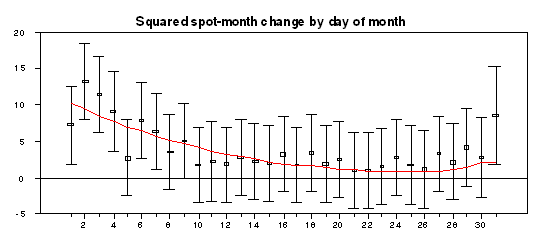
These modifications imply a certain pattern for the volatility of daily changes in the spot-month futures contract over the days of the month. The volatility generally should decline during the month, as uncertainty becomes resolved as to what this month&#8217-s target is going to be, but then increases again a bit at the end of the month due to the greater volatility of deviations of the target from the actual on those days:
kuttner1.gif

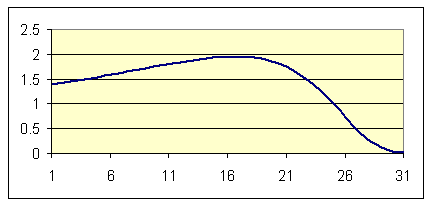
On the basis of the observed volatility of fed funds futures and the effective fed funds rate, the framework then implies a generalization of the Kuttner weights one should use to multiply an observed change in the spot-month futures contract to infer the change in the market&#8217-s expectation of the target. The relation is not monotonic. The ideal weight initially increases as one gets farther into the month, for the same reason as the original Kuttner formula. But it then starts the decrease in the last third of the month, because it is more likely that spot-month changes on those days are driven by noise in the effective fed funds rate rather than news about the target itself.
kuttner2.gif

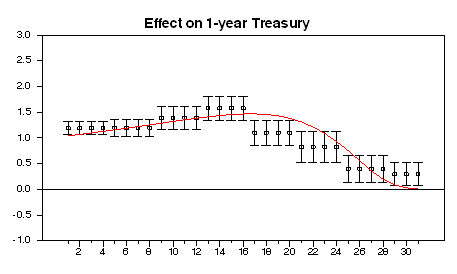
The model then implies a prediction as to what sort of response one should see of an interest rate such as the 1-year Treasury yield to a given change in the spot-month contract. Since it is the target itself, and not deviations between the effective rate and the target, that will matter for longer term yields, the coefficient from a regression of the change in yield on the spot-month change should show exactly the same calendar pattern as the figure above. The following figure reproduces the predicted pattern (the smooth red line), as well as the actual estimated coefficients when days of the month are grouped into octiles based on calendar date. The prediction seems to fit the facts reasonably well.
kuttner3.gif

One thing we obtain from such calculations is an estimated average extent to which interest rates of various maturities respond to news about what the Fed is gong to select for the target for the current month. I found that a 10-basis-point increase in the expected target was on average associated with a 6- or 7-basis-point increase in Treasury yields at horizons up to 3 years, and a 4-basis-point increase even for a 10-year horizon. Although the methods and data sets are rather different from those of earlier researchers, these estimates are very similar to those obtained by earlier researchers. The consistent finding in this literature has been that changes in Fed policy have surprisingly long-lived consequences.

MaturityResponse
3 months0.66
6 months0.71
1 year0.75
2 years0.68
3 years0.64
10 years0.43

Cross-posted from EconBrowser.

Could prediction markets help our society to become more truthful?

No Gravatar

[…] [About the Iraq war] – “There is no question that America is living a nightmare with no end in sight,” retired Lt. Gen. Ricardo Sanchez told a convention of military journalists on Friday. […]

But why didn&#8217-t he come forward before, then?

[…] Asked why he did not speak out about his concerns, Sanchez said general officers take an oath to carry out the orders of the president while in uniform. “The last thing that America wants, the last thing that you want, is for currently serving general officers to stand up against our political leadership,” he said. However, general officers do have the option of stepping down if they disagree with the country&#8217-s leaders. Sanchez said he felt he could not resign and go public with his reservations while he was in Iraq, because he feared that move could further jeopardize troops serving there. “I think once you are retired, you have a responsibility to the nation, to your oath, to the country, to state your opinion,” he said.

Associated Press:

Retired Lt. Gen. Ricardo Sanchez

We can&#8217-t rely on retirees to tell us the truth. We need an anonymous information aggregation mechanism that gives an incentive to people who come forward with advanced information: the prediction markets.

Have Betfair ever extended a ?1m credit line to Harry Findlay?

No Gravatar

Asked the lawyer representing one of the defendants in the Fallon case. For your information, &#8220-Harry Findlay&#8221- is the name of a &#8220-high-profile, high-staking punter who has never been connected with the case.&#8221- Why is it that his name is brought into the courtroom, then?? Bizarre. There is something they know and we don&#8217-t, obviously.

The link is from Niall O’Connor.

UPDATE: More from the Beeb.