
The worst US economic recession in 50 years
Reply

Feed readers: Download this post to be able to watch this CBS 60 minutes video on the credit crisis.
–
Watch CBS Videos Online
– Text of Draft Proposal + NYT explainer
– Conrad Black’-s take on the financial meltdown
– Takes from 3 economists
– More links here. More links, again.
– UPDATE: Paul Krugman says the plan does not address the real problem.
– UPDATE: More Krugman
Some are saying that we should simply trust Mr. Paulson, because he’s a smart guy who knows what he’s doing. But that’s only half true: he is a smart guy, but what, exactly, in the experience of the past year and a half — a period during which Mr. Paulson repeatedly declared the financial crisis “contained,” and then offered a series of unsuccessful fixes — justifies the belief that he knows what he’s doing? He’s making it up as he goes along, just like the rest of us.
Exactly.

The most credible explanation of why risk management based on state-of-the-art statistical models can perform so poorly is that the underlying data used to estimate a model’s structure are drawn generally from both periods of euphoria and periods of fear, that is, from regimes with importantly different dynamics.
–
FOLLOW UP
–
Since Halloween, financial markets seem to be getting spooked again.
Larry Kudlow writes:
Until recently, I thought the Fed could stand pat at their December 11th meeting. However, I have completely changed my mind in light of the continuing credit market turbulence.
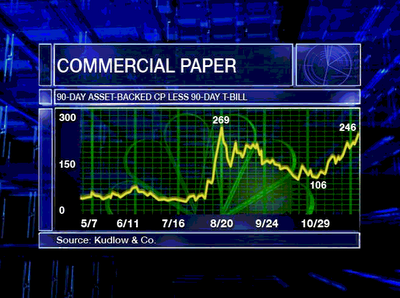
Kudlow notes that the spread between 30-day asset-backed commercial paper and U.S. Treasuries, which spiked up dramatically after August’-s liquidity events but subsequently eased back down, climbed back up during November to the neighborhood of its previous high.
 |
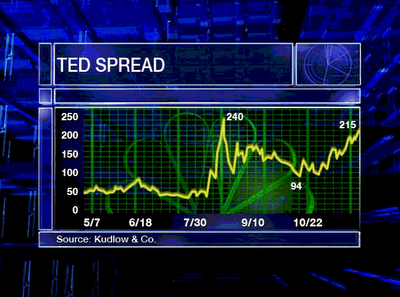
The same is true of the spread between the London interbank offered rate and Treasuries.
 |
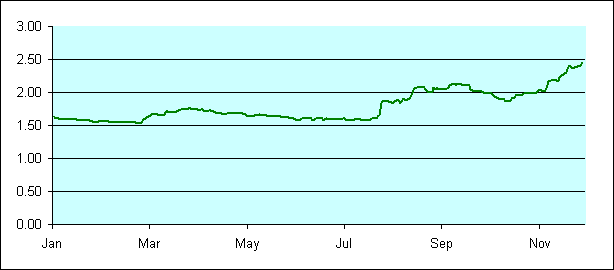
One of the features of the initial financial turmoil on which I commented last August is that it seemed to be confined specifically to the financing of problematic securities, but was not showing up as a broader risk premium in something like the spread between Baa-rated corporate bonds and 10-year Treasuries. But the latter spread has made a significant move up over the last month, and now stands 80 basis points higher than in July.
 |
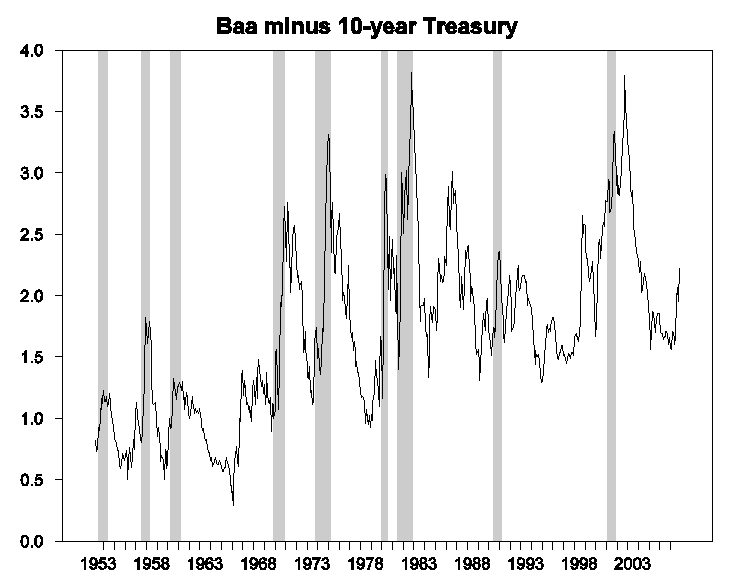
A sharp upward move in the Baa-Treasury spread is often associated with the early stages of an economic downturn, as the following longer-term perspective using monthly data illustrates:
 |
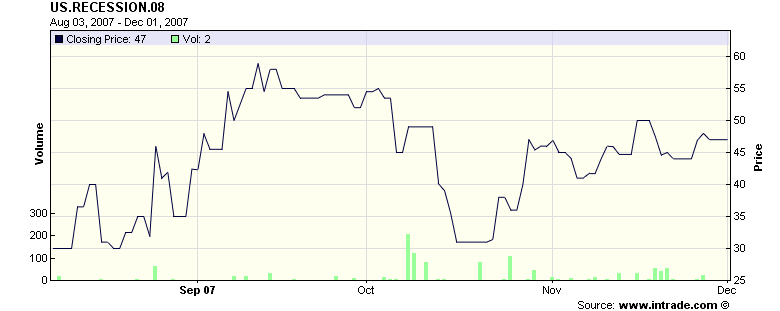
For what it’-s worth, bettors at Intrade also seem to believe that the risk of a U.S. recession during 2008 has crept up since mid-October.
 |
Cross-posted from Econbrowser.