An Email Interview: Alex Kirtland

No Gravatar

(A note from AK: So, in case you haven&#8217-t noticed, Chris has proposed email interviews as a way to get a bit more participation on MidasOracle. I&#8217-m happy to start off by answering his questions to me.)

Chris Masse: What is the best public explanation of prediction markets? As &#8220-stocks&#8221- (Hollywood Stock Exchange, Washington Stock Exchange), as &#8220-event futures&#8221- (InTrade), or as &#8220-event derivatives&#8221- (HedgeStreet)?

Alex Kirtland: Considering that most people have probably never heard of derivatives, that most of the rest don&#8217-t know much about futures, and that almost everyone has heard of the stock market, I&#8217-m going to say that treating prediction market contracts as stocks is probably the best way to go for the general user.

For example, saying &#8220-They&#8217-re like stocks, but different,&#8221- is easier for most people to understand than: &#8220-You&#8217-re buying a futures contract on the likelihood of an event occurring that pays out either 0 or 100 depending on the result.&#8221-

Starting with something familiar, and then introducing complexity, rather than trying to be accurate right off the bat, is usually a better way to go.

That said, if the majority of your users are traders in pork belly futures, then using the stock market as your metaphor to explain prediction markets may just confuse them.

CM: What is the best trading model from a usability perspective: one single class of securities ala TradeSports (where selling means short-selling the &#8220-yes&#8221- contract) or two classes of securities ala Iowa Electronic Markets (where selling means selling the &#8220-no&#8221- contract)?

AK: I don&#8217-t know the answer to that, and I&#8217-ve actually pondered over this for some time. I&#8217-d like to do usability testing/user research to try and figure this out. Just from an academic point of view I think understanding this would be fascinating. But also I think that this has implications beyond prediction markets. Certainly brokerage houses and exchanges might be interested in understanding how to make trading easier for people who may not know how to trade, or are less familiar with trading.

My hunch is that both models work (in fact both models do work), but which one is better is a question of context – who is the user- what is their experience trading- what is the market- is margin involved- if so, how do we communicate that to the user- and so on.

I know there is a large body of research on behavioral economics, which I&#8217-m not as familiar with as I should be, but I don&#8217-t believe anyone has ever researched this specific question.

CM: What is the best pricing model from a usability perspective: a continuous price (HSX) or a 0-100 price (TradeSports)?

AK: It depends on the situation. Sometimes they&#8217-re clearly inappropriate – a linear contract for a binary question, for example. One is not inherently more usable than the other. It&#8217-s more important how it&#8217-s presented to the user.

CM: Should the designer of a new trading screen be innovative or be subordinated to the users&#8217- mental model (if any)?

AK: This is a fascinating question. First understanding a mental model and being innovative are not incompatible things. The mental model is usually a starting point from which innovation can spring forth. This is why you do user research: so you can understand how your users think (or even if they do) about the task you want them to perform.

So, it&#8217-s not so much that innovation (or, better, interface design), is subordinate to the user&#8217-s existing mental model(s), but how do you take advantage of an existing mental model(s) to get the user to more easily do what you want them to do on your site.

Secondly, a lot of readers are probably asking, &#8220-what the hell is a mental model?&#8221- Briefly (and quite vaguely), a mental model is a mental representation of something. For example, most everyone has a mental model of how a restaurant works. You go in, there may be a host, you sit, you order, they bring you food, you eat, you agonize over whether you&#8217-re going to get desert or not, you pay, and then you leave.

There&#8217-s a lot of subtlety to this mental model. Things can change drastically depending on whether you&#8217-re at a diner, a food cart on the street, or a five star restaurant. But the basic process is the same.

It&#8217-s important to note, though, that in and of itself a mental model has nothing to do with the interface of an application. It is usually a hodge podge of heuristics, tasks and sub tasks, and so on, all jumbled together. They don&#8217-t necessarily need to be a true representation of the world, but they need to help the person act in the world.

Referring to the above example, my mental model of a restaurant allows me to go to all sorts of restaurants I&#8217-ve never been to before, have appropriate expectations about what will happen there, and act accordingly.

As an experience designer we&#8217-re not necessarily interested in shaping our interfaces to someone&#8217-s mental model – we don&#8217-t want all interfaces to be exactly like McDonalds – but we do want to be aware of them and take advantage of them &#8230- and not violate them either. We don&#8217-t want to build a restaurant and not serve any food, for example. Once you violate someone&#8217-s mental model of some thing, then they&#8217-ll have no idea what to do next.

Donald Norman&#8217-s book, The Design of Everyday Things, is a good place to learn more about mental models and how they should used when designing an inteface.

CM: Should prediction exchanges set up corporate blog(s) and why? (And if &#8220-no&#8221-, why not???)

AK: Trendio, The Public Gyan, and TradeSports, for example, actually use their blogs quite nicely. These blogs, generally speaking, tell people about contract expirations, changes in margin, new contracts, and so on. They&#8217-re very useful to the people who trade on these sites.

Other prediction exchange corporate blogs are nothing more than self-promotion. That&#8217-s not a bad thing, but it&#8217-s less useful for traders on the site, and more useful for the person promoting the site (or the blogsters covering that site).

Prediction exchange blogs shouldn&#8217-t be treated differently than any other blog: they should publish on a timely basis, and write about something that is of interest to their users. If they can&#8217-t manage that, then they shouldn&#8217-t keep the blog.

One way or the other

No Gravatar

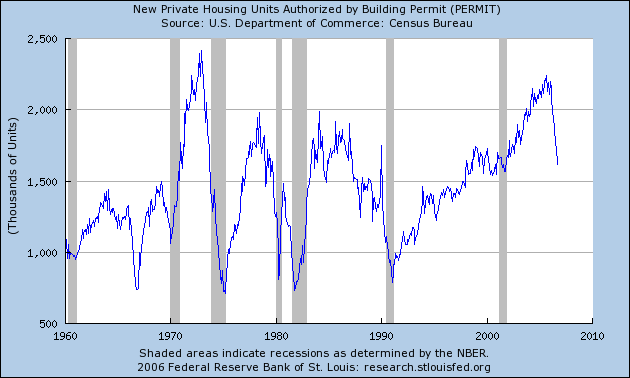
Something for everyone in this week&#8217-s data on housing from the Census Bureau. Pessimists will note the alarming 6% plunge during the month of September in seasonally adjusted new building permits. That one-month drop from the already low levels of August leaves them down 28% from September 2005. News this week of rising delinquencies and foreclosures provides more fuel for the pessimists&#8217- fire.

permits_oct_06.png

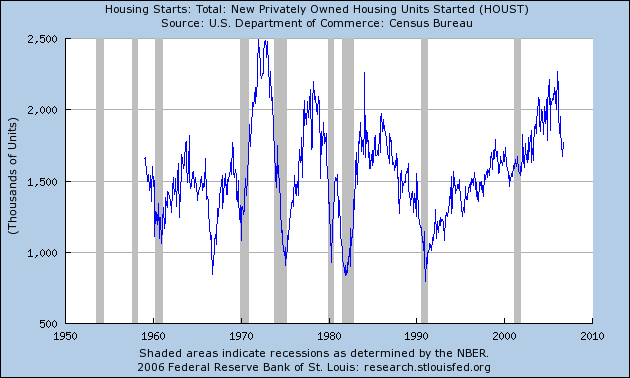
Optimists, on the other hand, might see new evidence that the housing bottom has been reached in the encouraging move in the number of new housing units started. This was up 6% from August to September, though still down 18% year to year:

starts_oct_06.png

For those of us who were unsure before this week, we&#8217-re stuck in the same rut at the end of the week. The effect of this summer&#8217-s drop in mortgage rates should start to show up in next month&#8217-s home sales, and we&#8217-ll have to wait to see if that effect is sufficient to outweigh the possible dynamics from financial distress and rapidly changing expectations.

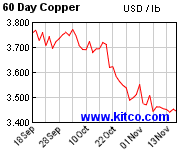
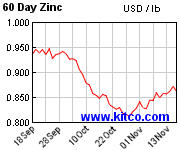
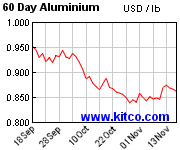
The optimists seem to be winning the argument as far as commodity markets are concerned. Commodity prices had been battered down as the dismal housing data came in during September. But over the last two weeks, copper, zinc, and aluminum have surged back up dramatically. It may be that the only way these prices will be kept in check is if GDP growth stays below 2% for the coming year.

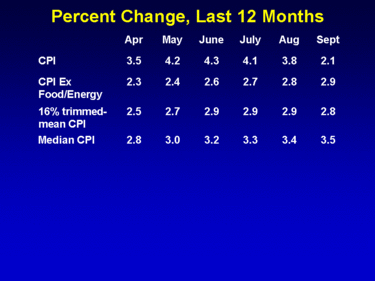
And although the headline CPI showed a dramatic 0.5% drop within the month of September alone, Dave Altig is none too impressed, noting that more robust measures such as the median CPI are still up 3.5% year-to-year:

inflation_oct_06.gif

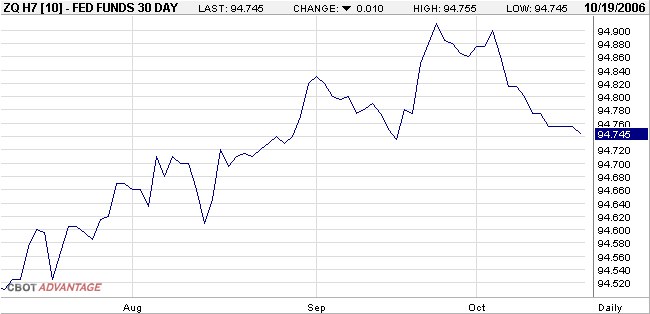
Mixed (as opposed to really bad) news for housing and &#8220-unwelcome&#8221- news on core inflation have eroded the likelihood that we will see the Fed cut interest rates by spring. Here&#8217-s the recent behavior of the March 2007 fed funds futures contract (subtract from 100 to get the implied interest rate):

march_ff_oct_06.png

At the start of this month, traders had been betting on a 5.0% rate (a cut of 25 basis points from the current value) by March. Those hopes have now evaporated, with the current consensus for a prediction of no change.

I&#8217-m wondering though whether &#8220-no change&#8221- might be the least likely outcome at this point. If we start to see some serious financial repercussions develop in housing, I&#8217-d look for a rate cut, and wouldn&#8217-t worry in that event about commodity prices, since I would expect to see commodities fall sharply on news of a big downturn in economic activity. On the other hand, if instead we have seen the bottom for housing and the core inflation numbers remain this high, I&#8217-d look for the Fed to tighten further.

Either way, you might want to exercise some caution before thinking you&#8217-ll pick up some homebuilder equities at these bargain prices.

Did the Korean Bomb help the Republicans?

No Gravatar

The biggest event in the news yesterday was the test of Korean Atomic Bomb, and it was bound to have political repercussions.

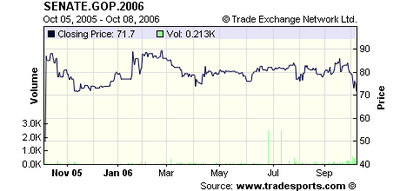
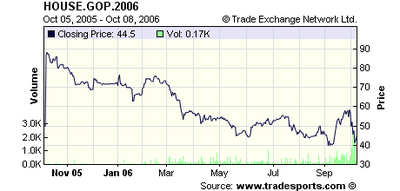
TradeSports has two contracts that measure the chances of GOP control after the November election- the SENATE.GOP.2006 and the HOUSE.GOP.2006.

These were both down yesterday by unusually large magnitudes given their recent volatility.

There was no other particularly bad news regarding the Republicans yesterday, hence I believe that effect of the bomb on the GOP was negative.

Odds of GOP Retaining Congressional Control

No Gravatar

A recent comment to yesterday&#8217-s Citibank Panic/Euphoria discussion led to this post being inserted in the weekend linkfest:

According to Tradesports, the odds of the Republican Party retaining control of each Congressional House in the 2006 Mid Term Election is mixed.

In the Senate, only one third of the 100 seats are up for re-election. Votes are staggered, so every 2 years a different third of the 6-year term seats come up. The odds strongly favor GOP retention of the Senate. The Democrats would need to capture 6 seats, something previously viewed as rather unlikely &#8212- not impossible, but unlikely.

Although several races have tightened, this remains a long shot for the minority party. The MSM is, as always, focused on the horse races but not the issues. See Race for Senate control tightens for example.

When we go to the most recent betting on the outcomes, the senate appears to be rather safe. Using trend or technical analysis, we see the GOP retention of Senate has been consistently above 70%- It has recently dipped as Tennessee and Virginia &#8212- formerly &#8220-safe seats&#8221- &#8212- have become competitive. But it would take a significant break of 70 to suggest this was anything but a long-shot.

Senate Trading

Ts_senate

via Tradesports

When it comes control of the House, however, the prediction markets present a very different picture. All 435 seats are up for grabs.

Its also one that lends itself even more to TA:

Ts_house

via Tradesports

From last November til today, we see a fairly well maintained down trend. Recently, that was almost reversed on an increase in volume since hitting lows of 40% in September. That was most likely the result of a 30% drop ingasoline prices, a 20+% in Crude Oil prices, and a strong post summer rally in the stock markets.

However, the Foley/Page scandal has now reversed that. On even bigger volume, the downtrend has been maintained, and the House odds are once again near low 40s.

If the election were held today, the Senate would stay GOP, while the House would shift to the Democrats.

~~~

There is one additional note: I have long complained that the relative thinness of these markets &#8212- the number of traders and the dollar amounts at issue &#8212- can make their results somewhat suspect. For more on this, see our 2004 critique, Iowa and Prediction Markets.

How important will the Unlawful Internet Gambling Enforcement Act be? Markets think pretty important.

No Gravatar

With news that the Unlawful Internet Gambling Enforcement Act has passed the House, all eyes seem glued on Washington to see just how regulation of online gaming is going to change the industry.

Looking at stockmarket reactions, it seems pretty serious.

From today&#8217-s Guardian:

The online gaming industry&#8217-s bet that American legislators would never get around to outlawing internet games such as poker went spectacularly wrong yesterday. An estimated ?4bn was wiped off the sector&#8217-s value as share prices crashed after a weekend ambush by Washington.

Full story: http://www.guardian.co.uk/frontpage/story/0,,1886369,00.html.

I have already heard of at least one major bookmaker – Australian-based Centrebet (www.centrebet.com.au) – already closing the accounts of US-based clients.

While these early stock-market reactions look pretty serious, my guess is that these sorts of laws tilt the competitive landscape away from the larger more legitimate operations (like those public companies based in London), and toward the smaller (and more legally &#8220-agile&#8221-) firms operating in a less transparent manner. So perhaps this stockmarket reaction somewhat overstates the impact.

Stay tuned for more&#8230- (Hat tip: Paul Tetlock and Sam Savage.)