A Big Traders Open Letter to TradeSports-InTrade

No Gravatar

Dear TEN Management:

I have decided to write you one final email in an attempt to discuss with you the problems that are existing on your websites, which continually go unacknowledged by your entire staff. The events of Monday evening have now pushed me to this point to try one last time to get a response from you. You will notice some attached forum posts in my email, and any emails that I reference are available to you. I will be happy to forward them to you if you&#8217-d like.

In the past 9 months, I have learned to use your site and become quite an avid trader. My trading volume must easily rank in the top traders on your combined websites. I trade sports and financials. However, the only thing that I now like about your website is strictly the concept of it. The unresponsiveness of the management and the disregard for the customers is alarming.

On this past Monday evening, the SMC/USF game was a live featured event. The forum reference for this issue is (http://forum.tradesports.com/eve/forums/a/tpc/f/809603632/m/3621061412). With one minute to go in the game, the exchange was closed for maintenance. The game was a 9 point game with a 5.5 spread. The game was an 8 point game with under 30 seconds to go, and the spread was totally in play. I first dialed your 1-866 phone #, and got no live help, I then sat waiting for live help via the internet and got no response even though I was first in line for over 5 minutes. Luckily for me, the game ended in my favor and the $2200 that I had at risk was credited back to my account. If you question my intention to trade in the last 1 minute of the game, let me include my trade lines from World Sports EXchange:
02/20/2007 02:06:18 Sell 10 CB-02-19-07-M1 ST MARYS -5.5 $90 Complete Fill
02/20/2007 02:06:23 Sell 4 CB-02-19-07-M1 ST MARYS -5.5 $90 Partial Fill
02/20/2007 02:08:56 Sell 1 CB-02-19-07-M1 ST MARYS -5.5 $100 Complete Fill

Unfortunately, I was unable to cover on TS because your staff closed out the system, and was 100% unresponsive. If you review the emails to and from live help and myself on the past few Monday nights you will clearly see that I remind your staff not to close out the system during a game, and get back messages from them basically telling me that they know. Well, apparently, they don&#8217-t know, or possibly they don&#8217-t care. Your promise to allow trading to the end of the game/event was 100% violated. I paid $44.80 in fees to trade this STC/USF game – and was approximately 20% of your volume. TEN should do the right thing and refund EVERY trader their fees from that entire game, and quite possibly take them from the employee who continues to make late night errors. If these were my employees who kept making stupid errors that upset a large portion of my clients, I would terminate them immediately. And this is not the first occurrence. To the same extent, many events have been paused before their completion – with the final outcome still in doubt – in an event to avoid traders covering their positions, so that TEN can save every last dollar in fees. (http://forum.tradesports.com/eve/forums/a/tpc/f/809603632/m/7751024691).

This brings me to my next two points, the first of which being your new fee structure. We all heard what it was designed to do. Increase traders and liquidity. I read the flowery statement from the CEO (http://www.intrade.com/news/news_101.html), about open contracts, new traders, new interest, etc., etc. But it has not resulted in increased liquidity. And if it has, none of the traders can see it. Don&#8217-t you see the problem? TEN has created this mad dash to cover at the end of events to save a few cents as a trader, and has created this urgency in its employees to get events paused so they can save a few cents also. A well thought out plan would have eliminated this need to cover. It would allow a user holding a winning contract to sit back and relax, it would allow TEN employees to take their time in pausing an event to actually make sure the event is over. In addition this new fee structure has killed trading at the extremes, which is clearly proven in volumes in late game/event situations. When I am trading with TEN on a normal basis, my fees amount to $3000 a month. I don&#8217-t mind paying a fee for a service, but the service I get in return from TEN is no where close to what should be expected. In addition to paying fees and being &#8216-charged&#8217- for a service, have you ever considered giving a discount? This is the only site that I have used that offers nothing back to its users, and is by far the most expensive site to use. No refunds for being a large trader, no bonus, nothing. In this link you will find a proposal I made regarding a fee refund structure that would promote higher volume and liquidity and be advantageous to being a high volume trader. (http://forum.tradesports.com/eve/forums/a/tpc/f/809603632/m/8451026112)

The next issue is your staffing decisions. It appears that once 4pm Dublin time arrives, there is no one left capable or authorized to make a decision to deal with issues that arise. All these employees are authorized to do it forward emails and leave the problems for the morning. Do you realize that almost all of your sports volume goes on while management sleeps? The majority of your finanacial (Dow/Nasdaq) volume goes on after Dublin business hours? Even a 24 hour McDonalds has a manager on duty at 4am. Someone needs to be responsible for what happens, and to deal with any issues that come about. Judging by emails I receive from live help during non-Dublin business hours, that person does not exist.

Regarding the grading of contracts, we all know there have been many issues. I did not trade the North Korea contract, so I cannot offer my opinion on it. But I have been involved in the past few weeks in a few sports mis-grades that continue to show the haste of TEN to get their fees and get money back into the accounts. Just last night, the LSU/UK game was paused as the clock when to 0, so obviously someone must have been watching the game via satellite. But the final score that the service you use was different from the one quoted at the end of the game. Wouldn&#8217-t it make sense to clarify the situation before grading the event? This happened in a Chicago Bulls game and another college game earlier in the month. Why the rush? Information is the key to grading the events. And in some cases TEN (and now specifically Intrade) does not have the proper information to even grade events. If you refer back to my DOW Jones Hourly posts. The hourly contracts where TEN pauses at xx:00:00, and then claims – &#8220-The source used to expire the intra-day contracts will be the Time Stamped print at 10:00:00am ET/01:00:00pm ET or other contract specific time [or first print thereafter if there is no print at the specified time) as reported on Bloomberg.&#8221- But in actuality the information that you use to expire these contracts does not ever even include a time stamp! The information that you expire on is some random point beyond xx:00:00 because TEN claims that the data does not exist. How can you have a contract paused at a specific time but then grade it on a data point that exists some random number of seconds beyond when we were allowed to trade it? Do you have any idea how much money I have lost out of on this technicality? Do you even care? The forum references for this issue are (http://forum.tradesports.com/eve/forums/a/tpc/f/809603632/m/2691083191), (http://forum.tradesports.com/eve/forums/a/tpc/f/169603632/m/7701093191), (http://forum.tradesports.com/eve/forums/a/tpc/f/169603632/m/3091048191/p/2)

On the topic of market makers, does TEN realize that their entire system is dependent upon them?? They control all events. Trading, price setting, liquidity. I will never make a market, it&#8217-s not my trading goal. Many others feel the same. These market makers need to be compensated so they don&#8217-t need to make their markets wider in order to protect themselves. Market makers are openly admitting to changing how they are doing business to protect themselves. Your fee structure and benefits to them should protect them &#8212- in return they will offer traders better markets, promote more volume, and ultimately increase liquidity. This will also motivate them to stay for the entire game/event. (http://forum.tradesports.com/eve/forums/a/tpc/f/809603632/m/8451026112) (http://forum.tradesports.com/eve/forums/a/tpc/f/809603632/m/7341030702) These issues also exist with the financial contract. http://forum.tradesports.com/eve/forums/a/tpc/f/809603632/m/2271068702

In your defense, I must say, dealing with banking issues, and trusting my money with your company, you are second to none. I have never once had an issue regarding a deposit or withdrawal. Any problems or questions that have arose have been dealt with promptly and fairly by some excellent employees. But on the topic of depositing and withdrawing, why haven&#8217-t some of the suggestions been taken? (http://forum.tradesports.com/eve/forums/a/tpc/f/809603632/m/8451026112) Why is TEN so far behind everyone else? This will hurt volume if money cant be moved freely into and out of the site. Why cant some of those quality employees be available to handle other problems and create methods of increased liquidity?

I hope you do not take my emails and forum posts as personal attacks. Like I said in my opening statements, I like the concepts of TradeSports and Intrade, however there are many issues that go unaddressed &#8212- and that is the fault of management. I would like to see the best for Tradesports/Intrade and would like to make my experience and the experiences of other traders to be positive ones, but I also fully understand the need for a company to make a profit. My suggestions to you take both into account. I have successfully owned, operated, and restructured many businesses and have always felt my opinions to be objective in balancing corporate profits with customer satisfaction. I feel if you begin to look your policies and procedures from both standpoints, your business can run more efficiently, achieve higher profit levels, and create a more stable and trusting customer base.

Thank you for your time and consideration. I hope this time you will take the time to respond to me either via email, or any other method you choose to contact me by. I am more than willing to discuss some of these issues with you further.

Sincerely,
Todd
E-mail: todd73nj &#8211-at++ aol &#8211-dot $$ com

Next: Second E-mail to InTrade-TradeSports

Previous blog posts by Todd Griepenburg:

  • TradeSports Cost of Service Charts
  • Third E-mail to InTrade-TradeSports
  • Second E-mail to InTrade-TradeSports

An invitation to join the simExchange beta

No Gravatar

The simExchange, a virtual video game stock exchange, is a new project to help gamers learn about upcoming video games and predict how well they will sell. Countless new games are on the horizon all the time and it is too time consuming to read up on all of them. The simExchange applies the Wisdom of the Crowds concept to upcoming video games. You can quickly identify the most anticipated upcoming games by simply checking out the most valued game stocks or the most traded game stocks.

Users submit the games they want to trade. Users also submit articles, images, and videos about the games. The community votes through a unique “content bidding system” to measure the value of submitted content to the community. This makes it easier for users to learn about games by quickly seeing the most valuable content about the game available and allows traders to more easily value the game stocks up for trading.

The simExchange is also a great opportunity to learn about the stock market by trading stocks that gamers care about. Unlike many prediction markets, the simExchange follows real market mechanics, such as a double call auction order system. The simExchange allows players to actually short stocks.

Games Stocks:
– The stock price forecasts the game’s lifetime worldwide unit sales. 1 DKP corresponds to 10,000 copies sold.
– Game stocks are perpetual and are structured similar to real stocks.
– Users can submit the games they want listed on the simExchange for trading. Users bid on games to indicate demand for that game’s listing.
– Read more about the stock structure here.

Trading Features:
– A virtual stock market that follows real stock market mechanics such as a double call auction order book (CDA form prediction market).
– Users can place limit orders and short stocks
– Players learn to manage margin. Will receive margin calls and forced liquidation if leveraged position moves against them.
– Liquidity provided by automated and human market makers.

User Interface:
– AJAX interface enables user to dynamically pull up a stock’s order book by clicking on a stock. No need to enter stock prices.
– Option for basic trading (market orders with easy to understand bid and ask) or advanced trading featuring limit orders with Level II Order Book.
– Level II Order Book auto-updates best bids and asks orders.
– Portfolio, Quick Portfolio, and Order Status pages auto-update balance, margin, and positions.
– Find stocks by browsing genre or platform or searching title or summary content
– AJAX forms dynamically appear and change content

Content System:
– All game stocks are accompanied by a succinct but comprehensive summary so that traders do not need to leave the site to learn about the underlying game.
– Extensive resources provided by articles, images, and videos submitted by the community give traders quick access to the news that can move the stock.
– The community bids on content using the simExchange Content Bidding System to determine the value of the content to the community.
– The news aggregator is part of the overall simExchange game- players earn DKP from submitting valuable content and posting intelligent comments.

The simExchange is currently in public beta and I welcome anyone to join and share feedback.

If you would like to learn about the development of the simExchange, you can follow everything from the beginning by reading the simExchange Official Blog. The first post discussing how I came up with the idea starts here. We are also currently exploring ways to provide the simExchange technology to third-parties. You can always contact us through the form in the simExchange&#8217-s Help section.

What are futures?

No Gravatar

A futures contract is an agreement between a buyer and a seller. It obligates the buyer to take possession of a specified amount of a given commodity or financial instrument and to do so by a given date. Likewise, it obligates the seller to deliver (sell) a specified amount of a given commodity or financial instrument by a given date. The specified date is the expiration date of the futures contract. Futures contracts lock in current prices, that is, the prevailing prices at the time the contracts were bought or sold. This protects both the buyer and seller against the risk of price change between the moment of the contract transaction and the time of delivery (the expiration date). Futures contracts can be bought or sold at any time by anyone and they can change hands any number of times before expiration.

Related to the expiration date is the first notice date. This is the date after which the contract holder may be required to take possession (if long) or to deliver (if short) the specified quantity of the underlying commodity. After first notice date, those who are long futures contracts can demand delivery and those who are short may be required to deliver. Futures speculators who want to maintain a position past first notice date &#8220-roll over&#8221- their contracts to others that have later expiration dates.

Futures contracts may be used in several ways. For example, producers of commodities use them to hedge risks. A grain producer may have 10,000 bushels of corn that will be ready on a given date, and he or she wants to lock in specific sales price on that date. Locking in the price with a futures contract avoids the risk of vagaries in the corn market. Consequently, the use of futures allows the producer to budget and plan, knowing what price to expect on delivery. The way the producer ensures the price is by selling futures contracts. The buyer of futures contract is then obligated to take delivery of the corn on a given date, at the specified price.

For the speculator [or] day trader, futures contracts are used purely as trading instruments. They enable profits to be made from correctly anticipated price changes. For example, a trader expecting stocks to rise can profit from the anticipated move by going long an S&amp-P 500 or E-Mini contract. To avoid acquiring the commodity and then having to turn around and sell it, speculators generally do not hold futures contracts past expiration or first notice date.

Today, futures trading on modern exchanges is highly standardized. Future contracts have fixed expiration dates and contract sizes, and each contract is identified by a unique symbol. Specifying a futures contract, such as when requesting a quote or placing an order, requires knowledge of the month in which the contract terminates or expires, and the root symbol used to identify the contract series.

Tony Reed

Cross-posted from &#8220-What are futures?&#8220-. Please, visit Tony Reed&#8217-s home page, Futures Trading &amp- Futures Market, for more information.

How about balanced budget contracts?

No Gravatar

Some think the US could have a balanced budget by 2008. If tax rates and economic growth rates remain unchanged, I would buy the 2008 contract in size.

If the Democrats roll back the capital gains and dividend tax cuts, then I would sell a little 2008.

Cross-posted from CaveatBettor.

Previous blog posts by Caveat Bettor:

  • Land-Ocean year-to-date temperatures 0.35 Celsius over baseline
  • Final InTrade v. Zogby Showdown Results
  • Intrade lists Global Warming Contracts!
  • Intrade beats Zogby on Super Tuesday
  • Super Tuesday Showdown: Intrade v. Zogby
  • The Democrat SC Showdown: Intrade v. Zogby
  • Zogby beats Intrade in predicting Nevada caucus winner Clinton.

Long-term housing derivatives?

No Gravatar

Tangentially related to the recurring long-term prediction markets discussion, I noticed at Economic Housing Derivatives that TFS London has launched a &#8220-Future House Price Index&#8221- extending to 2030.

A Reuters article says New indexes see UK house prices doubling by 2030:

The aim of the TFS FHP series of indexes, calculated using over-the-counter swaps based on the Halifax house price index (HPI) and traded by banks, was to raise the profile of British house price derivatives by expressing market expectations in more easily understandable terms.

I&#8217-m not at all certain whether banks are trading securities that expire in 2030 or this index is pure extrapolation. And despite the sensational &#8220-doubling&#8221- headline, the numbers (see the Economic Housing Derivatives post) seem to indicate a 2.7% annual increase, presumably not much above expected inflation.

CME housing futures go out no further than one year.

Something interesting, or move along?

Correction: The blog cited is called Housing Derivatives, not Economic Derivatives.

Discussion about applicability of prediction markets for long-term prediction!

No Gravatar

For now, prediction markets are mostly used for short- or mid-term prognosis horizons.

The pay-off for the traders is contingent upon the real event. That means they have to wait until the actual event occurs, before they know what their prognosis is worth and what the pay-off for each contract is.

What about long-term events?

For long-term prediction, this doesn’t seem to be a practicable way. Waiting till 2020 when e.g. the real unemployment rate is published does not provide an incentive to trade shares for this.

But what could be a way to construe a reasonable pay-off function?

One possible approach by Prof. Spann at the University of Passau is to run two separate prediction markets concurrently. All information about prices, traders etc. of market A would not available for traders of market B and contrary.

The pay-off for Market A would be the final price of Market B and vice versa.

So it is possible to run an virtual market for e.g. 2 months predicting the outcome of an event in 2020.Another way is to let an expert(s) assess the event an use his (their) opinions as the pay-off function.

Furthermore the own end-price of the market could be the pay-off. But then manipulation is to be expected.
I&#8217-m looking forward to discuss this challenge with you!

P.S. www.Ideosphere.com seems to be a prediction market for long term predictions, but they don’t provide a solution for the problem.

Global warming contract suggestion

No Gravatar

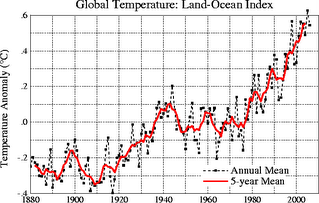
How about a contract series as follows, based on NASA&#8217-s Goddard Institute for Space Studies global temperature (C) data for surface air temperature change, using 1950-81 as baseline:

GISS.2007.ANNUAL.MEAN&lt-.50
GISS.2007.ANNUAL.MEAN&gt-.50
GISS.2007.ANNUAL.MEAN&gt-.60
GISS.2007.ANNUAL.MEAN&gt-.70

The data series can be found here. Some pretty graphs here.

graph

Cross posted from CaveatBettor.

Combining forecasts

No Gravatar

I have been suggesting that the best statistical approach, when confronted with conflicting signals such as the employment estimates from the BLS payroll survey, the separate BLS household survey, or the huge database from the private company Automatic Data Processing, is not to selectively throw some of the data out but rather to combine the different measures. Judging from some of the comments this suggestion has received at Econbrowser, Calculated Risk and Outside the Beltway, I thought it might be useful to say a little more about the benefits of combining forecasts.

Suppose we have available two polls that have surveyed voters for a particular election. The first surveyed 1,000 voters, and found that 52% of those surveyed favored candidate Jones, with a margin of error of plus or minus 3.2%. [By the way, in case you’ve forgotten your Stat 101, those margins of error for purposes of evaluating the null hypothesis of no difference between the candidates can be approximated as (1/N)0.5, or 0.032 when N = 1,000]. The second poll surveyed 500 voters, of whom 54% favored candidate Jones, with the margin of error for the second poll of plus or minus 4.5%. Would you (a) throw out the second poll, because it&#8217-s less reliable than the first, and (b) then conclude that the evidence for Candidate Jones is unpersuasive, because the null hypothesis of no difference between the candidates is within the first poll&#8217-s margin of error?

If that&#8217-s the conclusion you reach, you&#8217-re really not making proper use of the data in hand. You should instead be reasoning that, between the two polls, we have in fact surveyed 1,500 voters, of whom a total of 520 + 270 = 790 or 52.7% favor Jones. In a poll of 1,500 people, the margin of error would be plus or minus 2.6%. So, even though neither poll alone is entirely convincing, the two taken together make a pretty good case that Jones is in the lead.

In the above example, it&#8217-s pretty obvious how to combine the two polls, just by counting the raw number of people covered by each poll and then combining the two as if it were one big sample. But this example illustrates a statistical procedure that works in more general settings as well. We have two different estimates, 0.52 and 0.54, of the same object. We know that the variance of the first estimate is (0.5)2/1000, while the variance of the second estimate is (0.5)2/500 [again, does that sound familiar from Stat 101?]. If we followed the general principle of taking a weighted average of the two, with weights inversely proportional to the variances, that would mean in this case calculating [(1000)(0.52) + (500)(0.54)]/(1000 + 500) = 0.527, which amounts to combining the two estimates in exactly the way that common sense requires for the two-poll example. That principle, of taking a weighted average of different estimates, with weights inversely proportional to the sampling variance of each, turns out to be a good way not just to combine two polls but also to combine independent estimates that may have come from a wide range of different statistical problems.

But what if the second poll not only covered fewer people, but is also less reliable because it is a week older? One way to think about the issue in that case is to notice that the second poll&#8217-s estimate differs from the true population proportion because of the contribution of two terms. The first is the sampling error in the original poll (correctly measured by the (0.5)2/500 formula), and the second is the change in that population proportion over the last week. If we knew the variance governing how much public preferences are likely to change within a week, we would just add this to the sampling variance to get the total variance associated with the second estimate, and use this total variance rather than (0.5)2/500 to figure out how strongly to downweight the earlier poll. The earlier poll would then get much less weight than the newer one, but you&#8217-d still be better off making some use of the data rather than throwing it out altogether.

And what if you believe that one of the polls is systematically biased, but you&#8217-re not sure by how much? Many statisticians in that case might give you the OK to go ahead and ignore the second poll. On the other hand, there are many of us who would still want to make some use of that data, accepting some bias in the estimate in order to achieve a smaller mean squared error. In doing so, we acknowledge that we may make a systematic error in inference that you will avoid, but we will nevertheless be closer to the truth most of the time than you will if there are substantial benefits to bringing in extra data.
Examples where such an approach is quite well-established are estimating a spectrum (where we use the value of the periodogram at nearby frequencies, even though we know it would be a biased estimate of the spectrum at the point of interest) and nonparametric regression (where we use the value when x takes on values other than the one we&#8217-re interested in, even though again our assumption is doing so necessarily introduces some bias to the final estimate).

Robert Clemen, in a paper in the International Journal of Forecasting in 1989 surveyed over 200 different academic studies, and concluded:

Consider what we have learned about the combination of forecasts over the past twenty years&#8230-. The results have been virtually unanimous: combining multiple forecasts leads to increased forecast accuracy. This has been the result whether the forecasts are judgmental or statistical, econometric or extrapolation. Furthermore, in many cases one can make dramatic performance improvements by simply averaging the forecasts.

If I ask you what you think U.S. employment growth was in December, and your answer is the December BLS payroll number, one could say you have decided that the optimal weights to use for &#8220-combining&#8221- the payroll, household survey, and ADP estimates are 1.0, 0.0, and 0.0 respectively. But there&#8217-s an awful lot of statistical theory and practical experience to suggest those aren&#8217-t the best possible weights.

Or to put it another way, even though the payroll numbers were encouraging, the fact that ADP estimates that the U.S. lost 40,000 jobs in December should surely make you a little less confident about the robustness of employment growth than you otherwise would have been.

Iran – Is Something Really Up?

No Gravatar

Both Spook86 and Michael Ledeen suggested a few days ago that the USA might be adopting a stronger position towards Iran. Are we?

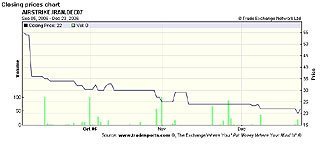
Look at Tradesports&#8217- price history for its AIRSTRIKE.IRAN.DEC07 contract:

(Click the thumbnail to display a large version of this chart.)

So what does this combination of an increase in stern American and British rhetoric, and stagnant odds in the geopolitical wagering market, mean? I think it&#8217-s clear. The rhetoric is most likely not intended as a prelude to action by us. It is intended as a substitute for action. This is business as usual and not at all encouraging.

(See also this post.)

Cross-posted at Chicago Boyz, an Intrade affiliate.

Libertarian baiting

No Gravatar

CFM hated it when Peter McCluskey wrote:

What many of us want from prediction markets bears more resemblance to the products of think-tanks than it does to any other institution that I&#8217-m aware of

But this reminds me of something. When has a pro-market think tank ever subjected its policy recommendations to market evaluation? Never, as far as I know.

The Independent Institute published a book chapter on Decision Markets by Robin Hanson in Entrepreneurial Economics. When institute Research Director Alexander Tabarrok gave a talk on the book, you can guess what subject he spent the most time on.

Think tanks that talk about prediction markets (AEI-Brookings is another) should walk the walk, as should institutions that laud the rigors of the market generally. This could involve setting up and running a non-profit exchange or paying Intrade to offer certain contracts, or variations between.

Many think tank proposals have virtually no chance of implementation. These would not be ideal candidates for prediction market evaluation, but not all think tank prescriptions are politically impossible, and much of what think tanks do is critique proposals that do stand real chance of implementation. If the choice is between yet another Op-Ed and a contract on the subject, I&#8217-ll take the latter.

I&#8217-ll make a $500 donation to the first think thank that makes an interesting, non-bogus use of real-money prediction markets before the end of 2007. I&#8217-ll be the judge of bogosity and interestingness, but I can say that a paper about prediction markets counts as uninteresting.

&#8230-

A grouping that loves to talk about markets (that is when they&#8217-re not going off on incoherent rants) but hates any sort of evaluation consists of U.S. Libertarian Party candidates, activists, and donorsfools. Each election there are LP candidates who vigorously argue that they have a good shot at winning significant office or at least obtaining millions of votes in the case of the U.S. Presidency, ignoring 35 years of abject failure.

The case of Michael Badnarik&#8217-s &#8220-campaign&#8221- for U.S. Congress ending last month is a hilarious case in point. He raised over $400,000, claimed he could win, and got &#8230- 4 percent of the vote. He&#8217-s now begging for another $200k and it turns out his &#8220-campaign&#8221- &#8220-manager&#8221- is starting his own Scientology-like religion.

That&#8217-s not all that out there for an LP campaign, nor is it surprising&#8211-there is no competition from non-wackos for candidacies that are doomed to failure.

One LP campaign this cycle that didn&#8217-t appear to be crazy but nevertheless radically overestimated its chances of success was that of Bob Smither, running in Tom DeLay&#8217-s GOP district against a Nick Lampson, a Democrat ex-Congressperson (who won easily) and a write-in Republican. Because the TX-22 race this year was unusual it was one of several seats Intrade ran markets on. The Intrade market included DEM, GOP, and FIELD contracts. FIELD could be taken as representing Smither, so this may have been the very first LP candidacy evaluated by traders. (FIELD exists in most Intrade election outcome markets but typically attacts no trading, as the field hasn&#8217-t a snowball&#8217-s chance in hell.) Their evaluation was not kind, as I pointed out in a blog post and several times in comments on a blog (no longer live) that hyped Smither&#8217-s chances, where I goaded fans to place bets. Smither polled 6%, against 51% for the Democrat and 43% for the write-in Republican.

One doesn&#8217-t need a prediction market to see that LPers are delusional, amnesiac, or just plain stupid. But as someone with strong libertarian sympathies (actually like prediction market legal scholar Tom W. Bell I&#8217-d prefer to take back the word liberal) I&#8217-ll gladly take additional opportunities to rub the facts in the face of my embarrassing and hypocritically scared-of-markets fellow travellers in the LP.

&#8230-

Did I say baiting? Oops, I meant betting!