

“-Infidels Are Cool”- is the name of a blog on US politics.
- Smart blog title-
- Cute header picture-
- The meaning of the blog title goes hand in hand with what the header picture conveys.

“-Infidels Are Cool”- is the name of a blog on US politics.
Previous articles in this series have discussed market makers and how they differ from book order markets, how to improve Liquidity in multi-Outcome claims, and how to integrate a Market Maker into Book order systems. But none of those talked in any detail about how a multi-outcome market maker coordinates prices and probabilities. Those details turn out to be important for an upcoming article on Combinatorial Markets, so I’-ll go through them carefully here.
Researchers use scoring rules as a laboratory tool to convince people to reveal their true expectations about some set of outcomes. Participants are asked to give estimates of the likelihood for a set of outcomes, their scores are some function of the value they gave for the actual outcome. Scoring Rules are called “-Proper”- if they are designed so the participant’-s best strategy is to honestly reveal the probabilities that seem most likely. The Logarithmic Scoring Rule (one of the Proper rules) provides a reward that equals the logarithm of whichever estimate turns out to correspond to the actual value. Since the total of all the estimates must be 1, the participant can only increase some probabilities by decreasing others.
Robin Hanson described how an Automated Market Maker (AMM) that adjusts its prices based on a scoring rule can support unlimited liquidity in a prediction market. If each successive participant in the market pays the difference between the payoff for her probability estimate and that due to the previous participant, the AMM effectively only pays the final participant. If the AMM’-s scoring rule is logarithmic, participants who only update some probabilities don’-t effect the relative probabilities of others they haven’-t modified. (This last effect is only valuable for Combinatorial Markets, which I’-ll talk about in a later post.)
The change in the user’-s payoff is log(newP) - log(oldP) (or equivalently log(newP/oldP)) for each state. For a binary question, the possible gain will be log(newP/oldP), and the cost will be log((1-oldP) / (1-newP)). For the rest of this article, I’-ll use gain and cost rather than the log(...) expressions, since there are only these two, and I’-ll be using them a lot.In multi-outcome markets, the most common approach is to let the user specify a single outcome to be increased or decreased, and to adjust all the other outcomes equally, but this isn’-t the only possibility. This design choice has the useful property that the probabilities of other outcomes will be unchanged relative to one another. Since the other outcomes are treated uniformly, they can be lumped together, which results in the same arithmetic as a binary market. Since those other cases sum to 1-P, the price is cost. It is also reasonable to allow the user to specify either a complete set of probabilities, or particular cases to increase and decrease and how much to change them. Whatever the case, the LMSR adjusts the reward for each outcome to be log(newPi/oldPi). I’-ll describe more possibilities in this vein when I cover the Combinatorial Market.
I hope you found all this interesting in an intellectual sort of way, but you may have noticed that this description isn’-t applicable to markets in which the traders hold cash and securities. The whole thing is couched in terms of participants who will receive a variable payoff, but they don’-t pay for the assets, they merely rearrange their predictions in order to improve their reward.
In order to turn this into an AMM that accepts cash for conditional securities, we have to pay careful attention to the effects of the MSR on people’-s wealth. The effects are easiest to describe in the binary case, and every other case is directly analogous, so I’-ll start there. In a binary market, the participant raises one probability estimate (call it A) from oldP to newP and lowers the probability of the opposite outcome (not A) from 1-oldP to 1-newP. If the trader had no prior investment in this market, the reward will increase by gain.
In order to reproduce that effect in cash and securities, the AMM charges cost in exchange for gain + loss in conditional securities. Why does the trader get securities equal to the cost plus the potential gain? The effect of this is that if A occurs, the participant has paid cost, and received gain + cost, for a net increase of gain over the original position. If A is judged false, the participant has paid cost with no return, which is the effect we hoped to match.
When an AMM supports a multi-outcome market using the approach I described above, one outcome is singled out to increase (or decrease), while all other outcomes move a uniform distance in the opposite direction. If the single outcome is increasing, the exchange is trivial to describe: we charge the trader cost for gain + cost in securities. The effect looks just like the binary case. The user has spent some money and owns a security that will pay off in a situation the trader thought was more likely than its price indicated.
If the trader singles out one outcome to sell (and thus reduce its probability), the difference among the alternatives I described in the first article in this series on Basic Prediction Markets Formats becomes evident. The trader is betting against something, and the market can represent this using short selling, complementary assets, or baskets of goods. The market might allow short selling (like InTrade), a complementary asset (like NewsFutures and Foresight Exchange), or a basket of securities representing all the other outcomes (like IEM). Since there are distinctly different points of view on this question, different markets will make different choices.
In order to support the short sales model, the trader needs to receive the payment first along with a conditional liability. In our model, the trader would receive gain in cash immediately, and securities that required repayment of gain + cost if the outcome (which the trader bet against) occurs. The platform would presumably require the trader to hold reserves to ensure the repayment.
With baskets of goods, the trader would get the appropriate number of shares of each of the other outcomes. The charge would be cost, and that would purchase gain + cost of conditional assets in all other outcomes.
The complementary assets model would charge cost in currency, and provide gain + cost of an asset that paid off if the identified outcome didn’-t occur. The complicated part of this representation is that traders can hold both positive and negative assets. In a 4 outcome market, a trader holding 3 units of A and 2 units of B who sold 4 units of C could be shown equivalent portfolios of either A: 3, B: 2, C: -4 or A: 7, B: 6, D: 4. I think either choice is defensible. The first resembles the transactions the user has made, and so is probably more recognizable- the second provides a more consistent view of possible outcomes. (And looks the same as baskets.) If both positive and negative numbers are shown, the trader has to realize that the negative holdings pay off in all other cases. On the other hand, displaying a portfolio in a 7-outcome market as A: 3, B: 3, C: 3, E: 5, F: 3, G: 3 doesn’-t seem as clear as D: -3, E: 2.
I doubt this detail will be of much interest to most users of Prediction Markets. Luckily for them, the trade-off the logarithmic rule makes between cost and reward just happens to produce prices that match probabilities. But if you are implementing Hanson’-s LMSR, you should understand the alternatives well enough to verify that your market maker correctly implements the design.
Zocalo Prediction Markets support binary and multi-outcome markets with a Market Maker based on the Logarithmic Market Scoring Rule. The design takes advantage of the parallels between the different markets by only implementing the logarithmic rule in one place.
This article is cross-posted from pancrit.org.
– TradeSports – Partners Program
– InTrade – Partners Program
—-
Both “-Affiliates”- links lead to the same TradeSports page. Why do they insist on this charade? If there is some good reason to pretend that they are two separate and unrelated companies, why do they do such a bad job of hiding all these obvious connections?
Signed: Deep Throat
Jed has put his video on YouTube and I finally got to understand how to embed a YouTube video in a WordPress blog post —-simple, just temporarily uncheck the visual editor (in your profile area) and then paste the YouTube code in the writing area of your blog post.
It should work now. (You can either watch this video by clicking on “-play”- or watch it on the YouTube site by double-clicking on it.)
Previous blog posts by Chris F. Masse:
Now that I know how to embed a YouTube video  , here are some videos I linked to in the past. They are all about InTrade, but, in the future, we will show YouTube videos from other exchanges and vendors. (E-mail me if you know of other YouTube videos on prediction markets.)
—-
John Delaney of InTrade (CNBC Larry Kudlaw – August 2007):
—-
John Delaney of InTrade (Fox News – Feb 2007):
–-
Justin Wolfers on InTrade (Bloomberg – Feb 2007):
—-
If somebody can post the other Justin Wolfers video on YouTube (providing your criminality lawyer is OK for that), e-mail me and I will update this blog post.
– Beating Wall Street Economists – Bloomberg TV – AVI file – 30 Mega “Bs” – [Economic Derivatives versus surveys of economists] – 2007-03-08
—-
Also, if somebody can post the Yahoo! Confab on YouTube (providing that it is legal to do that), e-mail me too. (David Pennock would like it to be hosted on Yahoo! Video, instead, I suppose. Or is it already hosted by Yahoo! Video?? Just asking. I’-m not an expert in those things.)
—-
Also, if you have recorded conference segments, tell me, we could embed them too, if all people agree.
—-
If you think it’-s legally wrong to republish these YouTube videos, e-mail me to explain me IP rights management. I’-m a bit a newbie.
Scroll down the whole story and judge by yourself, folks.
—-
New York Times:
“As he stated on Saturday, Senator Craig intends to resign on Sept. 30,” Mr. [Dan Whiting, a spokesman for Mr. Craig] said in a statement. “However, he is fighting these charges, and should he be cleared before then, he may, and I emphasize may, not resign.”
Aaaarrrrgh…-

Slate Video – Senator Craig: The Re-enactment
Sen. Larry Craig plead guilty to disorderly conduct following his arrest for allegedly soliciting in a public restroom. Slate V delivers a re-enactment, based on the police report.
Minnesota Police report.
Bathroom Sex FAQ
—-
Yet another InTrade-TradeSports scandal??

—-
Sen. Larry Craig to announce resignation or intention not to run in 2008 on/before 31 Dec 2007 – This event derivative has been expired by InTrade.
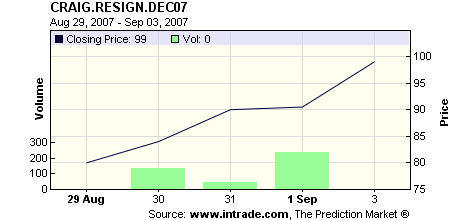
The rules (= the event derivative contract statement):
This contract will settle (expire) at 100 ($10.00) if Senator Larry Craig announces his resignation from the Senate or announces he will not run for re-election in 2008 on or before 11:59:59pm ET on the date specified in the contract.
The contract will settle (expire) at 0 ($0.00) if this does not happen on or before 11:59:59pm ET on the date specified in the contract.
A resignation does not have to result in the actual departure by the contract expiry date but rather the announcement of the resignation must be made before the date and time specified in the contract.
Expiry will be based on official, public announcements made by Larry Craig as reported by three independent and reliable media sources.
Due to the nature of this contract please also see Contract Rule 1.7 Unforeseen Circumstances.
The Exchange reserves the right to invoke Contract Rule 1.8 (Time Protection) if deemed appropriate.
Any changes to the result after the contract has expired will not be taken into account – Exchange Rule 1.4
Please contact the exchange by emailing [email protected] if you have any questions regarding this contract before you place a trade.
Important:
Please contact the Exchange if you have any query or uncertainty (including how it may be settled) about this Contract, the Rule above or the Contract Rules before you trade.
US Senator Larry Craig (on September 1, 2007 ):
Senator Craig Announces Intent to Resign from the Senate
BOISE, Idaho – Senator Craig made the following statement to Idaho:
First and foremost this morning, let me thank my family for being with me. We’-re missing a son who’-s working in McCall, and simply couldn’-t make it down. But for my wife Suzanne and our daughter Shae, and Mike to be with me is very humbling.
To have the governor standing behind me, as he always has, is a tremendous strength for me. To have Bill Sali who has never wavered, and who has been there by phone call and by prayer, and his wife, is tremendously humbling.
For the leader of our party, Kirk Sullivan, to be standing here, who sought immediate counsel with me in this, is humbling. For Tom Luna—for any public official at this moment in time—to be standing with Larry Craig is a humbling experience. Learn more about Senator Craig’-s top accomplishments
For most of my adult life, I had the privilege of serving the people of Idaho. I’-m grateful for the opportunity they have given me. It has been a blessing. I am proud of my record and accomplishments, and equally proud of the wonderful and talented people with whom I have had the honor and the privilege to work and to serve.
I choose to serve because I love Idaho. What is best for Idaho has always been the focus of my efforts, and it is no different today. To Idahoans I represent, to my staff, my Senate colleagues, but most importantly, to my wife and my family, I apologize for what I have caused. I am deeply sorry.
I have little control over what people choose to believe, but clearly my name is important to me and my family is so very important also. Having said that, to pursue my legal options, as I continue to serve Idaho, would be an unwanted and unfair distraction of my job and for my Senate colleagues. These are serious times of war and of conflict—times that deserve the Senate’-s and the full nation’-s attention.
There are many challenges facing Idaho that I am currently involved in. And the people of Idaho deserve a senator who can devote 100 percent of his time and effort to the critical issues of our state and of our nation.
Therefore it is with sadness and deep regret that I announce that it is my intent to resign from the Senate, effective September 30. In doing so, I hope to allow a smooth and orderly transition of my loyal staff and for the person appointed to take my place at William E. Borah’-s desk. I have full confidence that Governor Otter will appoint a successor who will serve Idaho with distinction.
I apologize to the people of our great state for being unable to serve out a term to which I have been elected. Few people have had the privilege and the pleasure to represent Idaho for as many years as I have. Each day, each week, each year brought new challenges and opportunities to create a better life for Idahoans. I have enjoyed every moment and cannot adequately put into words how much I appreciate what you have given me: the chance to work for this great state. I hope you do not regret the confidence you have placed in me over all of these years. I hope I have served you and our state to the best of my ability.
Lastly, Suzanne and I have been humbled beyond words by the tremendous outpouring of support we have received from our friends, our family, our staff and fellow Idahoans. We are profoundly and forever grateful. Thank you all very much.
US Senator Larry Craig announced his intent to resign, not his upcoming resignation (or effective resignation). Big difference. A resignation intent is not an upcoming/effective resignation. We know now, thanks to the New York Times, that there was an unstated conditionality —-whether Larry Craig gets cleared before the 30th of September 2007. Thus, InTrade should not have expired the Larry Craig event derivative on the basis of that senatorial output. I bet that some traders will soon complain on the Intrade-TradeSports forum. They can contact me, if they wish.
More Info: – AP – MSNBC Video – Idaho Stateman –
—-
ADDENDUM:
Definitions of the word “-intent”- on the Web:
* purpose: an anticipated outcome that is intended or that guides your planned actions– “-his intent was to provide a new translation”– “-good intentions are not enough”– “-it was created with the conscious aim of answering immediate needs”– “-he made no secret of his designs”-
* the intended meaning of a communication
* captive: giving or marked by complete attention to- “-that engrossed look or rapt delight”– “-then wrapped in dreams”– “-so intent on this fantastic…-narrative that she hardly stirred”– Walter de la Mare- “-rapt with wonde
r”– “-wrapped in thought”-
wordnet.princeton.edu/perl/webwn* Intent in law is the planning and desire to perform an act.
en.wikipedia.org/wiki/Intent* Reiki is an Intent driven system. Intent is the key to using the Reiki energy in healing and Attunements.
www.reikithehealingpath.com/reiki_glossary.htm* Intent is the plan and will to act in a particular way or choice to remain inactive.
www.attorneykennugent.com/library/i.html* The singlemost causal agency in all action, creation, destruction and change at all levels of existence. That component of consciousness which gives rise to all forms. The means by which the Will of God and Natural Law is manifest. The essence and source of motivation.
www.eoni.com/~visionquest/library/glossary.html* Humans appear to be comprised of two important awarenesses: The Conscious Awareness (usually experienced through the personality) and a Greater Awareness. The Greater Awareness resides at body center and is connected to a fundamental force Seers call Intent. Intent is the equivalent of a muscle in the physical world. It is the means by which action, change, and expression happen in both the physical and energetic worlds for all humans. …-
sentecenter.com/glossary.htm* the mood, message, or meaning desired by the artist
www.learner.org/channel/workshops/artsineveryclassroom/p1popups/vocabulary.html* A state of mind (mens rea) in which a person seeks a particular result through a particular course of action.
www.iejs.com/glossary/Glossary_I.htm* the subtextual objective of a character
www.austin.cc.tx.us/sbramme2/Glossary.htm* Voluntary function of a person’s mind in purposely performing a perceivable act.
www5.aaos.org/oko/vb/online_pubs/professional_liability/glossary.cfm* requires that one intended to deprive the possessor “-permanently”- of the property. Although the mens rea of larceny is the intent to steal, the focus is on the loss to the possessor, not the gain to the defendant. Thus, even if the thief did not gain in the taking, if the possessor lost in the process. Courts have also held that permanence can be more than keeping forever. …-
www.voyager.in/Larceny
—-
PARTING SHOT:
The problem with most of the socially valuable prediction markets (i.e., the non-sports prediction markets) is that all depends on:
– how well the event derivative contract is stated-
– how well the related information is interpreted-
– how well the event derivative contract is expired.
With the Larry Craig prediction market, we have yet another example that InTrade (which gets plenty of cites in Midas Oracle * and other business media outlets) might not have done its job with the highest degree of professionalism required —-at least in my opinion. Judge by yourself, scanning all the facts presented above by yourself.
In the summer 2006, I denounced the North Korean Missile scandal, and here’-s what followed:
– I received an e-mail from InTrade CEO John Delaney saying that I could put a prize of $10,000 in the ‘-lost’- column-
– I have been attacked by a second-tier phone-booth conference organizer, sponsored by InTrade-
– I received e-mailed insults from Ireland, sent on forged e-mail accounts.
—-
[*] 3,820 cites of InTrade, says Google Search.
—-
Next: Resignation Intent vs. Upcoming Resignation vs. Effective Resignation
—-
UPDATE: Chris Masse’-s response to the Mike Giberson comment…-
The real issue is not much that InTrade makes a mistake (we all do), but whether it acknowledges its mistake and compensates the victims. (In the North Korea Missile scandal, InTrade did not behave well in this perspective, according to my reading of the situation.) […]
US Senator Larry Craig simply said, “I’m thinking about resigning on September 30”. He did not say, “I’m resigning, effective September 30.” There is a huge difference between the two kinds of statement. And this difference (and InTrade’s error) pops up today because Larry Craig is exercising his constitutional right to change his intent. […]
Next: Donald Rumsfeld’-s resignation letter – November 6, 2006
—-
UPDATE: New York Times…-
Sen. Larry Craig has all but dropped any notion of trying to complete his term, and is focused on helping Idaho send a new senator to Washington within a few weeks, his top spokesman said Thursday. ”-The most likely scenario, by far, is that by October there will be a new senator from Idaho,”- Craig spokesman Dan Whiting told the Associated Press. The only circumstances in which Craig might try to complete his term, Whiting said, would require a prompt overturning of his conviction for disorderly conduct in a men’-s room at the Minneapolis airport, as well as Senate GOP leaders’- agreement to restore Craig’-s committee leaderships posts taken away this week. Those scenarios are unlikely, Whiting said.
Craig, a three-term Republican, met Wednesday with Idaho Gov. C.L. ”-Butch”- Otter, R, to discuss a transition in which Otter would name his Senate replacement, Whiting said. Even if Craig were to complete his term, he said, the senator would not seek re-election in 2008. Whiting said Craig remains intent on clearing his name through the legal process in Minnesota and by having the Senate ethics committee address his claim that his misdemeanor conviction should not be a matter for action by the panel. […]
UPDATE: How US Senator Larry Craig managed to fool InTrade-TradeSports.
—-
UPDATE: InTrade-TradeSports should have expired the Larry Craig event derivative today, on October 4, 2007, and not on September 5, 2007.
InTrade-TradeSports should have expired the Larry Craig event derivative today, on October 4, 2007, and not on September 5, 2007. That’-s their main error. Last September, they expired this event derivative on the basis on Larry Craig stating his “-intent to resign”- —-which is different than to announce an upcoming or effective resignation. Larry Craig later changed his “-intent”- —-he then intended to stay in the US Senate (providing he would be able to withdraw his guilty plea). Unfortunately, today, a judge ruled against his attempt to dismiss his guilty plea. So, US Senator Larry Craig is announcing today that:
The condition #2 is sufficient to expire the December 2007 Larry Craig contract on the “-yes”- side. (”-Yes”-, he is announcing his “-intention not to run in 2008″-.)
—-
UPDATE: Craig hopes to redeem himself for future lucrative job as lobbyist.
Any good journalist writing up a piece on InTrade or interviewing John Delaney does mention the North Korea Missile scandal.
—-
Bet on It! – (page two – page three + a crappy listing of exchanges) – by Spectrum’-s Steven Cherry
[…] Last year, a poorly worded contract by Tradesports caused a ruckus when some bettors lost money. Tradesports had set up a market to predict whether North Korea would test a long-range missile—which was defined as sending a missile beyond the country’s airspace. Those who bought that contract, which expired on 31 July 2006, thought they had won when a North Korean missile flew 442 kilometers (275 miles) into the Sea of Japan (East Sea). However, the contract also specified that the source of the confirming information had to be the U.S. Department of Defense, which declined to release any specifics about the test. Despite a White House statement that confirmed the missile “went out about 275 miles,” Tradesports awarded the contract to those who bet against a successful test. […]
More Information:
Event derivative trader “-Vancheeswaran”-:
[…] Bryan Whitman ([email protected]) explicitly stated in print, in press conferences, and by email that North Korea fired multiple missiles into the Sea of Japan. For instance, “North Korea fired a long-range Taepodong-2 missile and six short- and medium-range Scud and Nodong missiles. All landed in the Sea of Japan without incident.”
National Security Advisor Stephen Hadley, in a press conference at the White House, stated that the missiles “went out about 275 miles” into the Sea of Japan.
http://www.whitehouse.gov/news/releases/2006/07/20060704-1.htmlThere are many other examples of the U.S. military and government (not just the press) confirming that the missiles were launched and approximately where they landed. […]
Victory of the mind over matter!!!!!!
The PopSci PPX prediction exchange has finally created a jatropha biofuel prediction market, as the Freakonomics blog was suggesting them to do.
[…] some Goldman Sachs data on the estimated cost per barrel of fuel made from a variety of sources:
Cellulose: $305
Wheat: $125
Rapeseed: $125
Soybean: $122
Sugar Beets: $100
Corn: $83
Sugar Cane: $45
Jatropha: $43
Now, the second part of the equation is to promote this new prediction market, so it gets traded and a running-time probabilistic prediction is generated. (The interaction between a blog audience and a prediction market is part of my concept of X group. I’-m bullish on that.)
Next: Freakonomics + PopSci PPX = Not yet an X group + THE FREAKONOMICS BLOG AND THE JATROPHA PREDICTION MARKET AT POPSCI PPX NOW FORM AN X GROUP.
Previous blog posts by Chris F. Masse:
Bet on It! – (page two – page three + a crappy listing of exchanges) – by Steven Cherry
[…] Chris F. Masse, a [] consultant in Sophia Antipolis, France, who specializes in prediction markets, says that by 2010, “10 percent of Fortune 500 companies will have gone public about their use of internal prediction markets, and probably another 10 percent will be testing some projects.” […]
As [Robin] Hanson notes, “the winners are attracted by losers, just as wolves are attracted by sheep.” […]
I made a point to this journalist, and since he has not published it, I will share it with you. I said that prediction markets, as an information aggregation mechanism, is a meta forecasting tool, since prediction markets feed on all the other forecasting tools. Do you, guys, agree with my censored statement?
I also made a sidebar comment to him. I said that David Perry of Consensus Point is the major evangelizer of the use of internal prediction markets, these days —-once you have acknowledged Google’-s public input. Agree, disagree?
Ron Paul is being silenced, BetFair is victimized in the US, and, finally, Chris Masse is censored —-but we all try to resist. We will defeat these three conspiracies (which I suspect Bo Cowgill is part of), ultimately.
Go reading the article, if you haven’-t done already (and then read Mike Giberson’-s comments). —- Bet on It! – (page two – page three) —- Via Steve Roman
—-
UPDATE: Robin Hanson comments…-
I don’t that much care about terminology here, but I do agree that prediction markets should shine best at the meta level, when competing institutions try to draw what insight they can from other institutions running in parallel.