Prediction markets at the Money Tech conference

Money Tech conference = Technology and Money, Asset Management and Networks, Computing Horsepower and Trading + Prediction Markets

Robin Hanson will be presenting on prediction markets at the Money Tech conference. He is not yet on the official program, but our friend (and prediction market skeptic) Barry Ritholtz tells us that Robin Hanson was at the pre-conference dinner. (Robin Hanson was quite surprisingly &#8220-fascinating&#8221-, he wrote. :-D Will Robin Hanson manage to turn this skeptic into a fanboy? We&#8217-ll see.)

Psstt&#8230- Barry Ritholtz talks about November 2007 while the official site says February 2008. Bizarre.

Thanks to Alex Kirtland for alerting us about this Money Tech conference, last month.

UPDATE: Barry Ritholtz comments&#8230-

November? How did that happen?

I meant February.

My current excuse for any brain glitch like this is to declare that I smoked way too much pot in college and leave it at that. (That’s much better than admitting advanced senility/aging)

Read the previous blog posts by Chris. F. Masse:

  • Barack Obama’s victory in South Carolina won’t stop the Clintons.
  • eTech 2008 — Google’s enterprise prediction markets
  • Predictocracy = Market Mechanisms for Public and Private Decision Making
  • Prediction Market Management — Foresight Exchange vs. Inkling Markets & HubDub
  • Why you should launch your brand-new prediction exchange at a conference
  • Why Indian Software Outsourcing Companies are Outsourcing to China
  • Midas Oracle is the only popular, independent, exhaustive, multi-author, multi-exchange, Web-based resource on prediction markets.

The Bet2Give real-money betting exchange could facilitate the sponsoring of socially valuable prediction markets by foundations and think tanks.

No Gravatar

Could Emile Servan-Schreiber push his Bet2Give concept a bit further?

I&#8217-m thinking of something, having in mind the LongBets experiment. Bet2Give lets traders select the charity of their choice. Good. But can&#8217-t we go further than that? Why not letting some people (like Robin Hanson and his gullible fanboys like Chris Hibbert :-D ) create some long-term, socially valuable prediction markets, all this funded by foundations or think tanks&#8217- money (since the money will never leave the non-for-profit world, anyway). I mean, if AEI-Brookings funded the experiment, the subsidized traders could designate AEI-Brookings as the recipient of the trading winnings, right? So, the AEI-Brookings money would indeed be used for the trading, but, in the end, it would cost AEI-Brookings only some trading fees (5 cents for each dollar).

And, I&#8217-d like to see more interactions between blogs and prediction markets. In the scenario above, there would be a strong incentive to do just that from the part of all those crazy blogging experimental economists, don&#8217-t you think? Those hyper inflated egos will fire blog posts like crazy about their ongoing experiments at Bet2Give, and that would help the marketing of those experimental prediction markets.

Bet2Give is a too good idea to bet let it in the hands of Emile Servan-Schreiber. Does EJSS have what it takes to push the Bet2Give concept further? (EJSS is much smarter than most people in the field of prediction markets, but that&#8217-s not enough. He is not crazy enough.) I suggest that Bet2Give be declared of international social utility and be run by the Organization of the United Nations. :-D

Previous: Here’s how Bet2Give explains what a prediction market is to its prospects.

A methodology flaw in the last UK Gambling Commissions survey report makes it useless for analysts and policy makers.

No Gravatar

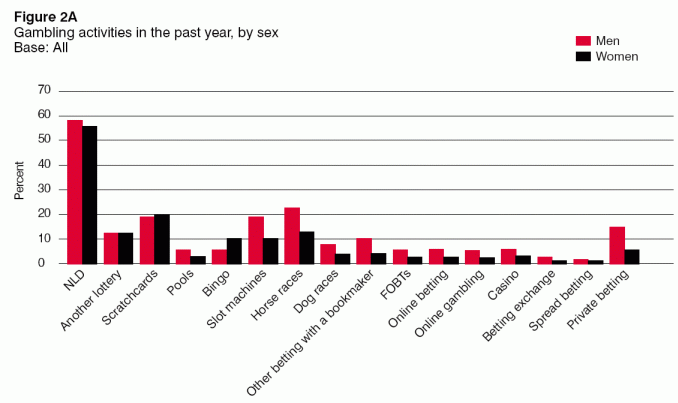
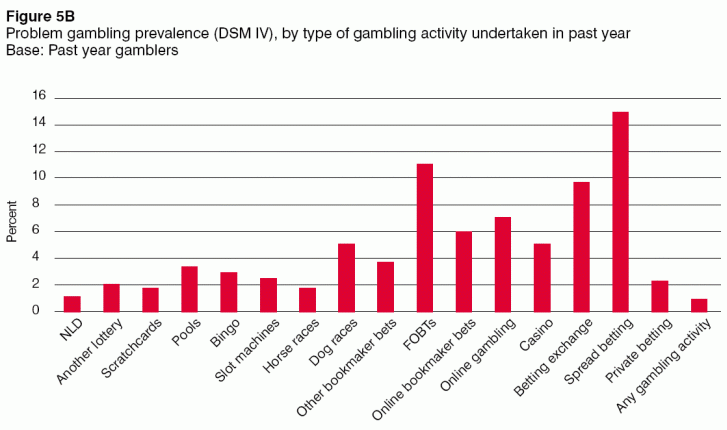
I have scanned and examined the UK Gambling Commission&#8217-s survey report on gambling and betting (PDF file), titled British Gambling Prevalence Survey 2007, and I have found out that there is a big problem in their list of gambling and betting activities. The problem is that survey respondents, who have been using a &#8217-spread-betting exchange&#8217-, were never been told specifically whether to select the &#8220-betting exchange&#8221- category or the &#8220-spread-betting&#8221- category. That should not be because there is big difference between a classic betting exchange (like BetFair, owned by The Sporting Exchange), which is regulated by the UK&#8217-s Gambling Commission, and a spread-betting exchange (like SpreadFair, owned by Cantor Fitzgerald), which is regulated by the U.K.&#8217-s Financial Services Authority (the equivalent of SEC + CFTC).

Indeed, spread bets (via a spread-betting bookmaker or via a spread-betting exchange) are high risk products, where the bettors/speculators need to deposit only a small percentage of the value of the bet. That is not the case with BetFair, which is a classic betting exchange. Here&#8217-s what is stated by BetFair:

Betfair do not offer credit facilities to our customers. Unlike some spread betting firms, we are not regulated by the Financial Services Authority in the UK. The reason that we do not offer credit is that the concept of the exchange relies on the fact that you must have the funds that you are staking in your account. When you place a bet, that money is secured by Betfair until the bet is settled and the funds paid out to the winner.

So the Gambling Commission survey report (cited like crazy by all the gregarious British media today) goes directly in my trash can. It&#8217-s a pity since we really need to know whether our beloved classic betting exchanges generate &#8220-problem gambling&#8221-. We can&#8217-t know that for sure reading this survey report, since they mixed up oranges and apples.

&#8212-

WHAT THEIR SURVEY FORM READ:

11. Betting exchange – (This is where you lay or back bets against other people using a betting exchange. There is no bookmaker to determine the odds. This is sometimes called &#8216-peer to peer&#8217- betting.)

15. Spread-betting – (In spread-betting, you bet that the outcome of an event will be higher or lower than the bookmaker&#8217-s prediction. The amount you win or lose depends on how right or wrong you are.)

&#8212-

HERE ARE THE GENERAL FINDINGS OF THE SURVEY REPORT:

Gambliing UK 2007

Problem Gambling UK 2007

Enthusiasm and Arbitrage Opportunities at Media Predict

No Gravatar

Another play money arbitrage explanation, much easier than the last one.

I sat down to the computer this morning at exactly the time emails were arriving from Media Predict announcing the opening of five new markets for the &#8220-Project Publish&#8221- finalists. One of the five finalists will receive a book deal.

In the prediction markets, five new shares were launched at $50 ($ = Media Predict play money). Shares held in the winning book will be paid $100, the others will expire at $0. So, at market launch, selling one each of the five shares would gain $250, and guarantee a payoff of $-100. Result: riskless profit of $150. The market should have launched at $20 each (or, at least, that is one set of prices that would have eliminated the riskless arbitrage opportunity).

First to the new markets, I sold short what I could afford across the board, bringing all the prices down to $35. An hour or two later prices had drifted up on several shares, no doubt due to the enthusiasm some trader had developed for the books, but in their enthusiasm they didn’t realize that they should complement a purchase of one share with sales of other shares – otherwise they leave free arbitrage opportunities in the market. A bit later someone came along and sold all of the share prices down to $20 each.

Now, several hours later, prices have moved much higher on three of the books, while two seem to be drifting lower. I’ve sold some other Media Predict holdings so I could arbitrage some more, but I’m credit constrained in the Media Predict economy so I can’t grab all of the riskless profit. As I write, the current gain from selling a one-of-each suite of shares is $156, so the present riskless profit available is $56.

While the book shares are presented as five parallel markets, actually we have a single multi-outcome market. There are five books, and only one of the five will be selected. Since the sum of the probabilities across the five books is constant, if you think option A is more likely to win then it must be the case that the joint probability of B, C, D, and E is less likely. The market can take advantage of that relationship to improve market performance, for reasons that Chris Hibbert explains in “Increasing Liquidity in Multi-Outcome Claims.” If the market won’t do it, arbitrageurs can.

Note: Chris Masse was puzzled about bigger picture issues in his earlier post on Media Predict, and I comment on some of those issues in response. For the purposes of the post above I’m ignoring the big picture and just wondering about the market mechanism and implementation.

Pennock & Sami on Computational aspects of prediction markets

No Gravatar

Dave Pennock and Rahul Sami have written a book chapter on Computational Aspects of Prediction Markets. It focuses on computability and complexity issues in markets that handle combination, conditional and compound orders. The article talks about the costs for the auctioneer, and presents the Logarithmic Market Scoring Rule and the Dynamic Parimutuel Auction as two feasible approaches to offering combination or compound markets.

The article is written for (and probably only accessible to) people who understand the language of computability and complexity theory. It does review the economic principles underlying prediction market mechanisms beyond call auctions and the double auction, but only sufficiently to introduce them to Computer Science people who are new to this application area.

The chapter closes with a list of open questions, and I&#8217-d like to highlight a couple of them:

  1. &#8220-Are there less expressive bidding languages that admit polynomial matching algorithms yet are still practically useful and interesting?&#8221- If someone can find a feasible mechanism that supports an interesting subset of a complete combinatorial or conditional claims, we could run markets that provide answers to much more interesting questions.
  2. The idea of betting on outcome permutations is intriguing. (Apparently I missed this paper at the recent conference in San Diego.)
  3. &#8220-What is the complexity of finding a match between a single new order and a set of old orders known to have no matches among them?&#8221- I&#8217-m more interested in finding cheap solutions or new ways to pose the problem that are more tractable, but determining the complexity is the first step in the crowd Sami and Pennock are talking to.
  4. &#8220-The model in Section 1.5 directly assumes that agents bid truthfully. Is there a tractable model that assumes only rationality and solves for the resulting game-theoretic solution strategy?&#8221- Wouldn&#8217-t proving incentive compatibility be sufficient to establish that rational agents would bid truthfully? I expect LMSR to be incentive compatible, though I don&#8217-t know how hard the proof is. I have a vaguer feeling that the Dynamic Parimutuel might also be incentive compatible, though I think the fact that the price isn&#8217-t directly a probability makes the link more tenuous.

I hope the inclusion of this chapter in what appears to be a broad work on computability, efficiency, and algorithm design in games, negotiations, markets, and networks will lead to new ideas that will expand the set of alternative market designs we can make use of. (I have linked to the chapter above- if you want to download the whole book, Pennock&#8217-s blog contains the password that you&#8217-ll need.)

BetFair accurately predicted the direction of the interest rate change, but was too shy in its prediction of the amplitude of the interest rate change.

No Gravatar

BetFair predicted: -0,25

The Fed decided: -0.50

That&#8217-s for the absolute accuracy. Now, what counts is the relative accuracy &#8212-the comparison between the prediction made by BetFair and the predictions made by the financial markets experts. I see that the rate cut of 50bp has come up as a big surprise to the Wall Street pundits. For example, here&#8217-s what Felix Salmon wrote this morning, before the Fed&#8217-s meeting taking place in the afternoon:

But my gut feeling is that Bernanke should announce a nominal 25bp cut in the Fed funds rate to 5% (hell, it averaged 5% in August anyway) along with a more substantial 50bp or even 75bp cut in the discount rate.

An interesting comparison would be Felix Salmon vs. BetFair over the next 10 years. I bet that BetFair will beat Felix Salmon and the other Wall Street pundits, over the long term.

&#8212-

The Federal Reserve&#8217-s statement:

Release Date: September 18, 2007
For immediate release

The Federal Open Market Committee decided today to lower its target for the federal funds rate 50 basis points to 4-3/4 percent.

Economic growth was moderate during the first half of the year, but the tightening of credit conditions has the potential to intensify the housing correction and to restrain economic growth more generally. Today’s action is intended to help forestall some of the adverse effects on the broader economy that might otherwise arise from the disruptions in financial markets and to promote moderate growth over time.

Readings on core inflation have improved modestly this year. However, the Committee judges that some inflation risks remain, and it will continue to monitor inflation developments carefully.

Developments in financial markets since the Committee’s last regular meeting have increased the uncertainty surrounding the economic outlook. The Committee will continue to assess the effects of these and other developments on economic prospects and will act as needed to foster price stability and sustainable economic growth.

Voting for the FOMC monetary policy action were: Ben S. Bernanke, Chairman- Timothy F. Geithner, Vice Chairman- Charles L. Evans- Thomas M. Hoenig- Donald L. Kohn- Randall S. Kroszner- Frederic S. Mishkin- William Poole- Eric Rosengren- and Kevin M. Warsh.

In a related action, the Board of Governors unanimously approved a 50-basis-point decrease in the discount rate to 5-1/4 percent. In taking this action, the Board approved the requests submitted by the Boards of Directors of the Federal Reserve Banks of Boston, New York, Cleveland, St. Louis, Minneapolis, Kansas City, and San Francisco.

UPDATE:

BetFair predicted: -0,25

The Fed decided: -0.50

And, now, how did the economists fare? (Bloomberg link via Niall O&#8217-Connor of Betting market, who has a comment.)

It was the first time in almost five years that the Fed move differed from analysts&#8217- predictions. The half-point reduction in the federal funds target was forecast by 23 of 134 economists surveyed by Bloomberg News. One hundred and five predicted a reduction of 25 basis points, while six forecast no change. A basis point is one-hundredth of a percentage point.

– BetFair&#8217-s probabilistic prediction: -0.25 @ 73%

– Bloomberg&#8217-s probabilistic prediction: -0.25 @ 78%

So, BetFair&#8217-s probabilistic prediction was close to Bloomberg&#8217-s one. Neither better, nor worse.

BetFair predicts: US Federal Funds Rate = 5%

No Gravatar

What will be the change in US Federal Funds Rate at this month&#8217-s scheduled Federal Open Market Committee (FOMC) meeting?
FOMC – September FOMC
Current Rate 5.25% .
– 0.25

What will be the change in US Federal Funds Rate at this months scheduled Federal Open Market Committee (FOMC) meeting?

UPDATE: BetFair accurately predicted the direction of the interest rate change, but was too shy in its prediction of the amplitude of the interest rate change.

BetFair predicted: -0,25

The Fed decided: -0.50

That&#8217-s for the absolute accuracy. Now, what counts is the relative accuracy &#8212-the comparison between the prediction made by BetFair and the predictions made by the financial markets experts. I see that the rate cut of 50bp has come up as a big surprise to the Wall Street pundits. For example, here&#8217-s what Felix Salmon wrote this morning, before the Fed&#8217-s meeting taking place in the afternoon:

But my gut feeling is that Bernanke should announce a nominal 25bp cut in the Fed funds rate to 5% (hell, it averaged 5% in August anyway) along with a more substantial 50bp or even 75bp cut in the discount rate.

An interesting comparison would be Felix Salmon vs. BetFair over the next 10 years. I bet that BetFair will beat Felix Salmon and the other Wall Street pundits, over the long term.

&#8212-

The Federal Reserve&#8217-s statement:

Release Date: September 18, 2007
For immediate release

The Federal Open Market Committee decided today to lower its target for the federal funds rate 50 basis points to 4-3/4 percent.

Economic growth was moderate during the first half of the year, but the tightening of credit conditions has the potential to intensify the housing correction and to restrain economic growth more generally. Today’s action is intended to help forestall some of the adverse effects on the broader economy that might otherwise arise from the disruptions in financial markets and to promote moderate growth over time.

Readings on core inflation have improved modestly this year. However, the Committee judges that some inflation risks remain, and it will continue to monitor inflation developments carefully.

Developments in financial markets since the Committee’s last regular meeting have increased the uncertainty surrounding the economic outlook. The Committee will continue to assess the effects of these and other developments on economic prospects and will act as needed to foster price stability and sustainable economic growth.

Voting for the FOMC monetary policy action were: Ben S. Bernanke, Chairman- Timothy F. Geithner, Vice Chairman- Charles L. Evans- Thomas M. Hoenig- Donald L. Kohn- Randall S. Kroszner- Frederic S. Mishkin- William Poole- Eric Rosengren- and Kevin M. Warsh.

In a related action, the Board of Governors unanimously approved a 50-basis-point decrease in the discount rate to 5-1/4 percent. In taking this action, the Board approved the requests submitted by the Boards of Directors of the Federal Reserve Banks of Boston, New York, Cleveland, St. Louis, Minneapolis, Kansas City, and San Francisco.

UPDATE:

BetFair predicted: -0,25

The Fed decided: -0.50

And, now, how did the economists fare? (Bloomberg link via Niall O&#8217-Connor of Betting market, who has a comment.)

It was the first time in almost five years that the Fed move differed from analysts&#8217- predictions. The half-point reduction in the federal funds target was forecast by 23 of 134 economists surveyed by Bloomberg News. One hundred and five predicted a reduction of 25 basis points, while six forecast no change. A basis point is one-hundredth of a percentage point.

– BetFair&#8217-s probabilistic prediction: -0.25 @ 73%

– Bloomberg&#8217-s probabilistic prediction: -0.25 @ 78%

So, BetFair&#8217-s probabilistic prediction was close to Bloomberg&#8217-s one. Neither better, nor worse.

How does Koleman Strumpf define the prediction markets?

No Gravatar

Koleman Strumpf&#8217-s conference webpage:

Prediction markets are a tool for harnessing the wisdom of crowds. Recently, firms have begun to use these markets to leverage the information dispersed among their employees and customers. The markets have been used to improve forecasts of uncertain events, to generate new ideas, and to improve resource allocation within the firm. Prediction markets have great promise for helping firms manage risk, because they can provide more precise estimates of events which are both internal and external to the firm.

Heres how Bet2Give explains what a prediction market is to its prospects.

No Gravatar

Bet2Give&#8217-s user guide:

What is a prediction market?

In a prediction market, traders buy and sell shares of a stock whose closing price is determined by a real-world event in the future. For example, each share of the Clinton Stock will be worth $1 if Hillary Clinton is the Democratic nominee for president in 2008, otherwise, it will be worthless. If you buy the stock at, say, $0.60, and Clinton goes on to win the nomination, then the stock will be worth $1 and you&#8217-ll have made a profit of $0.40 on each share that you bought. Well done!

However, you don&#8217-t have to wait for the stock to expire before making a profit. You can resell your shares at any time, hopefully for a higher price than what you paid for them. Buy low, sell high, it&#8217-s the secret of success.

Prediction markets offer a most entertaining form of betting directly against other people, with no &#8220-middle man&#8221-. They also allow exciting real-time betting during live events such as sports games. Finally, because, you can &#8220-resell&#8221- your bets at any time, the market allows you to control your risk precisely or to cut your losses. This may not be your usual way of placing bets, but it&#8217-s easy to learn and it&#8217-s well worth it for all the reasons above.

How to trade

bet2give()bet2give is a so-called &#8220-double auction&#8221- market, where each participant makes offers to buy and sell the stock at his or her chosen price. When a buyer&#8217-s price matches a seller&#8217-s, a trade happens.

To make a &#8220-buy&#8221- offer, you specify the price you&#8217-re willing to pay for the stock and the number of shares you want to acquire. To make a &#8220-sell&#8221- offer, you specify the price you want to sell your shares at, and a number of shares.

When you send your order to the market, it is entered into the &#8220-order book&#8221- where it joins the pool of other participants&#8217- offers. The offers are sorted by price, so that the best-priced offers to buy or sell are always given trading priority: When the highest-priced &#8220-buy&#8221- offer matches the lowest-priced &#8220-sell&#8221- offer, a trade happens whereby the buyer and seller exchange shares for cash.

Buyers and sellers must agree on price, but they don&#8217-t have to agree on the number of shares being traded. For instance, if the buyer wants 10 shares and the seller is only offering 6, then only those 6 shares are traded and the rest of the buyer&#8217-s offer, for another 4 shares, stays in the order book.

If your offer is priced too high or too low to find a counterpart immediately, it stays visible to all in the order book. It may find a counterpart later if the market moves your way, or you may also cancel it whenever you want.

Trading Strategies

While the outcome is undecided, the market stays open and the trading price moves up and down following supply and demand from the participants. Then, when the market closes, the shares you own are redeemed at the appropriate payoff value.

Strategy 1: Buy low, sell high: The usual way to make money in the market is to &#8220-buy low, sell high.&#8221- This means either buying shares at a lower price than their final payoff value, or buying shares only to sell them back later at a higher price to other participants.

Obviously, the &#8220-buy low, sell high&#8221- strategy only works if the trading price eventually goes up after you buy. If that&#8217-s not the case, you will lose money, but you can still try to cut your losses by selling your shares sooner than later:

Strategy 2: Pre-sell high, buy low: You&#8217-ll want to apply this reverse strategy if you think that the trading price will go down or that the payoff value will be lower than the current trading price. In essence, the market lets you sell shares that you do not yet own, under the strict condition that you must buy them back later. You are hoping, of course, that the price will fall in the meantime so that you can buy the shares back for less money than what you sold them for and pocket the difference.

You are free to choose when to do the buy-back, but if you haven&#8217-t done so by the time the market closes, you will have to buy the shares at the closing price.

How does it work? Technically, pre-selling shares you don&#8217-t own is called &#8220-shorting&#8221- or &#8220-going short,&#8221- and buying them back later is called &#8220-covering your shorts.&#8221- When you go short, you immediately pocket the amount of the sale, but the market also preemptively withholds from your account the maximum potential amount that may be required for the buy-back . Then, when you decide to cover your shorts, the cash that was withheld earlier is automatically used towards that purchase, and you get a refund for the money that wasn&#8217-t used.

In the end, your profit or loss is exactly the difference between the proceeds of the initial sale and the cost of the later buy-back. If the trading price has fallen in the meantime, you make a profit, otherwise, you take a loss.

Strategy 3: Buy a basket: In some cases, like elections, several stocks may be competing against each other so that only one of them will expire at $1 while the others will all expire at $0. In such cases, we give you the possibility to buy baskets of shares containing exactly one share of each stock, for $1. You can then dump the shares you presume will be losers onto unsuspecting buyers, and keep those that you think have a good chance of expiring at $1.

Experienced traders also view this as a cheap way to &#8220-short&#8221- several stocks at once.

The value of your holdings

Your holdings are the shares that you own in each stock, or the shares that you have pre-sold (your shorts). For each stock, the value of your holdings is estimated from the last trading price like this:

  • A share&#8217-s current worth is estimated to be exactly the price at which the last trade occured.
  • A short&#8217-s worth is estimated to be the difference between the maximum potential value of a share and the last trading price.

Of course, this is only an estimation. The actual liquidation value of your holdings will be determined by the price at which you are effectively able to sell your shares or cover your shorts when you decide to do so.

Liquidifying share/short pairs

If you do many trades, you may encounter a situation in which your portfolio contains both shares owned and shares pre-sold of the same stock. In this case, rather than having to buy-back the shares you pre-sold with cash, you can just use the shares you already own. Each pair of shares owned and pre-sold can be exchanged for exactly the maximum potential value of a share in cash.

NEXT: The Bet2Give real-money betting exchange could facilitate the sponsoring of socially valuable predic
tion markets by foundations and think tanks.

NewsFutures Competitive Forecasting and Idea Pageant technologies are both featured on UC Riversides eLab eXchange

No Gravatar

UC Riverside&#8217-s Sloan Center for Internet Retailing has just launched their eLab eXchange, a website for gathering collective predictions about marketing in the digital world. The New York Times had a nice write up about it this morning. I mention this because the eLab eXchange features two NewsFutures knowledge aggregation mechanisms of which there are precious few public examples: Competitive Forecasting and Idea Pageants. So, if you&#8217-re curious about what they look and feel like, just take a look at the eLab eXchange&#8230-

eLab eXchange Header

Just like HP did with BRAIN, NewsFutures invented and refined those techniques over the years as simpler/better-fit alternatives to prediction markets for some enterprise problems and contexts. It&#8217-s no secret around here that most people don&#8217-t have an intuitive feel for &#8220-trading&#8221-, and that the busier they are (eg, senior execs), the less time and patience they have to learn anything new&#8230- Nowadays, we find that most companies we work for naturally choose to use one of these alternative mechanisms for gathering the wisdom of their crowd. These approaches fit the customer&#8217-s problem tightly so we don&#8217-t have to fit the customer&#8217-s problem to a generic prediction market approach.

Competitive forecasting is specialized for extracting range forecasts for business variables, like sales, prices, market share, etc, while Idea Pageants are designed especially for the task of quickly identifying the best new ideas in a very large pool. For instance, the NYT article mentions two of NewsFutures other clients: Arcelor Mittal is a long-time user of Competitive Forecasting, while InterContinental Hotels Group relies on an Idea Pageant to vet new ideas.

Importantly, both of these approaches stay true to what NewsFutures believes should be the two pillars of any reality-based knowledge aggregation mechanism: reward people for (a) being right, (b) before others.

We look forward to your questions and comments about these approaches, which you can now get your hands on at UC Riverside&#8217-s eLab eXchange.

[Cross-posted from the NewsFutures blog.]