Irankling Study Group

No Gravatar

Three years after the Policy Analysis Market proposal&#8217-s untimely and tragic abortion has analysis of probable policy consequences improved at all? If reports on the Iraq Study Group are any indication, the answer is no. I gather a group of commissioners and their staff chatted with a number of supposed experts over many months and eventually churned out a long list of plausible sounding recommendations with zero attempt to quantify probability or size of the consequences of those recommendations. The report itself, which I have only skimmed, contains 39 instances of the word could, 34 of the word would, one of the word prediction:

These and other predictions of dire consequences in Iraq and the region are by no means a certainty.

Awww, that&#8217-s nice. And one of the word probability:

But there are actions that the U.S. and Iraqi governments, working together, can and should take to increase the probability of avoiding disaster there, and increase the chance of success.

Note that the report isn&#8217-t assigning probability, rather asserting someone should take care to increase the probability of a good outcome!

The report&#8217-s analysis of four often advanced policy courses (Section I(C): withdrawal, stay the course, more troops, devolution) consists of a string of cheap assertions.

&#8230-

Unfortunately no private sector prediction market has stepped in to fill this vacuum.`A little over two weeks ago as speculation about the ISG and potential changes in U.S. policy ramped up I looked for prediction markets relevant to Iraq and found three, all play money, one at each of FX, Newsfutures, and WSX. Unfortunately all are concerned with U.S. troop levels or deaths and none are conditional on other events.

So I created a market on Inkling with four stocks: will the Iraq Body Count increase by 40,000 or more from May through December of 2007, conditioned on whether U.S. troop levels fell below 100,000 in April 2007.

The latter will be judged based on the outcome of the Newsfutures contract USLEAV07. It seemed to make some sense to condition on an existing contract which already had some history and volume. As far as I know this is the first time a contract on one prediction market site has been conditioned on the outcome of a contract on another site. Not that it matters. This market was not a rare jewel, but an utter failure.

The market has attracted a total of two traders have made two trades, leaving prices almost exactly at their starting points, while Newsfutures&#8217- USLEAV07 has fallen by over half. There&#8217-s nearly free Inkles for the taking. Actually there are many markets at Inkling offering nearly free Inkles, including two Democratic U.S. presidential nomination markets with sharply different prices for some candidates, but apparently nobody wants Inkles.

Links to Iraq-related markets referenced above are at my personal blog.

&#8230-

If I create a play money market again I shall do so on FX, which at least has a base of knowledgeable traders, some of whom are fairly motivated to improve their FX score. I make an exception for playing with new sites.

Like our host I would like to see more (any!) socially relevant real money prediction markets. Over a year ago Masse said the solution is always &#8216-better marketing&#8217-. Slightly less than a year ago he said The key to more socially relevant prediction markets is better marketing. Stay tuned, folks.

I&#8217-m not certain that marketing is the critical piece (Tradesports hasn&#8217-t really tried &#8220-if you build it, they will come&#8221- though this hasn&#8217-t entirely stopped academics from using prediction and other market prices and fortuitous circumstances to make some socially relevant inferences), but it couldn&#8217-t hurt when combined with a tiny bit of vision.

I&#8217-m staying tuned.

Previous blog posts by Mike Linksvayer:

  • Voodoo analysis of prediction market contracts
  • Bob Barr markets
  • Bob Barr candidacy fails market test.
  • Small comforts of prediction markets
  • The Economist is taking suggestions.
  • Long-term housing derivatives?
  • Economists to Watch

How to Define EU Failure for Betting Purposes?

No Gravatar

Scenarios for possible breakup of the European Union have been a lively discussion topic for years. So far the EU is holding together but the possibility of some kind of radical restructuring is always in the background. With the help of a couple of people who may wish to join this conversation, I hope to create prediction markets that produce reasonable probability estimates for various EU events including complete breakdown. These will not be real-money markets but I think they will be useful nonetheless. The purpose of this blog post is to solicit suggestions on how to frame EU breakup (i.e., which tradable propositions or bundle of tradable propositions should we make available to traders) and on the specific contract specifications to use in such prediction markets.

There are at least two difficult issues: 1) defining the time horizon (expiration date) for each contract and 2) defining the criteria for EU failure. Time horizon is tricky from a liquidity perspective, because the plausible failure scenarios all occur at least a couple of years from now- traders usually prefer shorter-term contracts. WRT the other issue, failure criteria, how would we define EU failure? Would it be:

– Germany/France formally withdraws by date X?

– Germany/France resumes use of its own currency by date X?

– X nations formally withdraw?

– Value of the Euro declines below some fraction of the USD?

– UK/other country does not adopt Euro currency by date X?

– Euro currency removed from circulation?

– Repeal of acquis communautaire?

– Formal end of the EU?

– Something else?

So we might have a series of contracts along the lines of, &#8220-German govt formally withdraws from EU by 31 Dec. 2010 [2011, 2012, 2013, . . .]&#8221-

Or we might have a range of contracts (German formal withdrawal, French formal withdrawal, UK non-adoption, etc.). IOW, instead of defining EU failure as a discrete event, we provide contracts on multiple scenarios and traders bet on whichever basket of scenarios they prefer. This approach makes more sense to me than would an attempt to define &#8220-EU failure&#8221- as a single event.

Based on suggestions I&#8217-ve already received, I think the following contracts might make sense:

Next country to drop out. There would be one such contract, with no expiration date, for each country. All contracts expire when one country drops out (expiration value would be 100 for that country and 0 for the other countries), and would be automatically recreated for the remaining countries. There would have to be a contract provision to handle simultaneous withdrawal by multiple countries, but that shouldn&#8217-t be difficult. And of course withdrawal must be defined precisely.

Country X adopts/rejects single currency by 31 Dec. 20XX. (Again, &#8220-adopts&#8221- or &#8220-rejects&#8221- must be defined.)

Germany/France + one other country are last remaining EU members on 31 Dec. 20XX. (&#8221-EU member&#8221- must be defined.)

Euro currency removed from circulation by 31 Dec. 20XX.

But the above contract ideas are merely first efforts.

How would you define EU failure for contract purposes? What kinds of contracts would you like to see? How to make such long-term contracts appealing to traders?

I much appreciate any suggestions. Thanks.

The HRC attack, part 2

No Gravatar

Rationalization of the HRC attack

Since it seems that I won&#8217-t secure any more capital on which to exploit this within the relevant timeframe, I thought I&#8217-d complete the circle regarding the HRC attack of several days ago. (For the first half of the analysis, please read this post.)

The attack was clearly &#8220-irrational&#8221- and not related to release of any public information&#8211-if not directly contrary to that day&#8217-s information. A buyer with the sophistication of knowing the publicity power of Tradesports stats, who had learned a key piece of inside information, would have bought Hillarys much more gradually, saving himself significant dollars. However, we already established that no piece of private information could realistically justify the movement from 54.5% to 68.5%. It seems clear that the attack was &#8220-irrational.&#8221- But if every event is caused by something, what would cause this attack?

My answer: someone internal to the &#8220-Run, HRC, run&#8221- decision process wants Hillary to run, and is searching for other factors with which to convince her that she will run. So that someone, my guess is a senior staffer with some money lying around, did this so that s/he could go to Hillary and, having gone over the latest poll numbers, say, &#8220-Oh, by the way, the market numbers [which are so impartial, of course] on your likelihood of getting the nomination are&#8230-&#8221- And 68.5% sounds a lot better than 54.5%. The staffer probably knew it would go down pretty quickly, but it did happen, so it&#8217-s not a lie, even though the meaning was totally deceptive. And as the attack occurred at about 6 AM Eastern, it would be just in time for the morning briefing! (Yeah, that might be trying to tease too much out of the inference. Who knows. Right?)

Hillary is reading the tea leaves, sees her high negatives, sees her perceived and actual huge baggage, and is feeling hesitant about the whole idea. The final go-ahead to her big donors will happen sometime in December. I am sure that someone is staking big bucks trying to convince her to run. Probably a senior staffer who has a ton to gain personally and career-wise, if Hillary goes all-out. And Hillary is a lot more skittish than 55% skittish.

Addendum, again from Hotline: FNC&#8217-s Cameron: &#8220-The chairman of Iowa&#8217-s Democratic party told Fox News that Mrs. Clinton has not been adequately laying the groundwork for her campaign and that first in the nation caucus goers are being told she may not run because of growing buzz over Illinois Freshman Senator Barack Obama&#8217-s expected candidacy.&#8221-

The plan was for Iowa Gov. Tom Vilsack to be the stalking-horse for the Iowa caucuses, and render it irrelevant. The Iowa primaries are about retail politicking, which Hillary hates. Unfortunately for Hillary, Vilsack&#8217-s polling has been dismal, even in his home state. Which renders his run all the more irrelevant, and irrational, without ulterior motives.

Recession Contract Proposal

No Gravatar

A few days ago, I came across Chris&#8217-s question concerning recession prediction:

My Question: How would you structure a US recession prediction market? (…without splitting liquidity, I mean.)

My initial response to this was:

A recession is defined as two consecutive declines in real GDP. Why not create a series of contracts, as follows:

US.RECESSION.4Q06.1Q07
US.RECESSION.1Q07.2Q07
US.RECESSION.2Q07.3Q07

Here are some more of the contract details:

The Expiry Price will be 100 if Real GDP declines for two consecutive quarters, and 0 if Real GDP does not decline for two consecutive quarters. Final Real GDP figures (3 months after quarter end) will be used, not the advance (one month after) or preliminary (two months after) Real GDP numbers.
The Result used to determine the expiry prices will be the official figures released by Bureau of Economic Analysis, an agency of the US Dept of Commerce.

Comments welcome and appreciated!

Gartmans Rules of Trading

No Gravatar

My favourite Thanksgiving tradition, from trading God Dennis Gartman

1. Never, Ever, Ever, Under Any Circumstance, Add To A Losing Position&#8230- not ever, not never! Adding to losing positions is trading&#8217-s carginogen- It is trading&#8217-s driving-while intoxicated. It will lead to ruin. Count on it!

2. Trade Like A Wizened Mercenary Soldier: We must fight on the winning side, not on the side we may believe to be correct economically.

3. Mental Capital Trumps Real Capital: Capital comes in two types-mental and real, and the former is far more valuable than the latter. Holding losing positions costs measurable real capital, but it costs immeasurable mental capital.

4. This Is Not A Business Of Buying Low And Selling High- It is, however, a business of buying high and selling higher. Strength tends to beget strength, and weakness, weakness.

5. In Bull Markets One Can Only Be Long or Neutral , and in bear markets, one can only be short or neutral. This may seem self-evident- few understand it however, and fewer still embrace it.

6. &#8220-Markets Can Remain Illogical Far Longer Than You Or I Can Remain Solvent.&#8221- These are Keynes&#8217- words and illogic does often reign, despite what the academics would have us believe.

7. Buy Markets That Show The Greatest Strength- Sell Markets That Show The Greatest Weakness: Metaphorically, when bearish we need to throw rocks into the wettest paper sacks, for they break most easily. When bullish we need to sail the strongest winds, for they carry the farthest.

8. Think Like A Fundamentalist- Trade Like A Simple Technician: The fundamentals may drive a market and we need to understand them, but if the chart is not bullish, why be bullish? Be bullish when the technicals and fundamentals, as you understand, them run in tandem.

9. Trading Runs in Cycles- Some Good- Most Bad: Trade large and aggressively when trading well- trade small and ever smaller when trading poorly. In &#8220-good times,&#8221- even errors turn to profits- in &#8220-bad times,&#8221- the most well researched trade will go awry. This is the nature of trading- accept it and move on.

10. Keep Your Technical Systems Simple: Complicated systems breed confusion- simplicity breeds elegance. The great traders we&#8217-ve known have the simplest methods of trading. There is a correlation here!

11: In Trading/Investing, An Understanding Of Mass Psychology is Often More Important Than An Understanding of Economics: Simply put, &#8220-When they are cryin&#8217-, you should be buyin&#8217-! and when they are yellin&#8217-, you should be sellin&#8217-!&#8221-

12. Bear Market Corrections Are More Violent And Far Swifter Than Bull Market Corrections: Why they are is still a mystery to us, but they are- we accept it as fact and we move on.

13. There Is Never Just One Cockroach: The lesson of bad news on most stocks is that more shall follow&#8230- usually hard upon and always with detrimental effect upon price, until such time as panic prevails and the weakest hands finally exit their positions.

14. Be Patient With Winning Trades- Be Enormously Impatient with Losing Trades: The older we get, the more small losses we take each year&#8230-and our profits grow accordingly.

15. Do More Of That Which Is Working and Less Of That Which Is Not: This works in life as well as trading. Do the things that have been proven of merit. Add to winning trades- Cut back, or eliminate losing ones. If there is a &#8220-secret&#8221- to trading (and of life), this is it.

16. All Rules Are Meant To Be Broken.&#8230- but only very, very infrequently. Genius comes in knowing how truly infrequently one can do so and still prosper.

Summary of the Tradesports DEMS.HOUSE.OVER29.5 issue, and the TS credibility gap

No Gravatar

In the past weeks, there was something of a dust-up over TS&#8217- handling of the DEMS.HOUSE.OVER29.5 contract. According to all American media, the Democrats needed 15 new House seats to gain control of the House of Representatives. And, indeed, in the final days leading up to the election, there an excellent synchronization between the DEMS.HOUSE.OVER14.5 contract and the inverse of HOUSE.GOP.2006, indicating a perceived equivalence between 100 – p(HOUSE.GOP.2006) and DEMS.HOUSE.OVER14.5. Thus, the (presumably overwhelmingly American) market inferred that TS would follow the same convention as all American media, mainstream and otherwise, did. And according to American media, a Democrat replacing independent Socialist Bernie Sanders didn&#8217-t count as a Democratic pickup, because he already caucused with the Democrats anyway. However, TS initially disagreed with that, and counted Sanders as a non-Democrat. (More on that soon.)

Speaking personally, TS reinforced this perception&#8211-that independents who caucused with the Democrats counted as Democratic seats, and if they were replaced by an official Democrat, that wouldn&#8217-t increase the Democrats&#8217- vote total&#8211-by specifically stating, in regards to SENATE.GOP.2006, that a &#8220-loss&#8221- of the Connecticut seat to Joe Lieberman (who had switched from Democrat to Independent) would still be counted as a Democratic seat, because Lieberman already caucused with the Democrats anyway.

The fine print of the Tradesports DEMS.HOUSE.OVERXX contracts was, for most of the time, fairly clear in stating that the Democrats started from 201 seats, and anything over that number would constitute a gain. Judging from the activity of DEMS.HOUSE.OVER14.5, however, I believe that most of the market inferred (as did I) that 201 was the initial starting number of of Democrat seats according to American convention as well as TS, and didn&#8217-t realize the difference between the two systems. A very technical mistake, but not one for which TS deserved blame.

However, TS threw a monkey wrench in the system by telling forummer &#8220-gekko6&#8243- that Bernie Sanders&#8217- Independent seat going Democratic would not count as a Democratic pickup, because Sanders had already caucused with the Democrats in the first place. In this decision, as in its Connecticut Senate decision, TS showed an impressive grasp of the vagaries of the American political system&#8211-namely, that the size of each caucus was the real issue- and Congressional majorities being determined on the basis of caucus, not party affiliation, it only made sense to calculate the shift in power in the House on the same basis.

Unfortunately, that also meant that TS had, at the same time, repudiated its own convention for what constituted a &#8220-gain.&#8221- &#8220-gekko6&#8243- had already been very aware of this issue, because he had pointed out that the actual starting count according to the American system was 203, not 201&#8211-due to Sanders&#8217- being an independent endorsed and unopposed by the Democrats, and the vacancy of Bob Menendez&#8217-s seat after Menendez was appointed to the Senate by NJ Gov. Corzine. (From a foreign, technical perspective, this was defensible&#8211-Menendez&#8217-s seat was vacant, so the winner on Nov. 7 would count it as a &#8220-gain.&#8221- However, the Republicans did not contest Menendez&#8217-s very Democratic seat, so in the American convention, it was never counted as a Democratic pickup.) Tradesports&#8217- convention effectively said that the Democrats gained two more seats than the American convention did, and several days after the November elections, the American convention said that the Democrats had gained 28 House seats with 1 certain to go Democratic in a runoff (in Louisiana), so 29 seats total, while the Democrats had effectively gained 31 seats according to TS. Hence the problem with DEMS.HOUSE.OVER29.5. And while a legalistic interpretation would favor TS, I believe that the synchronization of DEMS.HOUSE.OVER14.5 and 100 – p(HOUSE.GOP.2006) indicated that most trading during the final few days showed that the market was unaware of TS&#8217- own convention for the election outcome.

I sent Tradesports an e-mail about it (apparently they don&#8217-t accept new entrants to their forum anymore, because my application has been pending for about a month), and they replied that the new number of Democrats minus 201 would constitute the number of Democrat gains, thus contradicting what they had told &#8220-gekko6.&#8221- I then publicly denounced TS for waffling the issue. TS did nothing, and apparently hoped the controversy would blow over. A bunch of recounts in close races later, TS appears to have lucked out, because according to the American convention, the Democrats now have at least 233 House members, up from 202-plus-one-Socialist, so the American system now says the Democrats have gained 30 seats and DEMS.HOUSE.OVER29.5 has been fulfilled either way.

Honestly, I was impressed that TS understood the American system as well as they did. Unfortunately, TS&#8217- subsequent &#8220-flip-flopping&#8221- showed that it did not, in fact, understand its own contract specifics. It also fit a larger pattern of cavalier disdain for its clients, often interpreting an ambiguous outcome significantly contrary to that of the market-majority (Harriet Miers confirmation, NK missile test contract) without appropriate compensation, setting up a joke &#8220-Arbitration Committee&#8221- that, if it even exists, has done nothing except infuriate customers, and most recently expiring sports contracts before the games were even concluded &#8211-and coincidentally raking in tons of expiry fees from people who weren&#8217-t given a chance to liquidate.

The latter, in fact, has happened with enough cavalier consistency that one can only wonder whether TS simply plans on milking its American consumers for as much as possible before closing the site to new American participants as a result of the recent US legislation. SportsBook has downgraded Tradesports to a C+ rating, which is at the very low end of what SportsBook can vouch for.

If TS plans on more effectively structuring its futures contracts, it should structure them along the lines of, &#8220-At 11:59:59 PM GMT on dd/mm/yyyy, Democrats will control ON or OVER XXX seats in the US House of Representatives.&#8221- If it wants to undertake a broader effort to restore its own credibility, it needs to stop the caprice that is fast becoming the norm for how it adjudicates contract outcomes&#8211-whether that adjudication occurs before or after the outcome has actually occurred. [added:] TS&#8217- infrastructure and trader base are both excellent, and there&#8217-s no point in wasting those assets on sloppy legalese and interpretation.

&#8211-Alex Forshaw

http://the-ts-maven.blogspot.com

Tradesports forum homepage: http://forum.tradesports.com/

Addendum: As for 100 – p (HOUSE.GOP.2006) vs DEMS.HOUSE.OVER14.5, I remember them consistently mirroring one another, and thinking to myself, &#8220-Aha! Efficient markets at work.&#8221- However, what little historical data TS makes publicly available makes it hard to judge that, and there were snapshots when the two were de-coupled, so perhaps a minority of perceptive traders _did_ trade on the differences in the rules. But in the sample of snapshots that I looked at, the two were coupled (within 2 points) much more often than not during the final days, when liquidity was high enough to make arbitraging the two contracts a worthwhile use of capital.

No change: Mispricing is greater in illiquid markets.

No Gravatar

Paul Tetlock’s latest paper on the subject of prediction markets “Does Liquidity Affect Securities Markets Efficiency?” follows the lines of the other authors whose model starts with the concept of first generation prediction markets, designed in such a way that their prices express probabilities.

First: We should not be surprised that those markets “underprice high probability events and overprice low probability events”. This is a consequence of continuous information arrival. Any binary option MUST show this behaviour, mathematically, depending on its In-the-money or Out-of-the money state.

In the framework of Price Information Theory, with continuous information arrival, you “lose” probability until the prediction horizon sigma sqrt T of the price differential. No “irrationality” there. (Remember: “Austrians” start on the premise that man is rational.)

Second: The immediate analogy from such binary contracts to behaviour of securities markets is not permissible. Securities markets price discounted future cash-flows in consideration of the two risks (ex-ante volatility and noise) affecting them. Applying the problematic binary framework to securities prices does not make binary options a security, they stay what they are. (Price predictions on rice in China does not make them edible.)

Third: Based on this, it is easy to explain why the conclusions of the paper appear overdrawn: The better the probability of a binary follows the information decay, the more mispricing the presented model would detect. Mr. Tetlock final thoughts appear to run in a similar vein by stating in the end that “…, liquidity may only appear to be a priced risk factor because it captures some systematic element of mispricing.”

So: On this one, let’s stay with the cited conventional models (Kyle) plus some empirical evidence from “real” securities markets: Mispricing is greater in illiquid markets.

Hubertus Hofkirchner

The five minutes on my 15 minutes of WSJ fame.

No Gravatar

Coming from a politics-obsessed family, we (family and I) have been fans of predicting election outcomes for as long as I can remember. We are all conservative-libertarians of one hue or another, and I began writing &#8220-wingnut&#8221- screeds in eighth grade for my junior-high newspaper. What with the Florida Bush recount and 9/11, a superpoliticized era had dawned. My first forecast was 2002, and I got all the Senate races right but for one. Uncanny, I thought. Then came 2004, and I nailed that one too. Really uncanny&#8211-but then again, every clock was right twice a day, and this being the high and higher tide of &#8220-my side,&#8221- my predictions didn&#8217-t seem so uncanny in retrospect.

Fast forward to October 2006, and I was a junior in college with a mediocre academic record in finance and Chinese. An election was gearing up. I wanted to put my forecasting ability to the test. I also realized that, by blogging the rationales for my trades, it could become a valuable tool in my quest for a summer internship/job, to represent a side of me that my GPA didn&#8217-t represent at all. Not exactly lacking confidence, I put $2500 where my mouth was, and soon afterwards plowed in another $1000. I shifted in and out of many positions, but the common denominator was (as I said on my own blog some days ago) that I believed the market was underestimating the intercorrelation between congressional races, and especially Senate races all over the country. In other words, I bet very heavily on the Democrats taking both houses.

Three or so weeks into my blog, I was getting scattered, but very positive feedback about my material. People in Tradesports threads began quoting it, and a major Tradesports speculator asked me for some further opinions regarding the direction of the 2008 US presidential nominations markets. (I told him not to do anything other than short Hillary, but to especially not short Barack Obama, until after the election, and I couldn&#8217-t have any &#8220-gut feeling&#8221- until I had gauged what a Dem election victory would mean.) So I knew my material was good, but I was still pretty surprised, not to mention ecstatic, when WSJ reporter Jim Browning contacted me for information about election prediction markets. So I happily gave him everything he asked, and the superb WSJ article was the result. (That&#8217-s the non-$$, Pittsburgh P-G version.) But as our conversations continued into election night, I begain to despair about my positions&#8230-

In Virginia, George Allen had about a 12,000-vote lead with about fifteen counties remaining to vote. I knew they were in the pro-Webb counties (Fairfax, Loudoun, Richmond City&#8230-) but those precincts ranged from barely better than even to 72-28 (Richmond). Webb would have required statistically&#8230-.unlikely turnout and/or margins in order to win. A lot of people on DailyKos and other communities emotionally invested in a Webb victory, processing new updates literally seconds after they came, had given up on Webb. Harry Reid came on TV and his body language screamed, &#8220-I don&#8217-t think the Senate is in play anymore, even though I thought it was a couple of hours ago&#8230-but that was too much to ask, anyway.&#8221- Without Virginia, the calculations for the Democrats&#8217- taking the Senate became very grim, very fast.

Final polls (which I had spent the previous weekend trashing) showed VA breaking for Webb, comporting well with my own intuition. As the returns came in, however, Allen seemed to have an insurmountable lead with about 96% of precints reported. I concluded that Allen would win re-election, barely. Michael Barone&#8217-s forecast to the contrary, I noticed that the remaining precincts to report were healthy-majority Democrat (about 60-40, 65-35), but I didn&#8217-t think that Webb would be able to cut Allen&#8217-s lead in half&#8211-well, maybe half, but not zero it out. (I learned only later that when Virginia says &#8220-precincts reporting,&#8221- it apparently does not include absentee ballots when it says that. Or it reported them before it started tallying up the actual votes from the voting booths on that day. Or something. But a bunch of absentee ballots flowed into Fairfax later that netted about 7k more votes for Webb.)
However, rewinding to that despairing moment, the Democratic machines in Richmond City, Fairfax and Loudoun had waited until all other precincts had reported before reporting. Now, I don&#8217-t know about Virginia, but I know that in Missouri, the urban Democratic machines in STL and KC have a certain notoriety (in some circles, anyway) of waiting until every other precint has reported, and then releasing surprisingly high results (that usually imply incredible voter turnout&#8211-certain STL precincts reporting 97%, 100+% turnout isn&#8217-t unheard of), magically pushing the Democratic candidate over the top by a fraction of a percentage point. (I don&#8217-t want to start a flame war here&#8211-I think American politics is a blood sport, both sides have their different ways of playing dirty, and this was just something I didn&#8217-t factor in.) And six to twelve months after the election, some low level Democrats get a year in jail for voting fraud. It happens like clockwork, except that this time around I don&#8217-t think the MO Dems will need to resort to that. But I digress&#8230-

So I figured VA was lost when it wasn&#8217-t, and I puked up all the SENATE.GOP shorts. At one point, over 50% of my entire principal was gone. Then, after despairing for about ten minutes, I went back to the TS markets intending to try and make back what I could. Then I realized that Webb had magically jumped into a 2200 vote lead in VA with 100% of precincts counted. I had already looked at the counties and their turnout/margin statistics and figured that couldn&#8217-t have happened, but it had. So after losing over a couple grand&#8230-not to mention feeling like a complete idiot for throwing away $8000 by buckling at the last possible second, I hopped back on the SENATE.GOP train and rode it down to zero, and made back that entire original investment, plus about $150 left over.

So a lot of lost hair, Wheat Thins, NoDoz, bad grades and exhaustive political analysis later, I felt pretty vindicated, even though I had managed to squander 90% of the potential compensation. (I did indeed lose hair.) I had staked 1,000 shorts against SENATE.GOP.2006, well against the majority view of the market. As I recall, total volume going into the election was 35k or 40k trades, but because some significant fraction of that was the same positions being flipped back and forth between a stagnant pool of traders before I&#8217-d arrived, it was probably closer to 5% of outstanding positions. If my money hadn&#8217-t buttressed the market-minority&#8217-s view, the price would have been even more inaccurate&#8211-before election day, the price hovered around 70 percent, and without my heavy position on the &#8220-minority&#8221- side, it would have been closer to 80-20 in favor of the GOP holding onto the Senate. Plus, going into the election, I had stuck by my calculations even as the market had continued to erode my investment. Having that kind of confidence and analytical precision vindicated meant much more to me than $8-9000 in potential winnings lost.

&#8211-Alex Forshaw

P.S. On that non-mercenary note, I&#8217-m seeking an internship this summer involving event derivatives trading/research or options trading, either academia- or finance-based. If you&#8217-re interested, please e-mail to: [email protected]

Accuracy of futures prices as predictors of the fed funds rate

No Gravatar

I&#8217-m just finishing writing a new research paper whose goal is to come up with a better measure and understanding of the lagged effect of monetary policy on the economy. One of my claims is that the public&#8217-s expectations of what the Fed is going to do next play a key role in that process. In this, the first of several posts based on that paper, I describe some of the properties I&#8217-ve found for fed funds futures prices as predictors of subsequent Fed policy changes.

The primary policy tool of the U.S. Federal Reserve is manipulation of the federal funds rate, an overnight interest rate on interbank loans that is quite sensitive to the total quantity of reserve deposits that are created by the Fed. The Chicago Board of Trade offers a futures contract whose payoff is based on the average value for the effective fed funds rate over all of the calendar days of a specified month.If this were a pure forward contract, no money would change hands until the first-of-month settlement day. The actual futures contracts are a little more complicated, since the exchange will require you to commit collateral to prove you can honor the contract, and these margin requirements will increase if the market moves against you. However, a recent paper by Monika Piazzesi and Eric Swanson demonstrates that the impact of these margin calculations on the value of the contracts should be quite small, and I will discuss here the simpler case of how to evaluate a pure forward contract.

Consider first how a contract that specified a 5.25% value for the current month&#8217-s fed funds rate would be valued at the start of the last day of the month (the day before settlement). If the actual rate turns out to be lower than 5.25%, the next day the seller of the contract will have to compensate the buyer for the difference (paying $41.67 per basis point in the standard contract). If you were the buyer of the contract, this would for you be a pure profit. The primary consideration that might prevent you from taking this bet is a concern that perhaps the rate would end up above 5.25%, in which case you&#8217-ll owe money. If speculators are risk neutral, the contract price will be bid up or down to the point at which its implied interest rate just equals traders&#8217- expectations of what the settlement rate will turn out to be.

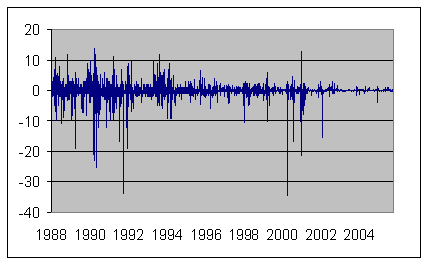
On the next-to-last day of the month, similar logic would again imply that the price reflects the market expectation at that time. New information could well come in after this, causing the price to move up or down before settlement. But if it were possible to anticipate, say, a price increase between the penultimate and last day of the month, there is a pure profit opportunity from buying on October 30 and selling on October 31. A statistical principle known as the Law of Iterated Expectations implies that the October 30 price should not only equal the expected settlement value, it should also equal the expected October 31 price. As time goes on and new information comes in, of course we know that the price is likely to change. But none of us can predict the direction. In other words, this simple theory suggests that the futures price should follow a martingale, in which the best forecast of where the price is going to be tomorrow is always just today&#8217-s price.In my statistical analysis I looked at daily changes in the interest rate implied by the current month&#8217-s fed funds contract (denoted f1d), the following month&#8217-s contract (f2d), and the month after that (f3d)- for example, for d = October 31 we could consider the change in the October contract (f1d), the November contract (f2d), or the December contract (f3d). The graph below plots daily changes in the interest rate implied by the current month contract from October 1988 through June 2006.

f1d.gif

On average, the values of f1d, f2d, and f3d all turn out to be negative over this sample period, with t-statistics around -4. This represents strong evidence against the martingale hypothesis, and some researchers have interpreted this bias as evidence of some kind of average risk or hedging premium reflected in the futures prices.

However, if you look at the graph above, you will see that it is a pretty wild series. Forty-six percent of the observations are identically zero, while 25 observations exceed 5 standard deviations. The variance is considerably larger at the beginning of the sample or the start of a month, with the volatility appearing in clusters and particularly on days of major monetary policy announcements. If one models all these volatility dynamics and departures from a Gaussian distribution, the maximum likelihood estimate of the population mean of f1d, f2d, or f3d all turn out to be positive rather than negative, and far from statistically significant. The sample median of all three series is also exactly zero. I therefore see the nonzero sample mean not as an indication of bias on the part of futures markets, but rather as reflecting the fact that there were a few big moves down in interest rates over this period

that caught traders by surprise.

I also looked for whether changes could be predicted on the basis of lagged changes, by regressing fid on a constant and five of its own lagged changes. OLS coefficient estimates along with their 95% confidence intervals are shown below.

fid_autoregressions.gif

The first lag is always highly statistically significant. Its value, however, is only around 0.15, which gives the regression an R2 of less than 0.03 and essentially zero predictability looking more than one day ahead. It is quite likely that this very modest degree of predictability could be attributed to measurement error in resolving daily bid-ask factors rather than systematic errors or risk factors in futures markets.

The paper by Piazzesi and Swanson mentioned above documents some predictability using monthly data of longer-horizon fed funds futures prices based on a number of interest rate spreads. However, consistent with their findings, I find these spreads do not predict the daily movements in the prices associated with the near-term fed funds futures contracts that I am studying, as summarized in the table below:

Explanatory variableDependent variable
xd-1-1f1df2df3d
10-year minus 5-year
Treasury spread
0.058
(0.086)
-0.036
(0.117)
-0.070
(0.138)
5-year minus 2-year
Treasury spread
-0.009
(0.058)
-0.085
(0.079)
-0.126
(0.093)
2-year minus 1-year
Treasury spread
-0.072
(0.112)
-0.136
(0.153)
-0.172
(0.181)
1-year minus 6-month
Treasury spread
0.006
(0.173)
0.302
(0.236)
0.439
(0.279)
Baa minus 10-year
Treasury spread
-0.035
(0.058)
-0.126
(0.079)
-0.184*
(0.094)
12-month job growth
(revised data)
0.017
(0.023)
0.089**
(0.031)
0.125**
(0.036)
12-month job growth
(real-time data)
0.016
(0.024)
0.093**
(0.033)
0.121**
(0.039)

I also replicate with these data Piazzesi and Swanson&#8217-s observation that employment growth helps predict futures prices, though again for my data the R2 is only 2%, and the results I will describe in my next post turn out to be insensitive to whether one includes this conditioning variable. Overall, I conclude that although these data do not appear to follow an exact martingale, that is really an excellent approximation to their behavior.

A separate question from whether changes in futures prices are possible to predict is the question of how far in advance they give a useful estimate. One standard of comparison is the mean squared error, or the average squared difference between the implied futures forecast at a given date and what the actual fed funds rate turns out to be. A benchmark for comparison is the assumption that the fed funds rate itself follows a martingale, so that one&#8217-s forecast for the future value of the fed funds rate is always its current value. Such &#8220-no-change&#8221- forecasts have often proven to be very difficult to beat out-of-sample with financial data. The table below shows that, if you simply predicted that the fed funds rate isn&#8217-t going to change, you&#8217-d have a mean squared error of 389 basis points (that is, a standard deviation of about 20 basis points or 0.2%) predicting one month ahead and 2,522 basis points (50 basis-point standard deviation) predicting 3-months ahead. For comparison, the MSEs of the futures-derived forecasts are only a third as large.

Forecast horizonNo-change
MSE
Futures
MSE
Percent MSE
improvement
Futures
MAE
1 month ahead38912867%6.90
2 months ahead124839269%12.76
3 months ahead252291464%20.03

Futures prices have become even better predictors over the last three years, with an incredible 97% improvement over the &#8220-no-change&#8221- forecast:

Forecast horizonNo-change
MSE
Futures
MSE
Percent MSE
improvement
Futures
MAE
1 month ahead183597%1.50
2 months ahead6651997%3.18
3 months ahead14844897%5.40

The moral is, if you think the fed funds rate is going to do something over the next few months that differs from what is predicted by the futures prices, then think again.

And what the futures prices say right now is, no change in December.

Chinese Markets

No Gravatar

In its October 25, 2006 press release, Cambridge-based consultancy Market Platform Dynamics says it has the &#8220-only China-based prediction market capability.&#8221- They actually seem to be referring to a survey. Their website gives no evidence of a price mechanism.

MPD’s partnerships in China give us exclusive access to a network of more than 11,000 Chinese managers who will serve as the firm’s Chinese “prediction market” and who will routinely surveyed on behalf of clients to determine their interests in new products and services.

Anyone know what&#8217-s up?