
…- would be an interesting idea —-Eric Zitzevitz would probably agree.
Addendum (January 2, 2006): Yahoo! Tech Buzz Game has one Sirius &- XM prediction market, says David Pennock in the comment area.

…- would be an interesting idea —-Eric Zitzevitz would probably agree.
Addendum (January 2, 2006): Yahoo! Tech Buzz Game has one Sirius &- XM prediction market, says David Pennock in the comment area.
Last time, I told you about TED 2007 and I noticed Nathan Myhrvold (former MicroSoft CTO –he founded MicroSoft Research) in the speaker list. That prompted me to visit his site, Intellectual Ventures, home of his “invention company”:
Intellectual Ventures is an invention company. We conceive and patent our own inventions in-house through a world-renowned staff of internal and external scientists and engineers. We also acquire and license patented inventions from other inventors around the world. Our network of invention sources includes: large and small businesses, governments, academia, and individual inventors. These inventions span a diverse range of technologies including: software, semiconductors, wireless, consumer electronics, networking, lasers, biotechnology, and medical devices. Our current focus is on developing our invention portfolio. Over time, we intend to market our portfolio on a broad and non-exclusive basis through a variety of channels including spin-out companies.
In the November issue of IP Investor (PDF), it is said that Intellectual Ventures has filed about 400 patents, and Nathan Myhrvold slams eBay for having filled only “10 patents or 11 patents” —big companies need patents “for the future”, he says. It would be interesting to know how many patents BetFair has filled —BetFair, like eBay, is a peer-to-peer exchange.
Of course, once you have transitioned from “invention” to “innovation”, the road does not end there: more than 75% of new products fail.
—
All this to come back to Robin Hanson’s invention, the concept of decision markets (a market-generated automatism to extract the wisdom of crowds and make it a better decision tool than managers or politicians), which he spams at each conference he is invited in. As I wrote two times, it’s a solution in search for a problem. I would see only two applications (last time I said “only one”, but I got a new idea):
– As I said, series of decisions that are NEVER taken by senior executives.
– In the coming two decades, imaginary universes (like Second Life) are going to meet with prediction markets. Once we are there, we can imagine a Second Life sub-universe filled with libertarians, playing with imaginary prediction markets. Then, yes, if the gamers agree, imaginary decision markets could rule —both at the macro and micro levels.
—
More Resources On Innovation:
– The Business Innovation Insider blog – (highly recommended, especially to my marketing guru Guy Kawasaki)
– Innovators share the lessons they’ve learned during 2006 – (a hodgepodge of ideas taken from various thinkers)
This is a recent picture of traitor Mike Linksvayer (much better than the New York Times picture where he looked like an angry chimp):

—-
First, Mike Linksvayer sided with moi:
[Hollywood Stock Exchange] could be an indicator that the [TradeSports] price is wrong and in which direction, which is enough for a [TradeSports] trader to place an order.
Then, as soon as I turned my back, he sold me down the river (I should have known!!!!!!):
I agree with everything you [you = Sacha Peter] write in the last comment (and your original challenge to CFM to put his money where his mouth is).
—-
#1. HSX “-prices”- are predictive (see The effectiveness of pre-release advertising for motion pictures – PDF – by Anita Elberse and Bharat Anand – 2005-03-05):
Despite the fact that the simulation does not offer any real monetary incentives, collectively, HSX traders generally produce relatively good forecasts of actual box office returns (e.g. Elberse and Eliashberg 2003, Spann and Skiera 2003). According to Pennock, Lawrence, Giles and Nielsen (2001a- 2001b), who analyzed HSX’-s efficiency and forecast accuracy, arbitrage closure on HSX is quantitatively weaker, but qualitatively similar, relative to a real-money market. Moreover, in direct comparisons with expert judges, HSX forecasts perform competitively.
#2. You can investigate accuracy and precision scientifically- no need to back one’-s research paper with one’-s money.
#3. My original question was: “Should I use HSX info to speculate at TradeSports?”. Looking at HSX and TradeSports odds, maybe The Departed is correctly priced or underpriced at TradeSports, and maybe Babel is underpriced at TradeSports.
Both Spook86 and Michael Ledeen suggested a few days ago that the USA might be adopting a stronger position towards Iran. Are we?
Look at Tradesports’- price history for its AIRSTRIKE.IRAN.DEC07 contract:
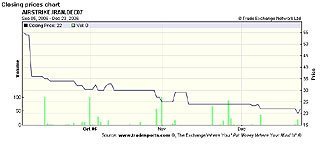
(Click the thumbnail to display a large version of this chart.)
So what does this combination of an increase in stern American and British rhetoric, and stagnant odds in the geopolitical wagering market, mean? I think it’-s clear. The rhetoric is most likely not intended as a prelude to action by us. It is intended as a substitute for action. This is business as usual and not at all encouraging.
(See also this post.)
Cross-posted at Chicago Boyz, an Intrade affiliate.
No definition, but there’-s an example, here —-static, alas.
(((In passing, I see that NewsFutures “-will use the Brookings Institution’-s Iraq Index as a source to measure troop levels.”- Good. But what it they fail to deliver, like the US DOD in the NKM scandal?)))
Previous blog posts by Chris F. Masse:
There’-s a set of Robin Hanson slides that are much more interesting than the presentation he gave at Yahoo! Confab.
– It’-s bigger (67 slides vs. 21) and it covers the prediction market problematic in a more comprehensive way (including MSR).
– The decision market concept takes a minor place, whereas at Confab, Robin Hanson made the mistake to focus most of his speech on it —-interesting concept but that was the wrong audience (Confab attendees wanted specific answers about basic prediction market questions).
– Here are excerpts, but I recommend you to download the presentation file, read it from A to Z, and share it with your friends and colleagues. (And if you had downloaded his Confab slides, direction the trash can of your computer –-don’-t keep 7 megas of useless bits of information.)
—-
Prediction Markets for Science? – (PPT) – by Robin Hanson – 2006-12-XX
—-
Today’s Science Prices (Play $ Alas) – [Foresight Exchange]
11-14% P != NP proven by 2010
16-18% Cancer cured by 2010
16-19% Cold fusion works by 2015
28-29% Mammal immortality by 2015
28-31% Eventual universe collapse
68-70% Fusion energy sold by 2045
74-76% Extraterrestrial life by 2050
91-95% A gamma ray burst w/in 33Mly
93-95% Cosmo constant >- 0
93-96% Neutrino mass >- 0Science Decision Markets
E[ Iraq civil war | US moves troops out? ]
E[ Sea levels | Raise CO2 tax ]
E[ Lifespan | Health care reform ]
E[ Murders | More gun control ]
E[ Cancer deaths | More research funding ]
E[ Firm stock price | fire CEO? ]
E[ Succeed? | Fund project ]
E[ Publications | Hire candidate ]
E[ Citations | Publish ]Theory I – Old
“Strong Efficient Markets” is straw man
No info – Supply and Demand
Assume beliefs not respond to prices
Price is weighted average of beliefs
More influence: risk takers, rich
Info, Static – Rational Expectations
Price clears, but beliefs depend on price
No trade if not expect “noise traders”
Price not reveal all info
More influence: info holdersTheory II – Market Microstructure
Info, Dynamic – Game Theory
Example – Kyle ’85
X – Informed trader(s) – risk averse
Y – Noise trader – fool or liquidity pref
Market makers – no info, deep pockets
If many compete, Price = E[value|x+y]
Info markets – use risk-neutral limit
If Y larger, X larger to compensate more info gathered, so more accuracy!Theory III – Behavioral Finance
Humans are overconfident
Far more speculative trade than need
Mere fact of disagreement shows
Overconfidence varies with person, experience, consequence severity
Implications
Price in part an ave of beliefs?
Adds noise to price aggregates?
Prices more honest than talk, polls, …Ask the Right Questions
Cost independent of topic, but value not!
Seek high value to more accurate estimates!
Relevant standard: beat existing institutions
Where suspect more accuracy is possible
Suspect info is withheld, or not sure who has it
Prefer fun, easy to explain and judge
Prefer can let many know best estimates
Not fear reveal secrets, use fear to motivate
Avoid inducing foul play
Eight Design Issues
How avoid self-defeating prophecies?
How handle billions of possible combos?
What if terrorists lose $ to mislead us?
What if terrorists gain $ by give us info?
How not alarm public, inform terrorists?
Price can mislead if deciders know more.
Will markets induce people to lie?
Will markets help employees embezzle?
—-
Thoughts About “-Decision Markets”-:

—-
#1. Robin Hanson first wanted to apply his decision market concept to refine the democratic process —-”-vote on values but bet on beliefs“-. He calls that “-futarchy”- (PDF) —-as far as I can see, only some libertarian wackos like Chris Hibbert or Peter McCluskey bought the idea. (I’-m not even sure his paper was accepted somewhere for publication.)
#2. Now, Robin Hanson tries to plug his decision market concept as a management decision tool —-here’-s from his Confab presentation:
Decision Market Applications
E[ Revenue | Switch ad agency? ]
E[ Revenue | Raise price 10%? ]
E[ Project done date | Drop feature? ]
E[ Project done date | Add personnel? ]
E[ Stock price | Fire CEO? ]
E[ Stock price | Acquire firm X? ]
The guy doesn’-t have the slightest chance that his envisioned applications see the ray of light, one day (that is, before his head gets chopped off and frozen, shortly after his death). Basically, he wants the senior executives to be replaced with a market-generated automatism. Even if he can prove that it would lead to lead to better management decisions (and I trust him on that), he’-ll encounter entrenched resistance from the same people his decision tool was created to compete with. I’-d short-sell Robin Hanson on that one —-with all my might, and I’-d bet George Soros would see an opportunity here.
#3. The only chance the guy has would be to dig the field of management science for areas where a series of micro decisions are taken by mid-level executives or technologist or scientists or other employees —-but NEVER by senior executives. In that perspective, all the examples of applications he gave above are worthless —-direction the trash can of your computer (and select “-empty the trash can”-, to make sure they disappear for good.)
#4. Robin Hanson (who is a bright inventor) is totally incapable of seeing the light of what could be a successful innovation. The only chance the guy has would be for him to network with Silicon Valley’-s geeks-turned-IT-executives, and, after a series of of pitches, maybe he would get feedback from someone who can find a mutant idea —-an idea that is original, almost bizarre- an idea nobody ever thought of before. Robin Hanson, on his own, is totally incapable of thinking creatively in terms of innovation —-he likes big ideas but he doesn’-t get people and marketing (including internet usability). Which is why I’-m suggesting to him to go West and to find his complement(s) there. That’-s his only chance.
The movie “-Babel”- seems quite hot at HSX for the Oscar of the Best Picture…- and not so hot at TradeSports. Since HSX’-s track record is quite impressive regarding Oscars predictions, I would use HSX info to speculate at TradeSports.
Agree, disagree?
Prediction Markets, Decision Markets, and More – (PPT) – by Robin Hanson – 2006-12-13
– All speculation is “gambling”!
– In direct compare, beats alternatives – (Vs. Public Opinion – Vs. Public Experts – Vs. Private Experts)
– Advantages – (Numerically precise – Consistent across many issues – Frequently updated – Hard to manipulate – Need not say who how expert when – At least as accurate as alternatives)
—-
What’-s above is about “-prediction markets”-. Now, below, here are possible instances of “-decision markets”- (a more complex form of prediction markets, structured to be a decision tool, not jut a forecasting tool):
Decision Market Applications
E[ Revenue | Switch ad agency? ]
E[ Revenue | Raise price 10%? ]
E[ Project done date | Drop feature? ]
E[ Project done date | Add personnel? ]
E[ Stock price | Fire CEO? ]
E[ Stock price | Acquire firm X? ]
CFM hated it when Peter McCluskey wrote:
What many of us want from prediction markets bears more resemblance to the products of think-tanks than it does to any other institution that I’-m aware of
But this reminds me of something. When has a pro-market think tank ever subjected its policy recommendations to market evaluation? Never, as far as I know.
The Independent Institute published a book chapter on Decision Markets by Robin Hanson in Entrepreneurial Economics. When institute Research Director Alexander Tabarrok gave a talk on the book, you can guess what subject he spent the most time on.
Think tanks that talk about prediction markets (AEI-Brookings is another) should walk the walk, as should institutions that laud the rigors of the market generally. This could involve setting up and running a non-profit exchange or paying Intrade to offer certain contracts, or variations between.
Many think tank proposals have virtually no chance of implementation. These would not be ideal candidates for prediction market evaluation, but not all think tank prescriptions are politically impossible, and much of what think tanks do is critique proposals that do stand real chance of implementation. If the choice is between yet another Op-Ed and a contract on the subject, I’-ll take the latter.
I’-ll make a $500 donation to the first think thank that makes an interesting, non-bogus use of real-money prediction markets before the end of 2007. I’-ll be the judge of bogosity and interestingness, but I can say that a paper about prediction markets counts as uninteresting.
…-
A grouping that loves to talk about markets (that is when they’-re not going off on incoherent rants) but hates any sort of evaluation consists of U.S. Libertarian Party candidates, activists, and donorsfools. Each election there are LP candidates who vigorously argue that they have a good shot at winning significant office or at least obtaining millions of votes in the case of the U.S. Presidency, ignoring 35 years of abject failure.
The case of Michael Badnarik’-s “-campaign”- for U.S. Congress ending last month is a hilarious case in point. He raised over $400,000, claimed he could win, and got …- 4 percent of the vote. He’-s now begging for another $200k and it turns out his “-campaign”- “-manager”- is starting his own Scientology-like religion.
That’-s not all that out there for an LP campaign, nor is it surprising–-there is no competition from non-wackos for candidacies that are doomed to failure.
One LP campaign this cycle that didn’-t appear to be crazy but nevertheless radically overestimated its chances of success was that of Bob Smither, running in Tom DeLay’-s GOP district against a Nick Lampson, a Democrat ex-Congressperson (who won easily) and a write-in Republican. Because the TX-22 race this year was unusual it was one of several seats Intrade ran markets on. The Intrade market included DEM, GOP, and FIELD contracts. FIELD could be taken as representing Smither, so this may have been the very first LP candidacy evaluated by traders. (FIELD exists in most Intrade election outcome markets but typically attacts no trading, as the field hasn’-t a snowball’-s chance in hell.) Their evaluation was not kind, as I pointed out in a blog post and several times in comments on a blog (no longer live) that hyped Smither’-s chances, where I goaded fans to place bets. Smither polled 6%, against 51% for the Democrat and 43% for the write-in Republican.
One doesn’-t need a prediction market to see that LPers are delusional, amnesiac, or just plain stupid. But as someone with strong libertarian sympathies (actually like prediction market legal scholar Tom W. Bell I’-d prefer to take back the word liberal) I’-ll gladly take additional opportunities to rub the facts in the face of my embarrassing and hypocritically scared-of-markets fellow travellers in the LP.
…-
Did I say baiting? Oops, I meant betting!
Three years after the Policy Analysis Market proposal’-s untimely and tragic abortion has analysis of probable policy consequences improved at all? If reports on the Iraq Study Group are any indication, the answer is no. I gather a group of commissioners and their staff chatted with a number of supposed experts over many months and eventually churned out a long list of plausible sounding recommendations with zero attempt to quantify probability or size of the consequences of those recommendations. The report itself, which I have only skimmed, contains 39 instances of the word could, 34 of the word would, one of the word prediction:
These and other predictions of dire consequences in Iraq and the region are by no means a certainty.
Awww, that’-s nice. And one of the word probability:
But there are actions that the U.S. and Iraqi governments, working together, can and should take to increase the probability of avoiding disaster there, and increase the chance of success.
Note that the report isn’-t assigning probability, rather asserting someone should take care to increase the probability of a good outcome!
The report’-s analysis of four often advanced policy courses (Section I(C): withdrawal, stay the course, more troops, devolution) consists of a string of cheap assertions.
…-
Unfortunately no private sector prediction market has stepped in to fill this vacuum.`A little over two weeks ago as speculation about the ISG and potential changes in U.S. policy ramped up I looked for prediction markets relevant to Iraq and found three, all play money, one at each of FX, Newsfutures, and WSX. Unfortunately all are concerned with U.S. troop levels or deaths and none are conditional on other events.
So I created a market on Inkling with four stocks: will the Iraq Body Count increase by 40,000 or more from May through December of 2007, conditioned on whether U.S. troop levels fell below 100,000 in April 2007.
The latter will be judged based on the outcome of the Newsfutures contract USLEAV07. It seemed to make some sense to condition on an existing contract which already had some history and volume. As far as I know this is the first time a contract on one prediction market site has been conditioned on the outcome of a contract on another site. Not that it matters. This market was not a rare jewel, but an utter failure.
The market has attracted a total of two traders have made two trades, leaving prices almost exactly at their starting points, while Newsfutures’- USLEAV07 has fallen by over half. There’-s nearly free Inkles for the taking. Actually there are many markets at Inkling offering nearly free Inkles, including two Democratic U.S. presidential nomination markets with sharply different prices for some candidates, but apparently nobody wants Inkles.
Links to Iraq-related markets referenced above are at my personal blog.
…-
If I create a play money market again I shall do so on FX, which at least has a base of knowledgeable traders, some of whom are fairly motivated to improve their FX score. I make an exception for playing with new sites.
Like our host I would like to see more (any!) socially relevant real money prediction markets. Over a year ago Masse said the solution is always ‘-better marketing’-. Slightly less than a year ago he said The key to more socially relevant prediction markets is better marketing. Stay tuned, folks.
I’-m not certain that marketing is the critical piece (Tradesports hasn’-t really tried “-if you build it, they will come”- though this hasn’-t entirely stopped academics from using prediction and other market prices and fortuitous circumstances to make some socially relevant inferences), but it couldn’-t hurt when combined with a tiny bit of vision.
I’-m staying tuned.
Previous blog posts by Mike Linksvayer: