Malcolm Gladwells Blink + James Surowieckis The Wisdom Of Crowds

No Gravatar

&#8212-

What Do We Mean When We Talk About Intuition? – by James Surowiecki

[…] This suggests that the real challenge is figuring out which problems can be solved by rapid cognition and which are better solved by a calculating, rational approach. […]

Challenging the Standard Model of Decision-Making – by Malcolm Gladwell

[…] The war game that I write about, which was the most expensive and most elaborate war game ever conducted in history ($500 million dollars!), was a preview of the Iraq War. One side played the United States. Van Riper, essentially, played Saddam Hussein. And van Riper won, hands down, sinking half the U.S. Navy on the second day of the war. How did that happen? Because at the moment he attacked the U.S. Forces, they were so caught up in their computers and charts and systems analysis and complex matrixes that they had lost the ability to engage in the flexible, free-wheeling, instinctive thinking that is essential in the midst of battle. […]

The Virtues of Group Decision-Making – by James Surowiecki

[…] To me, that&#8217-s one of the (and maybe the) great virtues of collective decision-making: It doesn&#8217-t matter when an individual makes a mistake. As long as the group is diverse and independent enough, the errors get corrected and you&#8217-re left with the knowledge. […]

The Biases and Delusions of Experts – by Malcolm Gladwell

[…] My survey of Fortune 500 CEOs, as you mentioned, revealed that, with very few exceptions, they are almost all tall. Are CEOs chosen whimsically? Not at all. Committees spend weeks and months in deliberation. But at the end of the day they still end up overwhelmingly picking tall men. Deliberation makes us more confident in our decision. But I&#8217-m not sure it makes the decision itself more accurate and free of bias. […]

Which Information Really Does Matter? – by James Surowiecki

[…] I&#8217-ve thought for a while now that one of the reasons why the collective decision-making mechanisms I write about in my book—like, for instance, betting markets—work well is that in part they aggregate intuitions and impressions that people can&#8217-t necessarily articulate, but that are nonetheless real and valuable. […]

How To Improve the Decision-Making Environment – by Malcolm Gladwell

[…] For instance, one of the really interesting facts about police work is that an officer behaves much better—makes better decisions, fires his gun less frequently, has fewer complaints filed against him—when he is by himself than when he is paired with a partner. Officers on their own are far more cautious. Without the emboldening presence of a companion, they take far fewer risks. They don&#8217-t pick fights, or put themselves into nearly as many ambiguous or dangerous situations, because they know they have no one looking out for them. […]

INTRADE-TRADESPORTS: John Delaney LIED in his Freakonomics interview.

No Gravatar

That&#8217-s what tries to demonstrate event derivative trader &#8220-Vancheeswaran&#8221- in a comment on the Freakonomics blog post featuring a complacent interview of InTrade-TradeSports&#8217- John Delaney.

&#8212-

InTrade-TradeSports&#8217- John Delaney:

We listed a market on whether the U.S. Government would formally report that North Korea tested a missile in a certain manner. While the media reported that North Koreans did test a missile, it was not confirmed in an official U.S. Government release as was required in the market rules, so we settled the market according to the strict interpretation of the rules and not the understood intention of the market. This was understandably a real issue for some of our members and also for Intrade. It was a bad situation for everyone, really. We have learned from it.

Event derivative trader &#8220-Vancheeswaran&#8221-:

BULLSHIT.

Bryan Whitman ([email protected]) explicitly stated in print, in press conferences, and by email that North Korea fired multiple missiles into the Sea of Japan.

For instance, “North Korea fired a long-range Taepodong-2 missile and six short- and medium-range Scud and Nodong missiles. All landed in the Sea of Japan without incident.”

National Security Advisor Stephen Hadley, in a press conference at the White House, stated that the missiles “went out about 275 miles” into the Sea of Japan.
http://www.whitehouse.gov/news/releases/2006/07/20060704-1.html

There are many other examples of the U.S. military and government (not just the press) confirming that the missiles were launched and approximately where they landed.

John Delaney is completely misrepresenting what happened, just as he did at the time of the launches.

As I wrote last week, I will have my say on this Freakonomics interview. Stay tuned, folks.

The Harry Potter litmus test

No Gravatar

I propose the following test to check whether &#8220-Harry Potter is alive at the end of the novel&#8220-.

Is J.K. Rowling able to write an 8th installment of the series (a sequel) without resurrecting Harry Potter?

1. If &#8220-yes&#8221-, that means that &#8220-Harry Potter is alive at the end of the novel&#8221-.

2. If &#8220-no&#8221-, that means that &#8220-Harry Potter is not alive at the end of the novel&#8221-.

NOTE: Prequels are of course allowed in both cases. (Thanks to Deep Throat for the tip)

&#8212-

1. If J.K. Rowling writes in an epilogue that Harry Potter will die after a life well lived (that is, from natural cause, after a long and happy life), then an 8th book is possible.

2. If J.K. Rowling writes that Harry Potter dies in the hands of his &#8220-old nemesis&#8221-, then an 8th book is not possible (unless J.K. Rowling resurrects her hero).

&#8212-

Note that, in the Sir Arthur Conan Doyle’s Sherlock Holmes case, we are in the configuration #2.

&#8212-

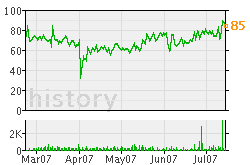
Harry Potter will survive The Deathly Hallows. (15,813 contracts held.)


© NewsFutures

Static chart:

Harry Potter NewsFutures

&#8212-

Previous: The contract of the Harry Potter event derivative at NewsFutures may be flawed.

&#8212-

NEXT: THE FATE OF HARRY POTTER IN J.K. ROWLING’S 7TH BOOK, THE DEATHLY HALLOWS: prediction market vs. bookmaker + NEWSFUTURES JUDGES THAT HARRY POTTER IS STILL ALIVE AT THE END OF J.K. ROWLING’S 7TH NOVEL, THE DEATHLY HALLOWS.

&#8212-

Previous blog posts by Chris F. Masse:

  • The FaceBook profiles of the 2 most important men of the field of prediction markets
  • THE HUMAN GADFLY WHOSE OBJECTIONS ROBIN HANSON IS DUCKING…???…
  • Google now considers Midas Oracle as a major blog.
  • Horizon 2015: A long-term strategic perspective for the real-money prediction markets
  • Join our group at LinkedIn to have your “Prediction Markets” badge on your profile. It’s ‘chic’. (“Groups” info should be set as “visible”, in your profile options.) We are 63 this early Saturday morning —keeps growing.
  • If you have been using PayPal to fund your InTrade, TradeSports or BetFair account, please, check that horror story.
  • 48 hours after the launch of the “Prediction Markets” group at LinkedIn, we have already 52 members —both prediction market luminaries and simple people (trading the event derivatives or collecting the market-generated probabilities).

BETFAIR DOES FIGHT VIGOROUSLY ANY ATTEMPTS AT MONEY LAUDERING.

No GravatarBetFair&#8217-s P.R. release (BetFair PDF file):

London, 11th July 2007

There have been a number of recent media articles suggesting that terrorist offences concerning planned attacks in London in November 2005, for which Waseem Mughal and Younis Tsouli were convicted, involved money laundering through Betfair’s site. Indeed an individual was convicted for specific money laundering/fundraising offences, and the articles have suggested successful attempts to launder money through Betfair.

A number of attempts were made to use Betfair’s site fraudulently, but they were unsuccessful: they were identified- accounts were closed- and all relevant information was shared with the police. It is simply incorrect to say in respect of Betfair that “winnings were withdrawn and transferred to online bank accounts under their [the terrorists’] control”.

We worked with the police during this investigation, and continue to do so as necessary. We are pleased to have played our part in providing evidence to them.

We are prevented from disclosing anything further.

Notes to Editors:

1. Betfair has a money laundering team of four full time employees, headed by a former Detective Chief Inspector in the Serious &amp- Economic Crime Directorate of the Metropolitan Police.

2. Betfair is compliant with the Proceeds of Crime Act and the soon-to-be-implemented EU Directive on money laundering.

For further information, please contact Mark Davies, +44 20 8834 8208

Previous: BRITISH BETTING EXCHANGE BETFAIR USED FOR MONEY LAUNDERING BY RADICAL ISLAMIC CYBER-CRIMINALS WHO PREPARED THE GROUNDWORK FOR ANTI-WESTERN TERRORISTS. – I have updated that old blog post with today&#8217-s correction.

Previous blog posts by Chris F. Masse:

  • If Midas Oracle were to meet, would we use Huddle, and why?
  • WORLD’S SUCH A SMALL PLACE: Smarkets meet HubDub.
  • 50% of our prediction market luminaries have a MacBook.
  • STRAIGHT FROM OUR TRUISM DEPARTMENT: Money buys happiness.
  • Ron Paul (R) and Barney Frank (D) ally together to attack “the practical hurdles of the federal law, known as the Unlawful Internet Gambling Enforcement Act, rather than its legitimacy”.
  • Clicking on the “SPHERE: RELATED CONTENT” button, at the bottom of each Midas Oracle post, will bring you a list of external webspots.
  • FRIGHTENING: Jed Christiansen’s prediction market blog was briefly overtaken by web spammers, who inserted invisible links to their commercial sites so as to game the Google PageRank system.

We, the undersigned, petition J.K. Rowling to write more new adventures for Harry Potter and his friends no matter what happens at the end of Harry Potter and the Deathly Hallows.

No GravatarSave Harry Potter

There is a precedent for resurrecting a literary hero &#8212-Sir Arthur Conan Doyle&#8217-s Sherlock Holmes. In The Adventure of the Final Problem (1893), Sherlock Holmes falls to his death during a violent struggle with his nemesis, Professor Moriarty. A public clamor then persuaded Conan Doyle to resurrect him.

Holmes archenemy and popularly-supposed nemesis was Professor James Moriarty (&#8221-the Napoleon of Crime&#8221-), who fell, struggling with Holmes, over the Reichenbach Falls. Conan Doyle intended The Final Problem, the story in which this occurred, to be the last that he wrote about Holmes. However, the outpouring of protests and letters demanding that he bring back his creation convinced him to continue. He did so with The Hound of The Baskervilles, although this was a case Holmes was involved in before his supposed death. His return in The Adventure of the Empty House had Conan Doyle explaining that only Moriarty fell over the cliff, but Holmes had allowed the world to believe that he too had perished while he dodged the retribution of Moriarty&#8217-s underlings.

Harry Potter will survive The Deathly Hallows.


© NewsFutures

Previous: Sherlock Holmes and Professor Moriarty at Reichenbach Falls

Sherlock Holmes (the good) and Professor Moriarty (the villain) fell together in the Reichenbach Falls. Sherlock Holmes is thought to be dead. Many years later, he re-appears, to the astonishment of his Doctor Watson.

–&gt- Let’s say there were a prediction market on the Sherlock Holmes survival, which was bound to expire just after the Reichenbach Falls episode. It would have expired on the “no” side —although the ultimate truth was going to be that Sherlock Holmes was still alive.

UPDATE: The contract of the Harry Potter event derivative at NewsFutures may be flawed.

NEXT: THE FATE OF HARRY POTTER IN J.K. ROWLING’S 7TH BOOK, THE DEATHLY HALLOWS: prediction market vs. bookmaker + NEWSFUTURES JUDGES THAT HARRY POTTER IS STILL ALIVE AT THE END OF J.K. ROWLING’S 7TH NOVEL, THE DEATHLY HALLOWS.

Read the previous blog posts by Chris F. Masse:

  • Many people twitter on prediction markets.
  • Folks, when you have something important to say, write up a full post, not a comment.
  • Prediction Market Journalism
  • TechCrunch is 221 times bigger than Midas Oracle.
  • Earthquake measuring 9.0 or more on Richter scale to occur anywhere on or before December 31, 2008
  • Why Midas Oracle (and not TV news shows or print newspapers) will dominate the future.
  • The Six Degrees Of Separation

New Fee Structure At TradeSports Causes Confusion.

No Gravatar

[This article is cross-posted from Major Wager.]

&#8212-

Tradesports.com (and sister operation, Intrade.com) have long been at the forefront of exchange-based sports wagering and futures markets. In operation since 2002, Tradesports represented the first real exchange open to Americans, long preceding eventual rivals Mansion and Matchbook.

The Tradesports fee structure has long been the subject of player confusion, at least for in-game betting. Previously, trades were subject to trading fees, and the holder of the shares at expiry was also charged expiration fees. Tradesports recently reconfigured their fees to be more in line with other exchanges. The new fee structure calls for a 4% commission to be assessed on the net profit on any market, regardless of the number of individual buy/sell orders placed.

The new fee structure, in general, has met with approval from traders, as it should increase liquidity on in-game betting, a niche market which Tradesports has mostly cornered. The elimination of transaction fees means players won&#8217-t be penalized for actively trading in a market. And while the new commission structure is undercut significantly by Matchbook (charging only 2%), it is generally cheaper for most scenarios than the preceding fee structure at Tradesports.

The previous structure also allowed pre-game trades to occur commission-free. Now all trades, regardless of time placed, will be taxed at the same 4% commission level. Tradesports has given up the big price advantage they had by offering pre-game trades with no commission, one area where they were cheaper than competitors. Perhaps Tradesports is aiming more towards the European market, and trying to undercut BetFair&#8217-s 5% fee. Tradesports has a lot of catching up to do in that market, however, and Tradesports still fails to offer the volume discounts that BetFair does, a big benefit for heavy traders.

One point of controversy is that Tradesports is charging the new commissions on long-term market contracts that were in existence prior to the fee change, and which have been trading under the old rules. This is not the first time Tradesports has retroactively changed fees on markets already trading, having faced similar complaints in November of 2006. Of course, the issue is that an exchange like Tradesports, with markets constantly trading, never has a &#8220-downtime&#8221- to make major changes like reconfiguring fee structures. It is impossible to smoothly transition to new rules in an active market.

Following trader outcry, Tradesports relented and promised to refund the excess fees for any shares that were already traded prior to the implementation of the new commission structure. However, all future trades would be subject to the 4% profit tax, even if the market had been actively trading for months. This prevents traders from trading out of their current positions without suffering the 4% profit tax. While Tradesports did notify their traders of the fee increase a week in advance, the ambiguity regarding whether fees would be applied to pre-game trades as well as to existing contracts was not clarified until after the new fees had gone into effect.

Tradesports could have avoided this confusion quite easily by explaining their position more clearly well before the new fee structure took effect. This would have allowed those who wanted to hold onto their positions to know that they would not be charged higher fees than they expected going into the trade. It would also allow those who did not want to hold their contracts to completion to exit the market prior to the new fee structure. Ideally, Tradesports would have offered traders a few days grace period where they could close existing positions without incurring the new fees, or even offer to buy back or sell outstanding shares to traders at a preset baseline price, to allow them to exit the market.

While hardly a travesty, the transition could have been carried out better. Existing contracts have not lost any value, as long as the current holder holds them until the end. Yes, traders have lost the liquidity that exchange betting brings, but this is a minor glitch in a long-established operation. But to maintain the goodwill of their customers, Tradesports needs to avoid such glitches in the future.

For future rules changes, Tradesports should consider shutting down active markets permanently, with at least a few weeks advance notice. This would allow traders to decide whether they were willing to hold their positions until the end, or whether to get out before the new rule change. For instance, the existing World Series future market could have been closed to further trading as of June 27th. Anyone still holding shares as of a set date would be stuck with them for the duration, when they would be paid out under the old structure. A new World Series market could have been opened immediately, now trading under the new rules. This scenario allows all traders in a given market to participate under the same set of rules, and eliminates the ambiguity that caused trader confusion in the present case. Having both the new and old markets open simultaneously would allow further liquidity, as traders hedged their risk on long-term versus short-term holdings.

More important is the lack of attention this move has received in the online gambling community. This may speak to the fact that Tradesports&#8217- profile in the online gambling arena has diminished significantly in recent years. Outside of some isolated message board posts calling foul for changing prices after bets are made, this topic has received scant attention.

The new fees likely have set Tradesports back significantly in the pre-game betting arena, as they now will offer prices closely in-line with traditional sportsbooks, and will be twice as expensive as closest competitor Matchbook.com. It appears the only real niche Tradesports may have is in-running wagering, as traditional sportsbooks have failed to expand live betting options, and the selection of opportunities at Matchbook is still limited. The new fee structure should provide added liquidity to the in-game markets, and this may become the ultimate niche for Tradesports if they are unable to compete in fees with other exchanges. If Matchbook were to step up their in-game selection, and market liquidity, they might price Tradesports right out of business.

07-11-07
Jay Graziani
MajorWager.com
graziani -|at|- majorwager -.- com

&#8212-

[This article is cross-posted from Major Wager.]

Deep Throat sells Harry Potter short.

No Gravatar

If there is a 50/50 chance of the epilogue being interpreted as part of the novel (I think it would be higher) and a high chance of a sad epilogue (telling Harry Potter will die after a life well lived), then I don&#8217-t think I would want to be long on survival.

Signed: Deep Throat

Previous blog posts by Deep Throat:

  • Who will write to the CFTC?
  • Why do BetFair Games (regulated in Malta, E.U.) have a timer on games?
  • Deep Throat on the idle Prediction Market Industry Association (PMIA)
  • IN-PLAY BETTING: BetFair is already compliant with the Gambling Commission’s first pointer.
  • Rumor Mill — Wednesday morning
  • Conference on Prediction Markets
  • How BetFair did treat its customers on the day that the BetFair Starting Price system crashed down

PROFESSOR KOLEMAN STRUMPF STILL DOUBTS THAT THERE HAS BEEN MANIPULATION OF THE HILLARY CLINTON EVENT DERIVATIVES.

No Gravatar

Koleman Strumpf on the Hillary Clinton prediction markets:

I think the market behavior since the original posting still could be consistent with no manipulation.

(1) At the time of my original post (Is there manipulation in the Hillary Clinton Intrade market?), Clinton’s conditional probability of getting nominated was 65%. It is now about 60%.

(2) Is there any news which might explain this drop? Sure– the market has decided that Obama is a much stronger contender for the nomination (and conversely Hillary is weaker). Namely, since the end of May, Hillary’s nomination contract fell from 51 to 43 and Obama has risen from 29 to 38. If the market thinks that the nomination is more unclear, then it is more likely there will be a protracted fight, and, even if Hillary gets the nod, she will be weaker and not be as likely to win the general contest.

Previous: Is there manipulation in the Hillary Clinton Intrade market? – by Koleman Strumpf + Win Justin’s Money? (re: Is there manipulation in the Hillary Clinton Intrade market? Redux.) – by Koleman Strumpf

Betcha.com: On Steamroller Justice and Reports of our Demise

No Gravatar

Yesterday, the Seattle Post-Intelligencer ran a story entitled &#8220-Betting web site&#8217-s computers seized.&#8221- Within hours, bloggers and other news outlets picked up the story and translated it into something akin to &#8220-Betcha shut down.&#8221-

Problem: the translation isn&#8217-t true. (WARNING: if tails of government bureaucrats running roughshod over its citizens turns your stomach, stop reading here.)

What&#8217-s Happening
What happened was this. Last Friday, Betcha&#8217-s attorneys and I met with the state Gambling Commission to address their concerns. They had us drive to their offices in Lacey, WA, about an hour from Betcha&#8217-s offices. The meeting lasted all of about five minutes, with it ending in a deputy commissioner handing us a pre-printed Cease and Desist order. I&#8217-ll attached a PDF copy of it later, but the gist of it was &#8220-shut down or else.&#8221- Why she couldn&#8217-t have told us this over the phone I am not sure &#8212- I suspect it had something to do with making my Friday afternoon a very expensive one. (Tax dollars hard at work.) At almost the exact same moment, Seattle lawyer Lee Rousso was, coincidentally, filing a lawsuit in state court asking the court to declare the state&#8217-s anti-Internet gambling ban unconstitutional. Although the law has previously been criticized on First Amendment grounds [1|2], and the Commission has taken positions in the past that appear pretty tough to square with any notion of free speech (an example), Mr. Rousso&#8217-s challenge is based on the Commerce Clause &#8212- that is, the law seeks to protect the in-state Native American casinos from out-of-state competition, and is therefore unconstitutional.

On Monday, I arrived to the offices early to unlock the doors so the raiders wouldn&#8217-t bust them down. (Not cheap to replace a busted down door.) A few hours later, Commission enforcers, indeed, showed up and took everything. Our books, our posters, my business cards &#8212- everything. (The warrant wasn&#8217-t limited – among other things, it included &#8220-stamps,&#8221- &#8220-printers,&#8221- &#8220-scanners,&#8221- &#8220-jewelry,&#8221- &#8220-envelopes&#8221-, &#8220-napkins&#8221-, &#8220-cardboard coasters&#8221- and &#8220-keys.&#8221-) No one from Betcha was there &#8212- not a good way to start the week, being on the business end of a roving commission. Ironically, my wife stopped by during the raid and chatted up Rick Herrington, the chief Raider (read: head of Commission enforcement.) When my wife asked Mr. Herrington whether they&#8217-d be selling our equipment on eBay, he shrugged his shoulders, as if to say &#8220-maybe yes, maybe no.&#8221- He then told her &#8220-Nick should have come to us first about this.&#8221- This exchange I find revealing: it seems that the Commission is more interested in ruining me and Betcha than anything else. Why? Because we&#8217-re near their turf.

As troubling was how the conversation continued. According to my wife, Mr. Herrington repeated several times &#8220-he&#8217-s breaking the law, he&#8217-s breaking the law.&#8221- When she told him that that was a judge&#8217-s decision, he replied &#8220-doesn&#8217-t matter, he&#8217-s still breaking the law.&#8221- (If that&#8217-s not guilty until proven innocent, I don&#8217-t know what is.)

On Tuesday, we petitioned a state court in Olympia to enjoin the Commission from this &#8220-seize and threaten now, ask questions later&#8221- approach. It almost never happens that a court will enjoin law enforcement from enforcing its version of the law, no matter how warped that version may be. This is an extraordinary remedy and we didn&#8217-t get it yesterday, although it wasn&#8217-t for lack of fantastic work by our lawyer.

The hearing wasn&#8217-t without substantial incident and irony. Apparently, although several people at both the Commission and Attorney General&#8217-s office had been served with our papers via fax, e-mail, and PDF, someone at the Commission did not receive an original copy of one of the documents, as required by the state service statute. As a result, we could not proceed until we could prove someone at the Commission had been served with an original copy of this document. We then had to race across Olympia to the Commission&#8217-s office in a nearby town to serve the one of the Commissioners himself &#8212- personally. (Not a single person in the legal department was working on that glorious 94-degree Tuesday &#8212- go figure.) The irony &#8212- exactitude matters big time to the Commission when it comes to serving paperwork that they already had. But precision in reading a criminal statute that may result in me doing years in the Gray Bar Hotel, not to mention wiping out a fair bit of investor capital and no less than seven years of man work &#8212- nah.

What&#8217-s Next
In terms of next steps, the situation is this. We are pursuing an action to get a court to declare Betcha legal. If the law and/or the Constitution matters in Washington (open question, that), I am confident Betcha will prevail. In the meantime, however, we face a Cease and Desist Order from a Commission that appears hell-bent on destroying Betcha at all costs. We&#8217-re going to review it in detail later today and decide on a course of action. We may have to take the betting-for-money part of the site down until we get on the other side of the steamroller.

You can rest assured, however, about our resolve. The government bureaucracy has been running roughshod over the citizens of this country for far too long. (Check out this book or BoilingFrog.com, among other sites, for some examples.) Prosecutors make up facts, legislators make it a crime to play poker in your own home, bureaucrats rewrite the laws, logic and the dictionary &#8212- and we&#8217-re all left at their mercy. The frog is boiling and the water&#8217-s getting hotter every day. I pledge to the friends and users of Betcha.com that I will do my part to turn the heat down. If that means rotting in jail, so be it.

Cross-posted from the Betcha.com blog

What should be Done about Manipulation of Prediction Markets?

No Gravatar

In “Is Manipulation Good for a Prediction Market,” Eric Zitzewitz seeks to counter my view that “Deep Pocketed Manipulators are a Prediction Market’s Friend” by suggesting that even if my argument is correct, manipulators still may be a net bad for prediction markets.

I argued that a manipulator ends up subsidizing the participation of informed traders in the market by putting money on uneconomic positions. Eric responded with three reasons that manipulation nonetheless may tend to undermine prediction markets. In brief (and in my words), he said:

  1. People have a distaste for behaviors which violate the spirit of the activity.
  2. The possibility of manipulation, and therefore a biased indicator, will lead decision makers to rely on less efficient methods for information gathering.
  3. Manipulation makes it harder to understand what is happening in the market – manipulation is harder to decode than noise – because the manipulator actively tries to trick the market.

I suspect Eric is right that many people will instinctively oppose manipulation– even when a manipulator&#8217-s actions comply with the explicit rules of the market, the conduct seems to violate the spirit of the enterprise. The manipulators aren&#8217-t betting that they can out predict you, they don&#8217-t care about out-predicting you, they are just using the market in the attempt to buy a signal for which they have a private value. This violation of the spirit of the enterprise probably strikes most people as just wrong.

I think the best response to instinctive opposition to manipulators is &#8220-get over it&#8221-. Hold your nose if you have to, but take as much of the manipulator’s money as you can. (If it troubles you to take advantage of manipulators this way, consider the public good you are doing by imposing a tax on undesirable behavior.)

Another obvious and useful response is to become more skilled at reading market prices, so as to not be readily fooled. In the face of a dramatic price change, consult other exchanges or the prices in related markets in order to gain context. Deploying such sophistication increases the cost and diminishes the usefulness of price manipulation.

The second and third points Eric makes suggests that the possibility of manipulation will reduce the value of prediction markets and lead decision makers to rely on noisier, but less manipulable tools for information gathering. (E.g., use expert forecasts instead of manipulable prediction markets.) In these cases, manipulation leads to real economic losses.

Useful responses here constitute a research program for the academics and market developers: what effects do various rules have on the potential for manipulation? what effects do the rules have on market efficiency? can manipulation be detected by analysis of trading patterns (perhaps something a prediction market could implement itself), or would more extensive investigations be necessary (likely beyond the capacity of a prediction market)?

Prediction markets, when they work well, create something of value: a price that can serve as a useful probability forecast of future events or conditions. If anyone relies on these prices to make decisions of economic significance, that reliance will create incentives for third parties to influence the prices. On these grounds I think the potential for manipulation is inherent in the enterprise.

So what? To some extent the natural balancing effects of the market will tend to counter manipulation, because manipulation provides a subsidy to participation by informed traders, and informed trading counters manipulation. This process is unlikely to be transparent, however, given that manipulation only works if it is disguised. The best response to the residual prospect of manipulation seems to be to resort to informed-rather-than-naive interpretation of prediction market prices, and research into market rules which may enhance usefulness of prediction markets.